
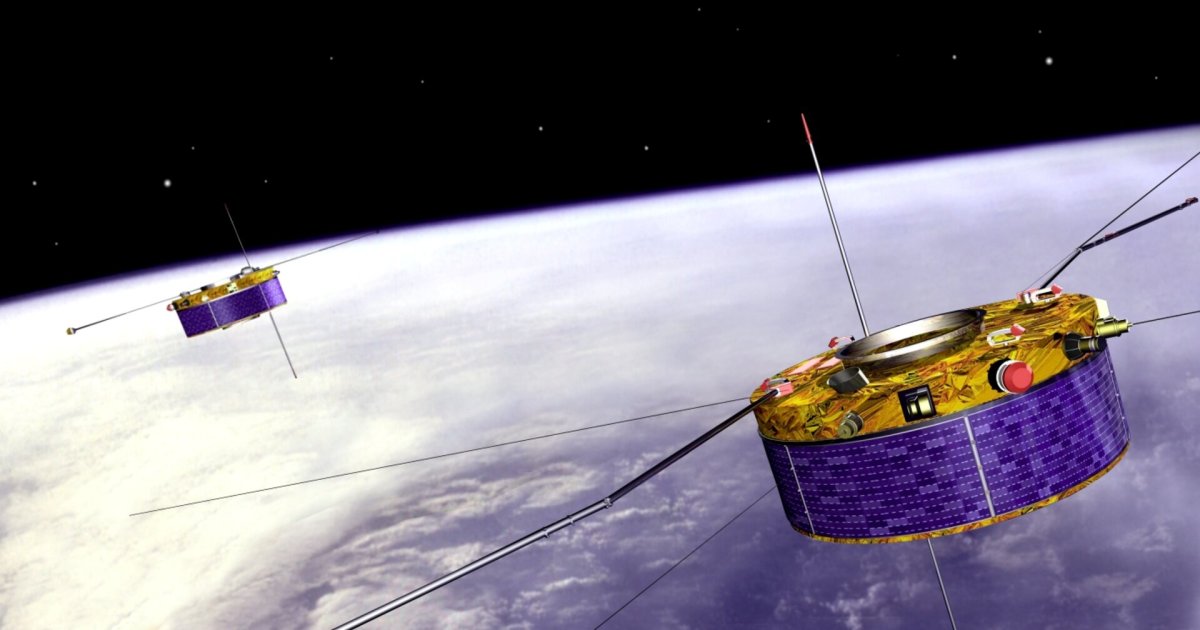
The four Cluster satellites fly in formation above Earth's cloud tops, sampling the surrounding magnetic field, in this artist's illustration. Named Rumba, Salsa, Samba, and Tango, the quartet spent 26 years mapping how Earth's magnetosphere responds to the solar wind before ESA guided each one through a final, targeted reentry. Credit: ESA - CC BY-SA 3.0 IGO The last two spacecraft of the European Space Agency’s (ESA) Cluster mission plunged into Earth’s atmosphere this week, closing out 26 years of research into the planet’s magnetic environment — and handing scientists a front-row seat to their destruction. ESA’s Samba spacecraft reentered the atmosphere on Aug. 31 at 5:39 p.m. EDT, disintegrating over a remote section of the South Pacific Ocean. Tango, the last of the four Cluster satellites, followed less than 24 hours later, on Sept. 1 at 5:30 p.m. EDT. Both reentries had been planned years in advance to happen at predictable locations — precise enough that a team of scientists could fly a small plane towards the event and record each satellite’s demise. The team recorded nearly a full minute of each reentry with dozens of instruments. The collected data will help engineers design future satellites that burn up more cleanly. As launch rates climb and Earth orbit grows ever more crowded, concern over orbital debris is also rising. Debris that survives reentry can strike someone on the ground, and debris that doesn’t survive burns up, depositing pollutants like aluminum oxide into the atmosphere. “With better data on exactly when and how reentering satellites heat up, break up, and which materials survive,” Stijn Lemmens, acting head of space debris at ESA, said in a statement, “engineers can design satellites that burn up completely, so-called design-for-demise satellites, while also preventing pollution of the atmosphere.” What makes Samba and Tango special? Samba and Tango were two of the four identical satellites — along with Rumba and Salsa — that comprised the Cluster mission. Launched in 2000, this quartet flew through Earth’s magnetosphere, mapping how Earth’s magnetic field responds to the solar wind. Cluster’s science mission formally ended in 2024, but the spacecraft lingered in high elliptical orbits. This created an opportunity for a targeted reentry, more predictable than the vast majority of reentering satellites. Satellites in low Earth orbit eventually reenter the atmosphere because of drag. Trace nitrogen and oxygen molecules in the upper atmosphere resist the spacecraft’s motion, gradually stealing its orbital energy. As the orbit shrinks, the air grows thicker, drag increases, and the process accelerates until the satellite burns up. But Cluster’s satellites flew in higher, elliptical orbits, swinging past Earth at their closest approach — called perigee — every 2.5 days before climbing back out toward apogee, nearly 80,000 miles (130,000 km) away. That wide, looping orbit kept them free from the effects of atmospheric drag for the most part. However, their orbit was impacted by the gravitational pull of the Sun and Moon. Small gravitational tugs could shift perigee from one pass to the next by as much as 19 miles (30 km). The satellites’ orbits moved through 12-year cycles, with perigee drifting closer to Earth, then farther away. At some point in that cycle, perigee dropped enough that a single pass plunged the satellites so low that atmospheric drag and Earth’s gravity took over and the satellite reentered the atmosphere. Fortunately, scientists were able to predict when that pass would take place and exploit it. In November 2024, ESA’s flight dynamics team fired a handful of small thruster burns to nudge Samba and Tango’s trajectories, so that when the satellites reentered, they would do so over a remote, uninhabited stretch of the South Pacific Ocean where an airplane full of researchers would be waiting. Once a spacecraft is already built, launched, and paid for, you might as well milk it for every bit of value before it’s gone. Cluster’s final act presented an opportunity to wring one more dataset out of spacecraft that had already given decades of service to magnetosphere science. Cluster’s Salsa spacecraft loops through a highly eccentric orbit before diving toward Earth and burning up in the atmosphere on Sept. 8, 2024, as shown in this ESA diagram. Salsa’s reentry was the first of four targeted disposals for the Cluster satellites, capping a multidecade mission to study Earth’s magnetosphere. Credit: ESA Salsa and Rumba’s fiery dance In order to design satellites for demise, scientists have worked to build models and test them in the laboratory. For instance, ESA has tested individual satellite parts on the ground at the German Aerospace Center’s (DLR) site in Cologne. Engineers loaded satellite components into a plasma wind tunnel and blasted them with arc-heated gas to mimic the heat of reentry. Those tests allow ESA to check whether a given part will vaporize cleanly or survive to hit the ground. But a wind tunnel can only test one piece at a time, in isolation. It can’t reproduce how an entire spacecraft actually comes apart as it tumbles through the atmosphere. Watching an intact satellite burn up for real is the only way to check models against reality. Salsa became the first target of an airborne observation campaign when it reentered in September 2024, followed by Rumba in October 2025. The reentry of Salsa “has already produced intriguing results,” Lemmens said. For one, the expected atmospheric density during reentry differed from predictions by about 20%, which Lemmens attributes to uncertainties in the upper atmosphere. These discrepancies can reduce accuracy in forecasting when satellites will reenter. Salsa also started to disintegrate earlier than models predicted. An ESA map traces Samba and Tango’s final orbits, arcing from over North Africa and the Atlantic, across South America, and down into the South Pacific. The neon green represents where the spacecraft will be visible from the last ground station in Kourou, French Guiana. Credit: ESA And during Salsa and Rumba’s penultimate perigee, their last time passing Earth before reentry, both satellites dipped lower and faster than expected. They both reached altitudes of roughly 68 miles (110 km) and hit top speeds faster than 6 miles per second (10 km/s) while shockingly surviving intact. This low pass made them temporarily the lowest-flying active spacecraft ever. Sadly, the heat cooked their solar arrays during that pass and triggered a reboot and power failure, wiping the data that would have explained how the spacecraft components survived. “Because Samba and Tango are now in a slightly better power state than the first two spacecraft that reentered, they offer a strong opportunity to collect even more complementary data — provided they avoid rebooting this time,” said Bruno Sousa, Cluster spacecraft operations manager at ESA, in a statement. Two reentries in 24 hours The Re-entry Observation Setup and International Execution (ROSIE) airborne observation team is an international ESA collaboration of scientists, engineers, and pilots led by the private Slovakian space sustainability firm Astros Solutions. They successfully observed Salsa’s reentry in 2024 and Rumba’s in 2025, before returning for Samba and Tango’s back-to-back reentries this year. They hoped they would be able to pull out even more data from Samba and Tango than they had from Salsa’s reentry in 2024. But for this run they’ll be observing two reentries, less than a day apart. “To do this twice in 24 hours will ask the absolute maximum from all our team members as well as our equipment,” said Jiří Šilha of Astros Solutions ahead of the flights. On Aug. 31, the crew flew out from Tonga to reach Samba’s reentry point. Back at ESA’s mission control in Darmstadt, Germany, flight controllers sent Samba a last round of commands and said their goodbyes; the spacecraft’s final telemetry went silent about 13 minutes before reentry. At 5:39 p.m. EDT, Samba streaked into the atmosphere exactly as predicted, and the plane’s 30 instruments — including tracking cameras, spectrometers, and visual and infrared sensors — followed its breakup across the sky for roughly 50 seconds. The team then flew back to Tonga and prioritized sleep over reviewing footage. The next day brought the same routine. Controllers said their final farewells to Tango and lost its last telemetry about 15 minutes before reentry. This time, the plane’s pilot banked at just the right moment to hold the burning satellite in frame a few seconds longer. Tango reentered at 5:30 p.m. EDT on Sept. 1 — again matching the prediction almost to the second — bringing 26 years of Cluster operations to a close. 29 of the 30 instruments captured usable data on both nights, recording which materials melted, and when, as each satellite came apart. Now that the data is in, the team will have to sort through it. Matching signal and camera frame from the instruments to the right piece of spacecraft will take the ROSIE team weeks, if not months. The ROSIE Samba and Tango team poses in a hangar in Bankstown, Australia, in front of the plane they used to track the satellites’ reentries. Led by Astros Solutions, the team gathered as much data as possible as Samba and Tango came down about 24 hours apart over a remote stretch of the South Pacific Ocean. Credit: Astros Solutions/ROSIE What comes next: Draco The Cluster campaign was in part a dress rehearsal for something more ambitious. ESA is now building Draco, a spacecraft designed to launch in 2027 with the main purpose of reentering the atmosphere and recording its own destruction from the inside. The spacecraft’s main structure will largely disintegrate, but its more than 200 sensors and four cameras have been designed to survive the descent. “With the data from the Cluster and Draco reentries we will improve reentry models,” Lemmens said. “This helps to better predict where objects will fall and how they affect the atmosphere, and we can build better satellites to further reduce the chance of any pieces reaching the ground.” Brooks Mendenhall is a staff writer at Astronomy, based in Chattanooga, Tennessee, fueled by an unending curiosity about the universe. A former classroom teacher, he has a knack for breaking down complex concepts for a wide audience.
Scientists watch as two satellites burn
Full Article
Original Source
Read the full article at Astronomy →KhanList aggregates and links to publicly available news content. We do not host full articles from third-party sources. Always verify important information with original sources.