
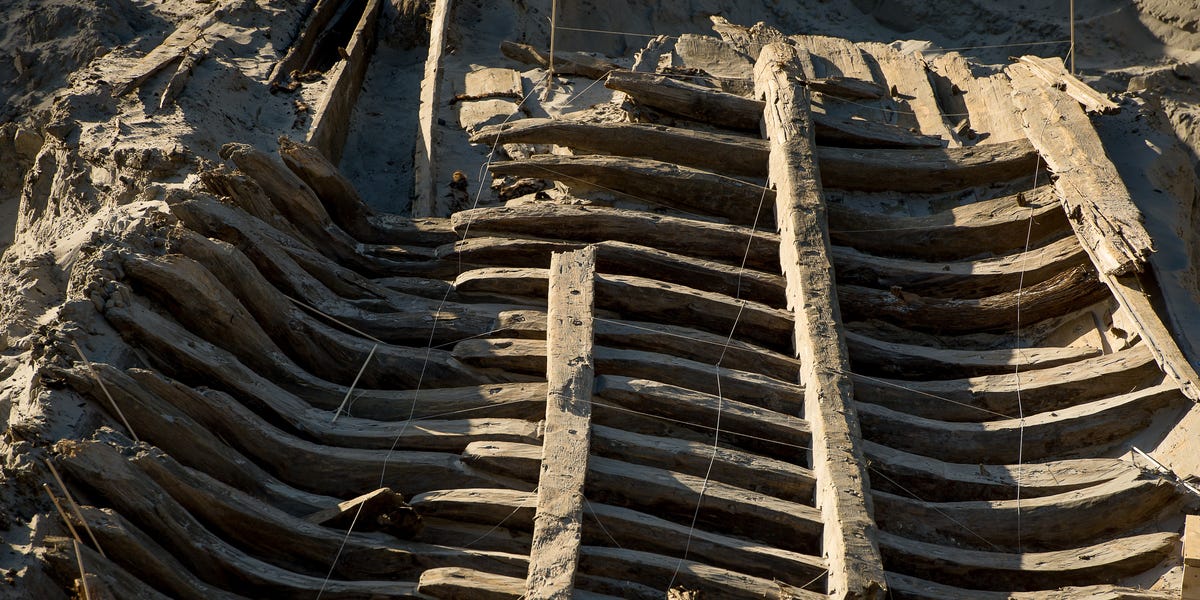
2 min readHere’s what you’ll learn when you read this story:Archaeologists discovered a cellar ceiling constructed in 1244 made from parts of a medieval ship.In a rarity, the entire hull of the ship was repurposed as construction material.Experts hope to uncover unique insights into medieval ship repairs and materials used during the period. The ceiling of a cellar constructed in 1244 C.E. along the Konradigasse in Konstanz, Germany, offers archaeologists a unique look into the medieval shipbuilding industry. Researchers exploring the home near Lake Constance found that the 270-square-foot ceiling was constructed not just from reused ship timber, but a ship’s intact hull.“At first, it was only clear that the planks had been reused,” Aline Kottmann, specialist in medieval archaeology at the State Office for Monument Preservation, said in a translated statement from the Baden-Württemberg Stuttgart Regional Council. “The fact that they were originally part of a ship came as a complete surprise.”“It is well-known that decommissioned ships were reused as construction timber in the Middle Ages,” said Alexandra Ulisch, a team member on the state office’s “Wrecks and Deep Sea” project searching shipwrecks in Lake Constance. “Nevertheless, the find in Konstanz is truly exceptional: It involved the incorporation not merely of isolated fragments, but of an almost entirely intact ship’s hull.”The team discovered 19 total planks, identified as originating from a medieval ship thanks to the wooden pegs, rows of nails, and plank shapes found at the site. The timber likely came from a flat-bottomed cargo vessel—a common style for the lake region. “If parts of the side planking have indeed been preserved, this could yield new insights into the construction of medieval ships and the design of the transition between the bottom and side planks,” Ulisch said.Some of the wood showed ingenious repairs, with damaged areas cut out and replaced with precisely fitted wood inserts. The team has located four such repairs so far, including a dovetail-shaped insert that has no direct parallel to medieval shipbuilding in the region. But even the standard planks have a distinct design. “They were cut to fit precisely against one another and are attached to the ceiling in the same configuration as they were installed in the ship,” Ulisch said. “As a result, the caulking—the sealing compound between the planks—has been preserved in some places.”The team now plans to conduct dendrochronological analysis on the wood samples and analyze the caulking material. Kottmann, for one, is “eager to see the results.”“While the few existing medieval shipwrecks in Lake Constance lie underwater and can only be investigated with considerable effort, the timbers from Konradigasse have been preserved in a much more accessible environment,” Kottmann said. “They therefore offer ideal conditions for further analysis. This discovery goes far beyond a mere incidental find. It is a valuable testament to medieval shipbuilding techniques and of particular importance in the maritime archaeology of the Lake Constance region.”Tim Newcomb is a journalist based in the Pacific Northwest. He covers stadiums, sneakers, gear, infrastructure, and more for a variety of publications, including Popular Mechanics. His favorite interviews have included sit-downs with Roger Federer in Switzerland, Kobe Bryant in Los Angeles, and Tinker Hatfield in Portland.
A Team Was Investigating a Millenia-Old Cellar—And Found a Medieval Ship In the Ceiling.
Full Article
Original Source
Read the full article at Popularmechanics →KhanList aggregates and links to publicly available news content. We do not host full articles from third-party sources. Always verify important information with original sources.