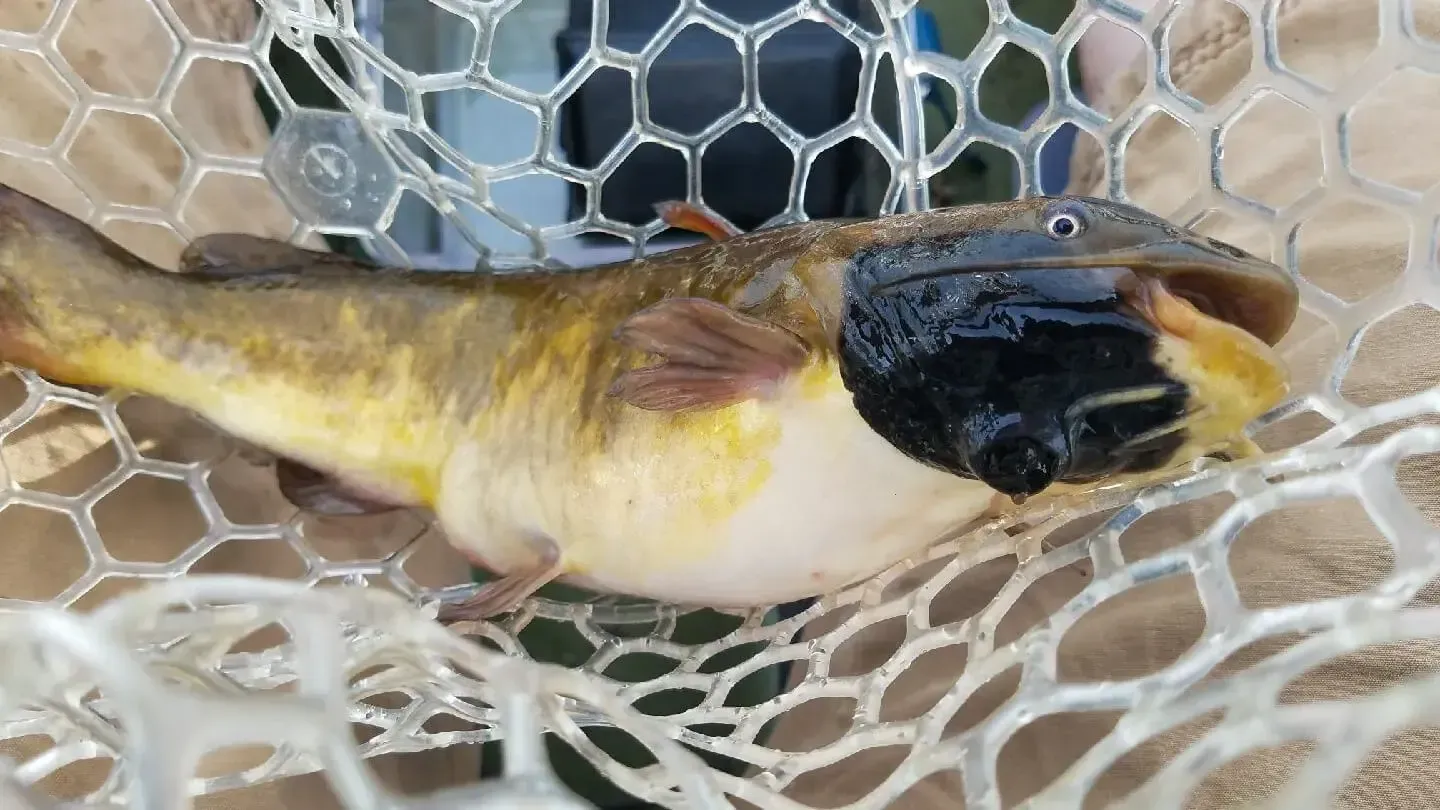
More than a decade ago, fishers and biologists noticed jet-black tumors on the skin of brown bullhead catfish in Lake Memphremagog. Genetic testing hints that they are caused by the first contagious cancer ever documented in fish A catfish with melanoma, a kind of skin cancer University of Vermont Lake Memphremagog, a roughly 30-mile-long waterway straddling the border between Vermont and the Canadian province of Quebec, is a big hit with fishers for its abundant trout, salmon and other species. But more than a decade ago, they discovered that it has a dark underbelly. Anglers and biologists noticed some of the lake’s brown bullhead catfish had black blotches across their fins, gills, lips and even eyes. “It looks like black tar on the skin—not very pretty,” Peter Emerson, a fisheries biologist with the Vermont Fish & Wildlife Department, tells NPR’s Ari Daniel. Experts confirmed early on that these dark spots were melanomas, a kind of skin cancer characterized by the out-of-control growth of melanocytes, cells that produce the pigment melanin. Although melanomas are exceedingly rare in catfish, roughly one-third of the lake’s bullheads currently carry the lesions. Now, in a study published in the journal Nature on 22 July, Emerson and colleagues report that the catfish seem to be infected with a contagious form of skin cancer, the first transmissible cancer ever documented in a fish species. Cancers are almost always caused by genetic mutations inside a host’s own cells. Transmissible cancers are an extraordinary exception where living tumor cells physically escape one host organism, bypass another’s immune system and take root in a new host. Initially, scientists suspected that non-contagious factors had triggered the catfish cancer. The sun’s ultraviolet rays, a common cause of melanomas, seemed improbable because the catfish are mainly nocturnal and spend their lives in murky lake beds. Chemical runoff from a local landfill was also investigated, but toxicological tests turned up minimal pollutants in the fish. Quick fact: This skin cancer might be centuries old Poet and naturalist Henry David Thoreau may have noticed the brown bullheads’ skin cancer during the 19th century. While visiting the Assabet River in 1858, he wrote the following about one fish: “Nearly half the head, from the snout backward diagonally, is covered with an inky-black kind of leprosy, like a crustaceous lichen.” That’s when researchers approached Julie Dragon, a geneticist at the University of Vermont. She began her search by hunting for cancer-causing viruses or bacteria but found no evidence. Then, she compared the normal DNA in the catfish to the mutated DNA in their tumors, which yielded surprising results. Tumor cells are usually descendants of the host’s cells, so they’re genetically similar. With the catfish, however, all the cancer cells were near identical clones of one another but genetically distinct from the fish carrying them. “I said, ‘We made a mistake. This can’t be right,’” Dragon, who co-authored the study, tells the New York Times’ Carl Zimmer. Stunned by the unexpected results, the team reran the entire analysis from scratch, only to arrive at the same conclusion. Analysis of the tumors hinted that they descended from an ancestral cancer cell that emerged in a single catfish years ago—a long-dead patient zero whose diseased cells have been jumping between fish ever since. Contagious cancers are exceptionally rare in nature, previously documented in only a handful of species. Perhaps the most infamous is the gruesome facial tumor decimating Tasmanian devils, which spreads when the creatures bite one another. Dogs can contract a transmissible venereal cancer during mating, and several species of marine shellfish like clams, cockles and mussels fall victim to a transmissible leukemia. The research team suspects that the catfish cancer spreads during spawning season, when adults crowd tightly together in shallow waters. “They aggregate into these big clusters, flop around on top of each other, and they have these spines behind their pectoral fins that are pretty sharp,” Dragon tells NPR. “And we think that they actually accidentally scratch each other, and that is one potential avenue for the cancer cells to invade a new host.” UVM Researchers Discover Transmissible Cancer in Catfish Not everyone agrees with the study’s conclusion, including Vicki Blazer, a fish pathologist formerly with the U.S. Geological Survey who was part of the research team but later left. Tissue samples collected before full-blown tumors developed showed telltale signs of cellular stress and inflammation tied to pollutants like arsenic, which was detected in unusually high concentrations in the animals, she tells Science’s Tim Appenzeller. While pollution might simply weaken the fish’s immune defenses and make them vulnerable to a contagious cancer, Blazer suspects that environmental toxins are the true primary driver. “I am not on board yet with the transmissible tumor,” she says. “That’s why I took my name off the paper.” Others say that the genetics are conclusive. The results leave “no question” that a transmissible cancer is to blame, Elizabeth Murchison, a contagious cancer expert at the University of Cambridge who wasn’t involved in the work, tells Science. “It is a clone, a single clone that’s spreading through the population.” What’s more, the discovery seems to mark the first known case of a transmissible cancer spreading in fresh water, Michael Metzger, a contagious cancer expert at the Northwest Research Institute who was not involved in the study, tells the Times. Cells typically require salty fluids to survive. “It makes us rethink how these things work,” he adds. You Might Also Like Get the latest stories in your inbox every weekday. More about: Animals Canada Cancer Ecology Environment Fish New Research Pollution Vermont
A Strange, Never-Before-Seen Cancer Seems to Be Spreading Among Catfish in a New England Lake
Full Article
Original Source
Read the full article at Smithsonianmag →KhanList aggregates and links to publicly available news content. We do not host full articles from third-party sources. Always verify important information with original sources.