
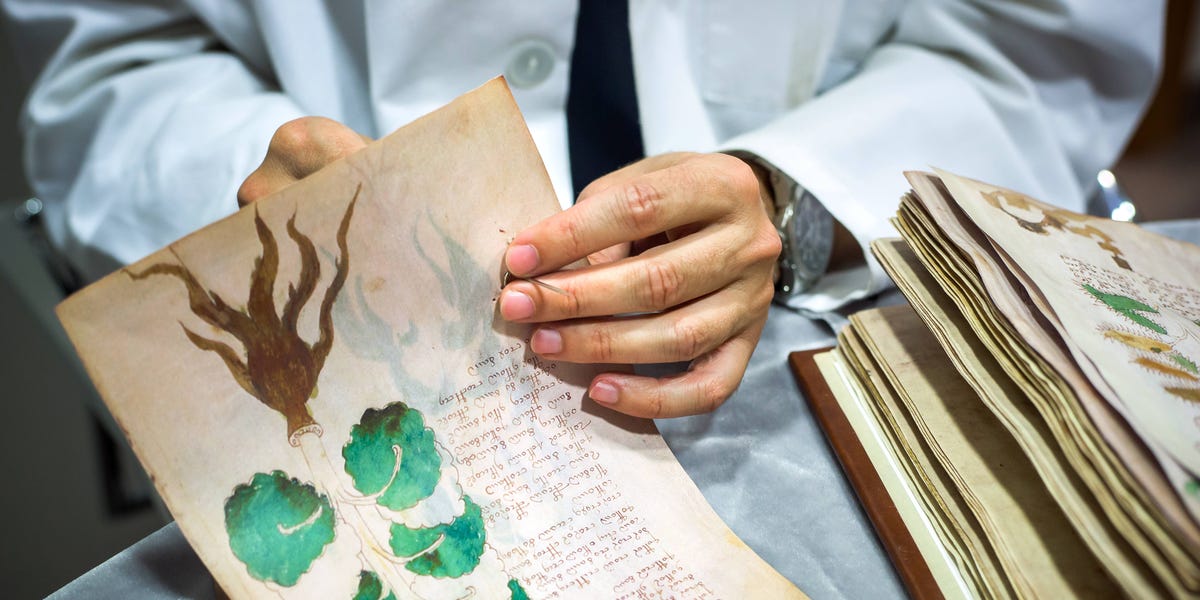
3 min readHistory is full of undecipherable mysteries. Sometimes those mysteries are entire languages, such as the script used by the ancient people of the Indus Valley or the very first advanced civilization of Europe. Sometimes those historical unknowns are confined to singular objects as seen in perplexing symbology of the famous Phaistos Disc or the mechanical workings of the Antikythera Mechanism.However, there’s one historical artifact that traverses both worlds—an incomprehensible language bound within one single object. It’s known as the Voynich Manuscript, and for more than a century (after its modern rediscovery, when Polish book dealer Wilfrid Michael Voynich purchased the text from a Roman Jesuit college in 1912), experts have tried to understand its purpose. Carbon dated by Yale University (the current owner of the text) to the early-to-mid 15th century, the codex appears, at first glance, like any other medieval text with flowery text and illustrations.But there’s still one problem: no one can understand what that flowery text says.The text appears to be written in either a completely unknown language or in a substitution cipher where the words of one language are replaced with made-up ones. Scholars have even unleashed artificial intelligence on the text in an attempt to make sense of it to no avail. For now, experts and cryptologists have simply referred to the text as “Voynichese.”Now a new study published in the journal Digital Medievalist suggests experts might’ve overlooked one very important aspect of the Voynich Manuscript: It’s assembled out of order.“The Voynich Manuscript has proven an inscrutable puzzle that has frustrated linguists, cryptologists, and bibliographers for centuries,” the authors write. “A book whose pages are out of order is almost certainly more difficult to read. It is our hope that linguists and cryptologists will revisit past work in the light of this hypothesis, ushering in a new era of Voynich Studies.”This latest insight comes from Colin Layfield, an information scientist at the University of Malta, and Lisa Fagin Davis, the executive director of the Medieval Academy of America. In 2020, Davis published a paper detailing how it was likely that five different scribes initially created the manuscript. Now, Davis and Layfield believe the book might’ve been misbound, which could seriously alter how the text is read. Currently, the manuscript is bound in what is known as a quire, folded pages (or bifolia) that are sewn together to form a booklet, but that was possibly a mistake.“Typically a single scribe writes in a quire ‘booklet,’ but the current binding has different scribes in the same quire, which, to be blunt, is simply not [how it is] done,” Layfield told Gizmodo. “That’s not how books are written.”Using a technique known as Latent Semantic Analysis, they found that some pages semantically similar but were interrupted by non-similar pages. When reordering the pages as loose singulions—folded pages that aren’t intended to be bound as a quire or book—then pieces began to fall into place as similar semantic sections, and even illustrations, appeared more in alignment.“Once you treat them as loose pages stacked together, all these artistic anomalies suddenly join up,” Layfield told The Guardian.Another complication that makes the Voynich Manuscript such an intractable problem is that only one example of the text exists. So while the errant bookbinding of some long lost monk or scribe has led a century of experts down an indecipherable path, considering the incredibly rare nature of the Voynich Manuscript, Davis doesn’t hold a grudge.“The problem is that so few manuscripts have survived from the middle ages, because they weren’t bound,” Davis told The Guardian. “The irony is that whoever misbound this manuscript still did us a huge favor by ensuring its survival.”Darren lives in Portland, has a cat, and writes/edits about sci-fi and how our world works. You can find his previous stuff at Gizmodo and Paste if you look hard enough.
A Notoriously Unsolvable 600-Year-Old Puzzle May Have Just Been In The Wrong Order All Along
Full Article
Original Source
Read the full article at Popularmechanics →KhanList aggregates and links to publicly available news content. We do not host full articles from third-party sources. Always verify important information with original sources.