
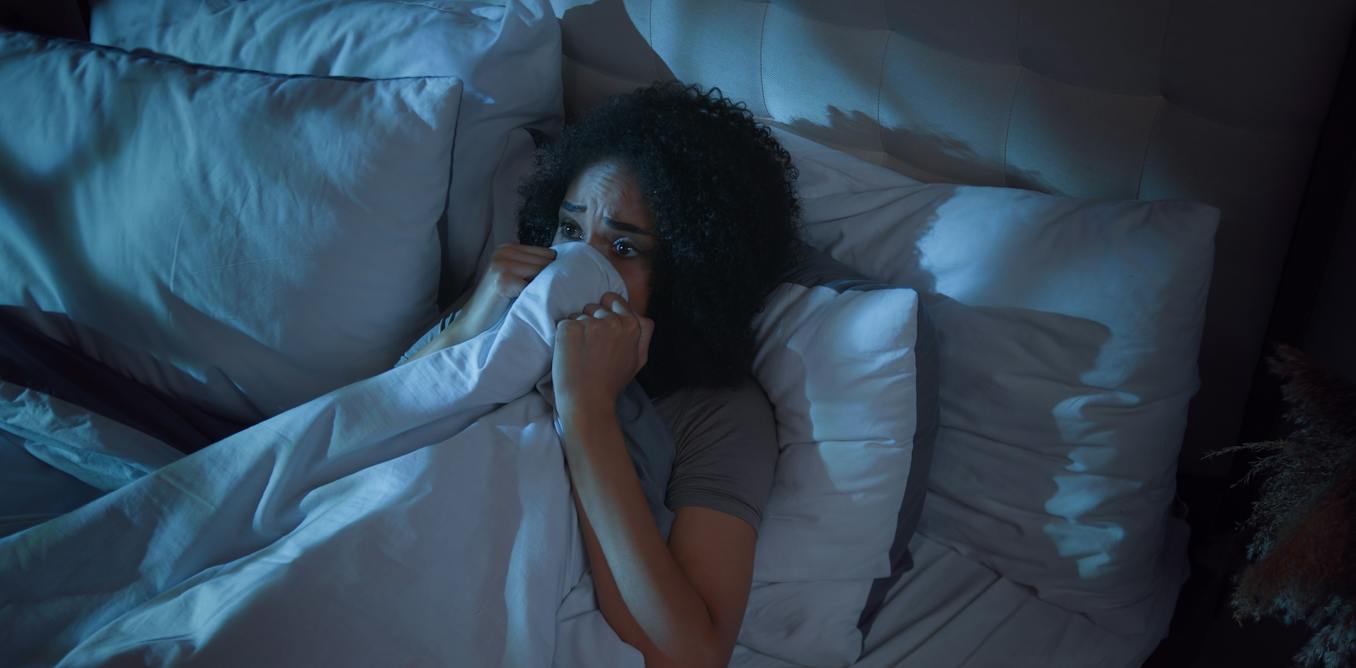
It’s three in the morning. You’ve woken from a dead sleep because you’ve heard a thud in the darkness or a floorboard creaking downstairs. Or perhaps you’ve woken because you have the unmistakable sensation you’re not alone. During daylight, these phenomena might be dismissed as the heating, your neighbours or the sounds of an old house settling. But in the middle of the night they can feel a tad more sinister. Your mind might immediately start reeling, jumping to the worst case scenario – wondering if you’ve been broken into, or if you’re being haunted by some supernatural force. In reality, the explanation is far more simple. Things really do go bump in the night. But occasionally, the culprit is closer to home than we might imagine. The edge of sleep Falling asleep is not the neurological equivalent of switching off a light. The brain moves gradually from wakefulness into sleep, accompanied by changes in sensory processing, muscle activity and awareness of the world around us. But these changes don’t always occur in perfect synchrony. So for brief periods, characteristics of sleep and wakefulness can overlap. The results can be surprisingly spooky. If you’ve ever been on the verge of sleep only to feel that you’ve fallen off a kerb, missed a step or dropped through the bed, you’ve probably experienced a hypnic jerk. Also known as a sleep start, this is a sudden involuntary contraction of one or more muscles as we move into the earliest stages of sleep. It’s an example of how the transition between wakefulness and sleep isn’t always a smooth one. Hypnagogic experiences can also involve vivid sounds, images or sensations. So as you’re on the edge of sleep, you may think you hear footsteps or whispers – or you may even think you see a figure in the room. Exploding head syndrome – perhaps the most alarming name for a harmless sleep condition – is another example of how the boundaries between sleep and wakefulness can become blurred. As someone is falling asleep, or occasionally waking, they suddenly perceive an enormous noise: an explosion, gun shot or slamming door – yet nothing in the outside world has made a sound. Its precise cause remains uncertain. But the phenomenon demonstrates something important: hearing a sound and a sound actually occurring are not quite the same thing. The conscious experience of hearing is constructed by the brain. So neural activity generated without an external sound can still produce an auditory experience that seems entirely real. The brain doesn’t even need to be asleep for this to happen. If you’ve ever thought you’ve heard someone call your name – only to turn around and find no one there – you’ve been tricked by your brain. Another possible explanation for the sounds we think we hear at night involves source monitoring. This is the brain’s ability to distinguish events generated internally from those coming from the outside world. Sleep paralysis can also cause us to see things that aren’t there. Dreams Illustrated/ Shutterstock Thoughts, memories and imagined speech are internally generated, yet normally retain the quality of being ours. But occasionally, that attribution goes awry – allowing something generated within the brain to feel as though it came from somewhere else. Around sleep, that boundary becomes particularly interesting. Awake but dreaming Another common – but frightening – experience that can happen at night is waking up with the sudden feeling that someone else is in the room. This experience is usually the result of sleep paralysis. During rapid eye movement (REM) sleep, when most of our vivid dreaming occurs, the brain temporarily suppresses activity in most muscles. This protective mechanism, known as REM atonia, prevents us from physically acting out our dreams. But during sleep paralysis, our waking awareness returns while this physical paralysis persists. You know where you are, but cannot move. Yet elements of dream perception can remain active. This is why you may have experienced the sensation that someone – or something – is in the room with you, despite clear sensory evidence of the contrary. One clue as to why this happens comes from experiments examining how the brain distinguishes itself from others. In one study, participants controlled a robotic device positioned in front of them, while a second robot, which was placed behind them, reproduced these movements by touching the participants’ backs. But when researchers introduced a slight delay between the movement and the touch, some participants began to feel as though somebody else was touching them. Some even sensed another person standing behind them. Read more: Can your brain make you see ghosts? The science behind the Bloody Mary legend While this experiment doesn’t explain every felt presence that can happen during sleep paralysis, it does reveal something remarkable: the distinction between ourselves and others is something the brain has to construct. Usually, movement, touch and our sense of body position agree about what belongs to us. But if that relationship is disrupted, an internally generated sensation can begin to feel like it originated elsewhere. Now picture this happening in a dark bedroom, when you’re partly awake yet still on the edge of dreaming and unable to move. The sensation that somebody else is there becomes rather less mysterious. Perception is not a passive recording of the world. It combines incoming sensory information with expectation and previous experience to construct the most likely explanation. But at the boundary between sleep and waking, this process can become less reliable. We may hear sounds that were never made, experience fragments of dreams intruding our bedroom or interpret sensations arising from our own bodies as the presence of somebody else.
When things go bump in the night: how our brains trick us into hearing things that aren’t there
Full Article
Original Source
Read the full article at Theconversation →KhanList aggregates and links to publicly available news content. We do not host full articles from third-party sources. Always verify important information with original sources.