
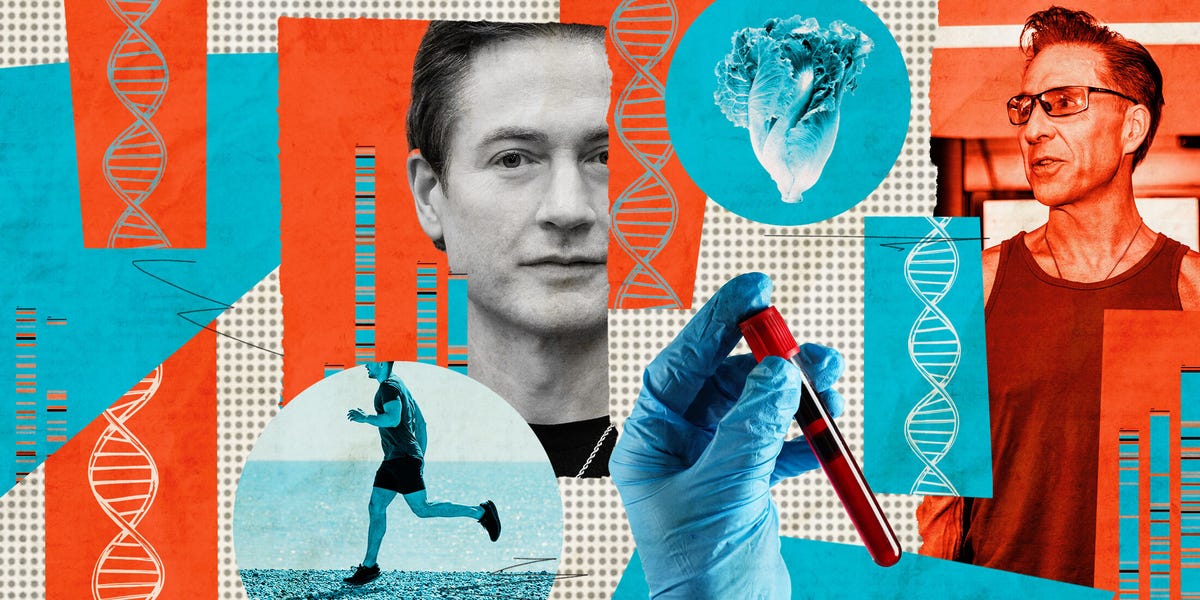
6 min readThe longevity industry is built on an appealing promise: We are in control of how long we live. Biohacker Bryan Johnson thinks he will not die (or will at least live to 160), while people are shelling out thousands of dollars for full-body scans to get ahead on their health. All you have to do, they say, is track your biomarkers, take the right supplements, optimize your sleep, and catch a disease before it starts, and you’re on your way to a longer, healthier life.For years, researchers estimated that genetics explained roughly 20 to 30 percent of lifespan, which was often interpreted to mean that the remaining 70 to 80 percent comes down to the impact of lifestyle choices. The idea that our genes play a relatively small role in determining our lifespan gave the industry enough scientific footing to promote protocols to “slow down” aging. But a 2026 study in Science, considered to be the most reliable yet (by removing extrinsic deaths like accidents and infection from the dataset), suggests that how long someone lives may be 50 percent heritable.The findings don’t mean that exercise, diet, and sleep don’t matter—those behaviors can profoundly affect both healthspan and lifespan. But they do challenge the central messaging behind the modern longevity industry that practically all it takes is the right health habits to add years to your life.The Genetic Lottery Is Real… MostlyOne of the clearest examples of the genetic influence on lifespan comes from people who live exceptionally long, but not necessarily exemplary, lives. Nir Barzilai, MD, director of the Institute for Geroscience at the Albert Einstein College of Medicine, studies centenarians (people who live to 100 years and older). He’s found that many don’t just live longer, they stay healthier longer. “Not only are they living healthier, they're getting their diseases 20, 30 years later. Not only that, they're sick very little at the end of their lives,” he says. “And if you look at their exercise and sleep, and their food and all that, they're terrible.”The genetic advantage trickles down to offspring. If you have two centenarian parents, your chances of living beyond the average life expectancy of your demographic are 24 percent. For example, if men similar to you live to be 84, you may live close to 98. If you only have one centenarian parent, the likelihood is still 13 percent. And if you’re third generation, it’s 7 percent.Researchers say the lesson isn’t that healthy behaviors don’t matter—they still account for 50 percent of how long you’ll live. It’s that genetics can influence the upper limits of lifespan more than we previously thought. For centenarians and their families, “their biological clock has been ticking at a slower rate from day one, almost completely outside of their control,” says Jay Olshansky, PhD, a research associate at the Center on Aging at the University of Illinois Chicago and associate editor of the Journal of Gerontology: Biological Sciences and Biogerontology. “Unless you win the genetic lottery, you are unlikely to live into your 90s or 100. It can't happen any other way.”Daniel Belsky, PhD, an epidemiologist and researcher at the Columbia University Mailman School of Public Health in the Robert N. Butler Columbia Aging Center, says the new 50 percent genetics estimate isn’t as surprising as it may seem. “This new number, which is bigger than the numbers in the past, is actually much more in line with what we understand about things like heart disease, cancer, diabetes, psychiatric illnesses, personality traits,” he says. Researchers have long known that the likelihood of having one of these conditions is largely driven by genetics. But he says the findings could have important implications for research, motivating scientists to identify the specific genes and biological pathways involved in the diseases of aging that impact lifespan.Healthy Habits Still Matter—but Maybe Not How We ThinkGenetic influence isn’t the same as genetic destiny. Uri Alon, PhD, head author of the Science study and researcher at the Weizmann Institute of Science, says that even if you have a gene that could shorten your life, there are opportunities to intervene. “Our genetic liability is not a liability that is written in stone,” agrees Belsky. “Knowing that you carry a degree of genetic risk does not mean that that degree of genetic risk is beyond your capacity to control.” For example, if you’re predisposed to high cholesterol due to having the gene variants for familial hypercholesterolemia, you can take medicine to reduce your risk of heart attacks.Although lifestyle alone may not create centenarians, healthy habits can still determine whether you reach your own biological potential. “If our genetic potential says 85, then eating right, exercise, sleep, social relationships, not smoking, not drinking, all those lifestyle factors can get you to 85. And maybe an extra few years beyond that,” says Alon.On the other hand, unhealthy behaviors can prevent people from reaching that potential. “The main control that we have is to shorten our lives,” says Olshansky. “We exercise that control all the time. We do dumb things. We smoke cigarettes, we drink too much alcohol, we expose ourselves to the sun too much. So, shortening our lives is easy. And we're really good at it, especially in the United States.”Is There Anything on the Horizon to Change All This?Geroscientists, researchers who study the biological mechanisms of aging, are actively working on science-backed interventions to increase both how long people live and how well they live in those years. Barzilai and Olshansky both say the field has made significant progress, and some researchers believe we’re on the verge of a breakthrough to slow aging.Right now, though, lifespan can’t be significantly modified. Barzilai says that our maximal lifespan as a human species is 115 years. Most people don’t live that long, so there’s room for improvement.But geroscientists we talked with say that much of what's sold as longevity therapeutics is a huge amount of noise. Take peptides, for example. Many strains that are marketed for longevity have little evidence behind them. “We have no idea what peptide companies are sending, because it's all about hope. It's not a promise,” Barzilai says.Biomarker tracking presents a similar challenge. Olshansky says there is real value in early detection of the diseases of aging, especially for people with a family history or those at elevated risk. “We do need biomarkers,” he says. “Anytime we can catch something early, it's a good thing, because treatments can begin earlier.”But entire companies have emerged selling interventions to manipulate biomarkers with no evidence that it makes you live any healthier or longer. “It's just that companies crop up out of nowhere so that people can make money selling the promise,” he says. Many require you to test every few months, with the goal of moving your numbers close to an “ideal” range. But optimizing a number should never be the goal in itself.Olshansky points to his own experience with prostate cancer: He could have taken drugs to lower his PSA, a biomarker used to detect prostate issues, but that wouldn’t have treated the cancer. “I would have been treating the number associated with the problem and not the problem,” he says. That’s why he says consumers should approach longevity claims with skepticism.What Barzilai would like to see is more evidence-based products and strategies. One promising treatment for healthy aging is GLP-1 medications, like Ozempic and Mounjaro, which have shown potential beyond treating diabetes and obesity. Barzilai says they may be beneficial for age-related diseases, since research suggests they may slow brain and heart aging, acting as a gerotherapeutic drug rather than one that targets a specific symptom. In the future, we may see more people taking them as longevity drugs—although that is not an FDA-approved use right now. “When you're over the age of 60, and if you maybe already have your first age-related disease or you walk slower or you feel that you are less energetic, you can take one of those drugs in order to prevent your next disease,” Barzilai says.For now, with all the attention on biomarkers, supplements, and experimental therapies, the fundamentals haven’t changed. The solutions that work the best aren’t expensive. “Exercise, diet, sleep and social connectivity improve your health. We have a lot of data on that,” says Barzilai. “And this data is not changing whether it's 50 percent or 20 percent genetics.”Hannah Singleton is a freelance journalist who writes about fitness, health, wellness, travel, and the environment. Her work has been in publications such as the New York Times, Wall Street Journal, GQ, Vox, Wired, National Geographic, Forbes, and Fast Company. You can follow her @hannahsingleton.
A New Study Challenges the Longevity Industry’s Biggest Promise
Full Article
Original Source
Read the full article at Menshealth →KhanList aggregates and links to publicly available news content. We do not host full articles from third-party sources. Always verify important information with original sources.