
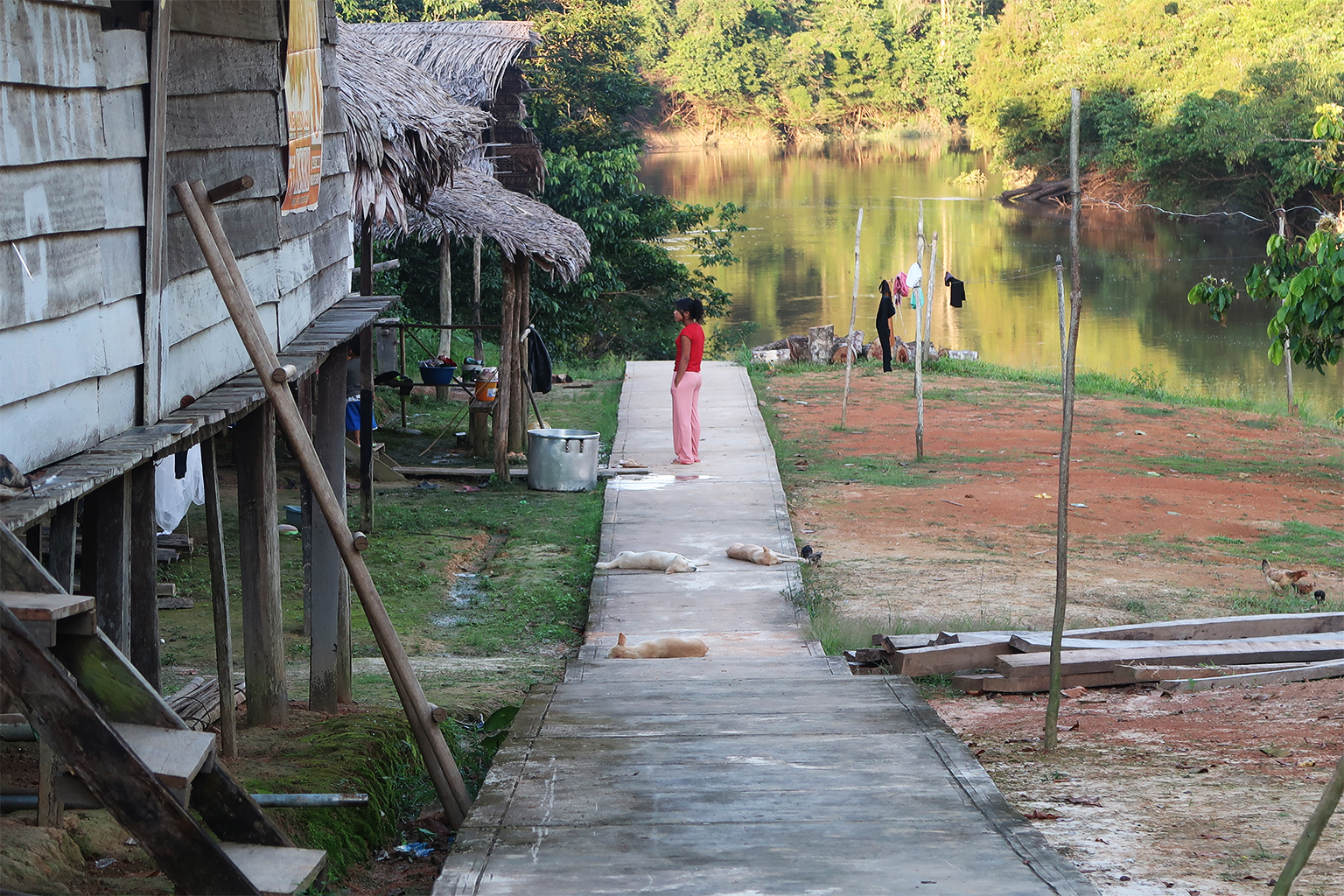
Mongabay staff writer Aimee Gabay joins the Newscast this week to discuss her reporting trip to the Peruvian Amazon, where she spoke with the Indigenous Matsés community. She made the trip initially to examine environmental threats to Matsés territory. Instead, she found them suffering from an epidemic of malaria and hepatitis B, which they have been asking the Peruvian government to help address.“The story itself was a surprise … every question directed to them about environmental changes would immediately become an issue about health,” Gabay says.The Matsés people have long experienced conflict with outsiders such as rubber tappers encroaching into their territory. So in 1969, in the hope of finding help to ease the conflict, they chose to initiate contact with the outside world, reaching out to evangelical missionaries, Gabay says. But making contact also exposed them to diseases they’d never encountered before, and since then they’ve suffered from a barrage of epidemics.“They don’t have the immunological defenses to be able to fight these diseases that maybe, for us, we are constantly exposed to,” she says.The current epidemic of malaria and hepatitis B they face is being exacerbated by climate change, drought, and state neglect. Prolonged dry weather allows for favorable conditions for malaria-bearing mosquitoes to breed, and at the same time cuts off the river transit that the Matsés depend on for access to health care.Community members have travelled to the nearest major city to plead with the Peruvian government, but they say they’re still not receiving the proper health care that they need — sometimes dying after they reach the city, according to Matsés chief Leo Chuma Teca Beso.The Peruvian government has had guidelines for addressing health risks for Indigenous communities for nearly two decades. Still, authorities say they struggle to implement the measures outlined in them, Gabay says.“On paper, they do have the protocols. They have got plans, but it’s the implementation that we’re not seeing.”Neighboring Indigenous people who continue to live in voluntary isolation or initial contact in the Yavarí-Tapiche Corridor are also at risk of exposure should they encounter any of the Matsés who carry diseases, she adds. And the combination of climate impacts and extractive industries encroaching on their territory adds even more risk.“The Yavarí-Tapiche territorial corridor is an area that has been under threat for a long time by oil and gas projects, by illegal mining, illegal loggers and narcotraffickers as well. So if the … isolated people have to move further away from the areas they usually inhabit because of disease, water availability, etc., they’re more likely to run into some of these invaders that could expose them to some of these diseases that could wipe them out entirely, which is super serious.”Gabay says this story highlights the delicate state of human health amid increasing climate impacts, and underscores the interconnectedness of human, environmental, and planetary health.“The moment there is an unhealthy environment, that automatically leads to more disease,” she says. “Planetary health is something that’s super important, and I think there needs to be a lot more focus or emphasis on … seeing all of these issues as intertwined rather than as separate things.”Mike DiGirolamo is the host & producer for the Mongabay Newscast based in Sydney. Find him on LinkedIn and Bluesky.Banner image: San Mateo village, one of 29 Matsés communities in Peru, on the banks of the Gálvez River. Image by Aimee Gabay/Mongabay. TranscriptNotice: Transcripts are machine and human generated and lightly edited for accuracy. They may contain errors.Aimee: The story itself was a surprise. So when I went to the Matsés territory to, to do this field reporting, I actually set out to work on a feature that looks at environmental threats to the Matsés territory every question directed to them about environmental changes would immediately become an issue about health. And it got to the point where I was like, th-this story, I’m, I’m asking the wrong questions here. I’m looking at the wrong thing. And so literally the surprise itself was the fact that there was a health issue. Mike: Welcome to the Mongabay Newscast. I’m your host, Mike DiGirolamo. Bring you weekly conversations with experts, authors, scientists, and activists working on the front lines of conservation, shining a light on some of the most pressing issues facing our planet, and holding people in power to account. This podcast is edited on Gadigal Land. Today on the newscast, we speak with Mongabay staff writer Aimee Gabay, covering Indigenous affairs. Gabay joins me to speak about her recent reporting trip to the Peruvian Amazon, where she connected with the Matsés Indigenous people. Until 1969, this community lived in voluntary isolation, officially deciding to make contact with a group of evangelical missionaries, the reasons for which will be discussed later in this episode. Following this contact, the Matsés have faced disease epidemics. When Gabay visited this community, she found them suffering from outbreaks of malaria and hepatitis B. After speaking with community members and leaders, it became clear that neglect by the state of Peru, climate change, and droughts were exacerbating these disease outbreaks. Gabay details what the state of Peru is and isn’t doing to help the situation, despite Matsés community leaders pleading for access to vaccinations. For neighboring Indigenous peoples in voluntary isolation or recent contact in the greater corridor, there is a heightened risk for them as well a need for access to medication that is administered in a culturally accessible and appropriate manner. Gabay tells me that while the state of Peru has had guidelines and health protocols in place for people in voluntary isolation for decades, there have been major gaps in its implementation. And with an upcoming El Niño, the Matsés fear this will intensify their health risks. Hi, Aimee. Thank you for joining me today. First of all, I just wanna say , this story looks like it was an incredible effort, so I want to commend you on the work that you’ve done here. But before we get into what is happening with the, the Matsés people, can you tell our audience the context for us? Because this goes back a century, I believe Aimee: Yeah. Thank you. It’s a pleasure to be here. And yes, exactly. So the Matsés people were very recently contacted in the grand scheme of things, so they decided to initiate contact with the outside world in 1969. So the health issues that I wrote about, these are not necessarily something new. From the moment they were in contact already, the missionaries who they first contacted reported in some of their journals that the Matsés were almost immediately struck with many different types of diseases. The issue now is that this has been exacerbated and has continued for all of this time and has been made a lot worse because of government inaction and also environmental changes. So droughts are a big one, not only because it brings more disease, but also because it prevents the Matsés from being able to get the healthcare they need. These people depend on the waterways. There’s no highways, there’s no runways for, for airplanes to arrive in their territory. So the moment there’s a drought, if a health crisis does hit it’s not very easy for health teams to make it inside the territory, especially to some of the furthest communities who are almost two days away on boat Mike: I think it might be important for us to discuss with whom they first made voluntary contact and why. Can, you tell us that? Aimee: Yeah, absolutely. So the Matsés decided to initiate contact with evangelical missionaries in 1969, as I said. The reason they chose to do this was because at that time they were facing a lot of conflict within the communities and outside. So it all started with people, especially rubber tappers primarily rubber tappers and other invaders starting to come into their territory. This was increasing the amount of contact they were having, not out of their own um, will, of course. This was leading to a lot of problems. So the Matsés were very hostile towards these outsiders. They saw them as a threat for good reason. And there was a couple of scenarios, for example, where the Matsés came into contact with some of these people, for example, the rubber tappers and it led to a lot of violence, and a lot of people got killed. Mike: Here, Aimee says this is where Roberto explains how he used to hide from outsiders before contact because of a great fear and the dangerous confrontation between Mestizos and the Matsés before contact Speaker 2: pacho. Roberto: Ya caneque. Speaker 2: Tsiraravi, no. Roberto: Tsirambo, no. Tsirambo, no. Eh, kuma pehe daku onravi. Kuma pehe daku ichin. Mbi ia kirana ia no pote potiet. Aimee: At one point the, the Peruvian government entered the Matsés territory because they were– they wanted to build a road. And when they came into the, in, into contact with the Matsés the Matsés s- attacked the people who were there. And the Peruvian government responded by calling on the US Air Force that was based in Panama to drop bombs on the Matsés communities. It destroyed the longhouses. Longhouses are basically the communal um, buildings where Matsés, the Indigenous people all used to live together. They all used to sleep in the same space. But these bombs completely destroyed a lot of these places. And they ended up having to flee into the forest to run away, and these kinds of conflicts were ongoing. It was constant. And after fighting, running away f- fighting even more, running away, it just ended up becoming a massive problem. Obviously if they weren’t if they had to run away from the kinds of places they usually settled, it had impacts also for food availability. Matsés are hunters. They look for wild meat. They were forced to go to places where there was less meat. And basically, the Matsés told me when I went to visit, they were just tired of all of the violence. They were tired of the fighting. , And so it was actually a small group of them that decided to go ahead and initiate contact with these missionaries who had already for a long time tried to make contact with them, but they rejected it. But then this small group of people were like, “No, we don’t want this fighting anymore. We’re gonna go.” And they actually thought that these, that there was a possibility that they could be killed by initiating this contact. But for them, after all of the fighting, they were so tired, they were like, “I would rather do this, see what happens and who knows?” So these, the actual people who initiated this contact are actually seen by the other Mats-Matsés people as very brave people that, that took this sort of like plunge for, for the safety and security and stability of the Matsés people Mike: That’s really important to note because they celebrate that event every year on the 30th of August, and it, and it sounds like it was a really pivotal moment for them. But of course that, that also came with some other things as well. And so you interviewed Roberto Necca Tumi Unan, and he’s an elder in the community and one of the last surviving elders born before this first voluntary contact. What did he tell you? Aimee: Yeah, so it was a really interesting interview. As you mentioned, Roberto was alive before first contact with the missionaries. And he described what it, what it was like. So he described actually going out hunting with his father, uncles, other men in the community and actually hearing outsiders come into their territory. And he described, he said that they would all run and they would hide and they would cover themselves with leaves not to be seen or not to make contact with these outsiders because it was such a dangerous thing for them. He described what life was like before, how, as I said earlier, they would all sleep in, in these traditional longhouses, which are called malocas all together. And the kinds of foods they relied on and all of these kinds of things. So that’s– he, he looks back at that time with, like, a lot of nostalgia. It was it, it was definitely a really good time for him, but it was definitely already present in his childhood that there was a lot of pressure on them, that there was– that they were running from something. They couldn’t really ever settle. Mike: And so another result of this though, is that the community has dealt with outbreaks for decades now of malaria, influenza, , and now hepatitis B, all brought in from the outside. What did he tell you about this? And also, what did he tell you about how the, the climate factors are influencing these epidemics? Aimee: Yeah. So, he told me that before contact, they, they never really suffered from any diseases. That wasn’t something that was known to the Matsés. And it was very clear from the moment they did make contact from then on that there was this new thing that they had never really faced before. So as you mentioned, all of those diseases were really present and and it is widely known that uncontacted people and recently contacted people are very vulnerable when it comes to exposure to diseases. They don’t have the immunological defenses to be able to fight these diseases that maybe for us, we are constantly exposed to. But for them expo- like if they were to run into, for example, a rubber tapper or something like that and this rubber tapper was to be carrying one of these diseases, that is enough to cause a genocide amongst these people, especially without the healthcare and all of those types of things. And even recently contacted people are still considered highly vulnerable to these diseases. And Roberto said he, he literally said they went from not having any of these diseases to all of a sudden entire families dying, and they didn’t really understand why at that time Mike: And how is climate change influencing– I mean, I think that it’s, it’s easier to see how climate change would influence something like malaria but it’s a little bit more difficult to see how it influences hepatitis B. Can you explain the difference there? Aimee: Yeah, absolutely. So malaria there’s a lot more clear link with, for example, environmental changes like drought, and that is because mosquitoes, for example they thrive in conditions where, for example, there are much higher temperatures and pools of water especially. So for example, In places like the Matsés territory or in other places across the Amazon, especially where there has been some kind of forest degradation or some land changes droughts as well, et cetera this can create the conditions for mosquitoes to proliferate. There is something known as the forest fringe effect. And so in places where people settle or in places where there are sort of, for example, some deforestation it does… in those areas there is increased temperatures and also it affects the ability of soils to absorb water, and therefore it creates sort of like these small pools which are like the perfect breeding ground for mosquitoes. So that’s one of the– That’s the link with malaria. With hepatitis, it’s more complex. So hepatitis B, which is what’s present in the Matsés territory, is actually sexually transmitted. And it doesn’t really have a connection to, for example, drought or high temperatures, et cetera. But the indirect problem, which is really hitting the Matsés right now, is that droughts, et cetera impact the water levels of the rivers that the Matsés depend on to travel. The Matsés, as I mentioned earlier, they don’t have highways, and they don’t have any sort of like, ability to like land a plane or anything close by. So for some of the Matsés, they live about two days away from the closest town which then you would need to get in ex- in serious circumstances, a small aircraft to take you to the biggest city, which is Iquitos. This takes a long time, a lot of expenses. And so when you are suffering from hepatitis B, the way to treat that, because it’s not… you can’t cure it, it’s, it’s treatment for the rest of your life. You need vaccinations and obviously medication for the rest of the symptoms. The Matsés, they don’t have health clinics inside of that territory. And so if they do suffer from something like hepatitis B, they need medical attention. But if the water levels are too low, they can’t reach that medical attention, and in the case of the Matsés who have not the most of the population haven’t been vaccinated yet it also affects the ability of healthcare workers from entering the territory to reach especially those communities that are furthest away to be able to actually do– to carry out that vaccination campaign. And not only that, but the, the lower water levels also impacts their ability to not just obtain medication, but also some food supplies that they’re depending on from outside nowadays. Wa-the water quality, they don’t have potable water so droughts, et cetera, also have an impact on water. And then this also can lead to other health impacts that can can sort of like, impact their ability to fight any disease they have, whether it be malaria, whether it be hepatitis B or even a cold Mike: Hello, listeners, and thank you as always for tuning in. As I always like to mention to you, Mongabay is a nonprofit news organization. And we report daily from nature’s frontline. However, this podcast relies on the funding from listeners like you. So I encourage you to support the newscast by going to patreon.com/mongabay. There, you can pledge to become a monthly sponsor of the show. Even if it’s just a dollar per month, it makes a big difference. If you’d like to read the full story from today’s podcast by Aimee Goodbye, you can find a link in the show notes You also spoke with Matsés Chief Leo Chuma Teca Beso. What did he tell you and how does he feel about the situation? Aimee: Yeah, so Leo is really concerned about this situation. It’s something he’s been fighting for for a long time, going to, for example, Iquitos um, the city in Loreto and even as far as Lima. He, he went there to speak to the Ministry of Health in Peru and basically plead for, for health teams to visit the Matsés to deal with this situation. He told me that there’s Matsés people dying on the streets. A lot of them, if they can get on a plane to Iquitos, for example, they end up dying on the streets because by that point the situation is so far gone. They enter a st- a stage of… Well, they enter the… Hepatitis B basically at its most severe can turn into cirrhosis, which is like kind of like the next level. At this point, it’s, it’s almost impossible to, to cure that. And Leo said that a lot of Matsés, if they do manage to even reach that far, they end up literally dying on the streets. He said those words. Mike: Here chief Leo says, “And yet here people are dying of illness. I don’t know how it can be. People are dying monthly, weekly in the city of Iquitos. Where is the government support?” Leo: Y nosotros, la gente se muere de enfermos. Entonces, a mí me– no sé cómo puede ser, la gente muere mensual, semanal, muere en la ciudad de Iquitos. ¿Dónde está el, el apoyo del Gobierno? Aimee: He knows many families where lots of people have, have died to– because of these problems and he feels a lot of frustration because he feels the, the Peruvian health system has not provided adequate care for them, especially as people who are classified as recently contacted. The Peruvian government, the Ministry of Health do actually have protocols to protect people like the Matsés and unfortunately that care is not reaching them no matter how many years they’ve been asking for it Mike: Peru’s Ministry of Health the acronym of which I think is MINSA, has recorded zero deaths from hepatitis despite the fact that multiple people you’ve spoken with, including a tropical diseases doctor, have told you that’s inaccurate. Can you explain why they are recording zero deaths? Aimee: Yeah. So, basically MINSA, they do, they, for starters, they don’t carry out studies on specific Indigenous populations. So they do their counts based on regional statistics. And MINSA is suffering from itself as as an agency from a lot of budget cuts. They don’t have a lot of funding. And so they’re really slow to update those numbers. Aside from the fact that they do have all of these problems most of the people I spoke to the Matsés, but also organizations, Indigenous rights organizations who are also supporting the Matsés and these doctors confirmed to me that the reason why the number is zero is because MINSA has never actually gone to the communities to do an entire community-wide screening for these diseases. Mike: In the following clip, Aimee says Chief Leo recounts how when he proposed to the Minister of Health in Lima last year that they intervene, the ministry denied that the Matsés are suffering from any of these diseases Leo: Ya justo me hice salud, ¿no? Entonces propuse mi propuesta para que ellos puedan intervenir Entonces ellos dicen que, que las comunidades nativas no cuentan ese tipo de enfermedad, es sana Aimee: So if they’re not going to do the tests, of course there’s zero deaths, and of course there’s zero cases. They have since last December mostly because of the work of some of these organizations and the Matsés. They did end up doing a first screening, but they only did 20% of the population. There’s still 80% that hasn’t been screened. And so in that screening, they found, I think it was 17 cases of hepatitis B. And most of these people, the LEO, for example, the leader expect that number to be much higher if they were to do, to, to basically screen 100% of the population Mike: As I understand it, that health brigade was in part assembled by the Matsés and several civil society groups. And, you know, like you just mentioned there’s thousands more people to screen. So what’s their next move? Aimee: Yeah, correct. So it was organized. The health brigade was sort of organized by these people. And the next step is to do the next round of vaccinations. So when they went to do the screening, the health brigade, they also vaccinated about 490 people out of the 1,500 who are eligible for a vaccine. And so the next round is supposed to be in October. The problem is we’ve already entered drought in the Peruvian Amazon. And I have quite a lot of concerns that that health team isn’t even gonna be able to make it Mike: So obviously the story does not end here, and there are several other groups of Indigenous communities in isolation and initial contact in and around the very large corridor the Yavarí-Tapiche territorial corridor. This is a massive, massive area. Can you tell our audience how large it is and how many people live in it and what the risks are here? Aimee: Yeah. So the Yavarí-Tapiche Territorial Corridor spans 16 million hectares across both Peru and Brazil, and it basically co- it’s basically home to the largest contingency of Indigenous people in voluntary isolation. So people, groups, Indigenous groups who have chosen to not make contact with the outside world. There are… I, I do- I can’t even tell you the exact amount of numbers of how many territories there are within it. So it might make more sense if I explain what a territorial corridor is. It’s basically a bunch of Indigenous territories all together in this large area. And the idea is by having all of these territories together it brings more protection for the isolated people. Isolated people, a lot of them are nomadic or semi-nomadic. , They travel to look for food. They move around based on the seasons. When it’s dry season, they might go look for places where there’s more water. In the wet season, they might go to look for places where there’s more fruits, et cetera. And so having this massive piece of land is really important for them to be able to do that without, you know, being disturbed. Yeah, so that, that would be the Yavarí-Tapiche Territorial Corridor. Mike: And so what are the potential health risks for the rest of these Indigenous communities either in voluntary isolation or initial contact? Aimee: Yeah. So the, as I mentioned earlier Indigenous people in voluntary isolation, they are a lot more vulnerable to disease. And so if people like the Matsés who live who are surrounded, their territory is surrounded by forests where there are– they know isolated people exist. So the Matsés even today when they go hunting, sometimes they find evidence of the presence of isolated people around. So they live very close. And so if the Matsés are carrying certain diseases that can spread easily to these isolated people that is a huge problem that could, as I mentioned earlier, lead to something as severe as a genocide towards these people. There’s been countless records of this happening throughout history in Peru and across the Amazon and many other places. And depending on the disease, it also brings more risks or less. So of course, something like hepatitis B being sexually transmitted, that is harder f- to reach the, the isolated people, for example. But the same risks of malaria, like I say, any impact to the land where these isolated people live could create the conditions for mosquitoes to proliferate. The same issues that a drought brings, for example, the impact on the water. So when there’s lower water levels, there’s more chance to for there to be diseases. Obviously access to water and all of these things to be able to fight these diseases. When there is drought or problems like this, they end up having to move further away to find more food um, more water. This increases the chances of them running into potential invaders or other Indigenous people who could be carrying diseases. So this obviously heightens the risk as well. The Yavarí-Tapiche territorial corridor is an area that has been under threat for a long time by oil and gas projects, by illegal mining, illegal, illegal loggers and narco traffickers as well. So if the Indigenous, the isolated people have to move further away from the areas they usually inhabit because of disease, water availability, et cetera, they’re more likely to run into some of these invaders that could expose them to some of these diseases that could wipe them out entirely, which is super serious Mike: The Matsés also did mention to you that they’re really worried about the upcoming El Nino. What did they tell you? And also, what did the National Meteorology and Hydrology Service of Peru tell you about this? Aimee: Yeah, so the predicted upcoming El Niño event is something that’s very present in the Matsés minds. The last El Niño event from 2023 to 2024 had a huge impact on them. Well, it had a huge impact on most of the Amazon basin, but they, they felt those effects. The drought was very severe. A lot of the furthest communities were isolated, and so a lot of the risks that I mentioned today that could exacerbate these health issues, they are risks that basically the Matsés have already lived before. So having that present in their mind, knowing that they’re facing these issues and knowing that they could be running into this problem where, again, health teams cannot reach them, they cannot go to a health clinic, is very scary. And this was something that was coming up constantly in the interviews with the Matsés people. And yes, in Peru, the Peruvian government, the team, the agency that’s in charge of sort of meteorological studies and tracing and doing all of these projections , he also mentioned some of these effects that the Matsés and a lot of communities in, in the Amazon faced during the last El Niño, and he said this is something that that they should expect to happen again. He made projections around the water levels dropping, the temperature changes, precipitation changes, et cetera. And these are all things that we know exacerbate disease Mike: What did Peru’s health ministry, MINSA, tell you they’re doing to address the malaria threat? Aimee: MINSA was, They did acknowledge that , there are a lot of things that they haven’t done. They did mention that because of these budget problems and also because of access issues, the Matsés territory, as I mentioned, is very remote. Very, very remote. It took many hours on boat and flights, et cetera, to reach the community. I did, and some of the communities are even further, up to two days away. And so for a health team, that increases how much money is required to be able to do these kinds of campaigns. So they did acknowledge the limitations they’re working with and the challenges they’re working with. However, they did talk about some of the protocols they do have in place, and they’re trying to make an effort to to be able to carry out. Some of this includes, for example, having culturally specific um, healthcare. So if y- even if you do have budget to carry out a vaccination campaign in an Indigenous community that might be facing an outbreak, it doesn’t mean that you can just go there and do the vaccination campaign. Each Indigenous community is different, and their cosmology is different, and the way they see the world and the way that they understand what, for example, a vaccine is, what a disease is, what it means to cure someone. And so they could turn up with this whole health brigade and say, “Oh, we’re gonna come and cure you,” or, “We’re gonna come and give you this treatment.” And the community might say, “No way. You’re not giving us this vaccine,” or, “You’re not gonna do this thing.” And so they told me they are trying to sort of implement more culturally appropriate kind of healthcare for these communities. Aside from that, they are trying to work on implementing a lot of these protocols they have. So on paper, they do have the protocols. They, they have got plans, but it’s the implementation that we’re not seeing because of these challenges that I’ve mentioned Mike: I think it’s important to note that those protocols that you’ve mentioned a couple times now, they’ve been around for decades. And, and so it I think it also speaks to the complexity of what your sources said about having culturally appropriate implementation of these vaccines. What did the people who live in these communities say to you about that aspect? Aimee: Yeah, so this, these protocols exactly like you say, have existed for a really long time. In the case of the Matsés they want these vaccines. They’ve been pleading for these vaccines. They’ve been pleading for more medical attention. They, like I mentioned, Leo Chuma ha- he went all the way to Lima to plead the Ministry of Health to, to actually do something to help the situation. So in the case of the Matsés, the culturally specific thing isn’t so big. But, but yeah the frustration is definitely there about, you know, the fact that these protocols do exist how high the risks are, and the fact that they’re not getting that medical attention that, that they have a right to. Mike: Was there anything that surprised you about working on this story, Aimee, or is there anything that, that you didn’t expect to see? Aimee: The story itself was a surprise. So when I went to the Matsés territory to, to do this field reporting, I actually set out to work on a feature that looks at environmental threats to the Matsés territory using it as one case study in the larger Yavarí-Tapiche territorial corridor and, and a lot of those threats I mentioned earlier. So I actually went there to document environmental problems, threats, and kind of the efforts to try and combat some of these problems with, you know, the unique aspect being that this, these Indigenous people are quite recently contacted. And when I arrived, interview after interview, I was asking questions about environmental threats, and people were like, “Well, people are dying on the streets. Like, we are– There’s something much bigger going on here that’s much more urgent.” Every question directed to them about environmental changes would immediately become an issue about health. And it got to the point where I was like, th-this story, I’m, I’m asking the wrong questions here. I’m looking at the wrong thing. And so the, literally the surprise itself was the fact that there was a health issue. When I, when I actually set out there, I didn’t know that this was a thing. It wasn’t something that was o-one of the questions on my interview question list. It was not even something I thought about until I arrived there and I’d learnt about this problem Mike: So , the topic of planetary health is a relatively recent field of study. What do you think that this story highlights to the world about planetary health? Aimee: I think that you cannot separate health from environmental issues or environmental health. I think often, I mean, you see it in UN sort of conferences, in reports, et cetera, health and the environment are seen as two entirely separate things, when in reality you can’t really separate them. Whenever there is an unhealthy environment that, especially for Indigenous people who depend on the water to drink, the water for their food, for, for the fish for the forests to hunt all of these things you can’t see them as, as two separate things. The moment there is an unhealthy environment, that automatically leads to more disease. So there’s a direct health consequence to an unhealthy environment. And the same thing when people who like the Matsés, who do h- put a lot of emphasis on conserving and taking care of their territory, if they’re too sick to look after their territory, the environment is gonna become sick too. And that is not because the Matsés necessarily the environment depends on the Matsés to look after it. But the environment, to a certain extent, in places like this, they do depend on Matsés monitoring teams to ensure that no invaders come in, to make sure that people aren’t, you know, coming into their boundaries and deforesting. There are– The Matsés are literally there. They have teams out there preventing this kind of stuff, and if they are too sick because there’s a massive epidemic and they’re all dying from hepatitis B and malaria, then you can’t really stop these people from coming in and impacting the environment. So I think um, planetary health is something that’s super important, and I think there needs to be a lot more focus or emphasis on sort of like seeing all of these issues as intertwined rather than as separate things. Mike: Do you have any plans for follow-up coverage? Aimee: Yeah, so I’m watching closely to see what happens in October with this vaccination campaign. Already I spoke to Leo yesterday. You mentioned earlier that every year on August the 30th, the Matsés people celebrate the day that they initiated contact with the missionaries. That was from the time of this recording a couple of days ago. And Leo actually couldn’t reach his community because the water levels were too low, so he missed out on celebrating that super important day with his family and his community because the boat literally couldn’t reach his community. He did celebrate in another one, but the drought is already there, and if they can’t reach one community to the next, I’m very worried about the chances of these health teams actually being able to reach the Matsés, especially knowing this is the early stages of drought, as in the early…We’re just entering it, and El Niño is only just starting. So I definitely think what happens in October will merit another story. And then to closely look out for how the Ministry of Health responds and, and if they take any measures to kind of deal with the drought and the potential implications on this developing health issue. Mike: Well, Aimee it has been a, a pleasure speaking with you. Fantastic work on this story, and keep us updated. I will um, post a link in the show notes to the story for people to read, and thank you for speaking with me today Aimee: Thank you for having me, and thank you for your interest in the story Mike: As always, if you’re enjoying the Mongabay Newscast or any of our podcast content and you wanna help us out, we do encourage you to spread the word about the work we’re doing and also leaving a review. But you can also support us by becoming a monthly sponsor By visiting our Patreon page at patreon.com/mongabay. As I mentioned earlier, we are a nonprofit news outlet, so even pledging a dollar per month makes a very big difference to us. So if you’re a fan of our audio reports from Nature’s Frontline, go to to learn more and support the Mongabay Newscast. I also encourage you to read our news and inspiration from Nature’s Frontline by going to mongabay.com. You can also follow us on social media. Find Mongabay on LinkedIn at Mongabay News and on Instagram, Threads, Bluesky, Mastodon, Facebook, and TikTok, where our handle is @mongabay, and also on YouTube at MongabayTV. Thank you as always for listening
A health crisis for Peru’s recently contacted people brings planetary health to the fore
Full Article
Original Source
Read the full article at News →KhanList aggregates and links to publicly available news content. We do not host full articles from third-party sources. Always verify important information with original sources.