
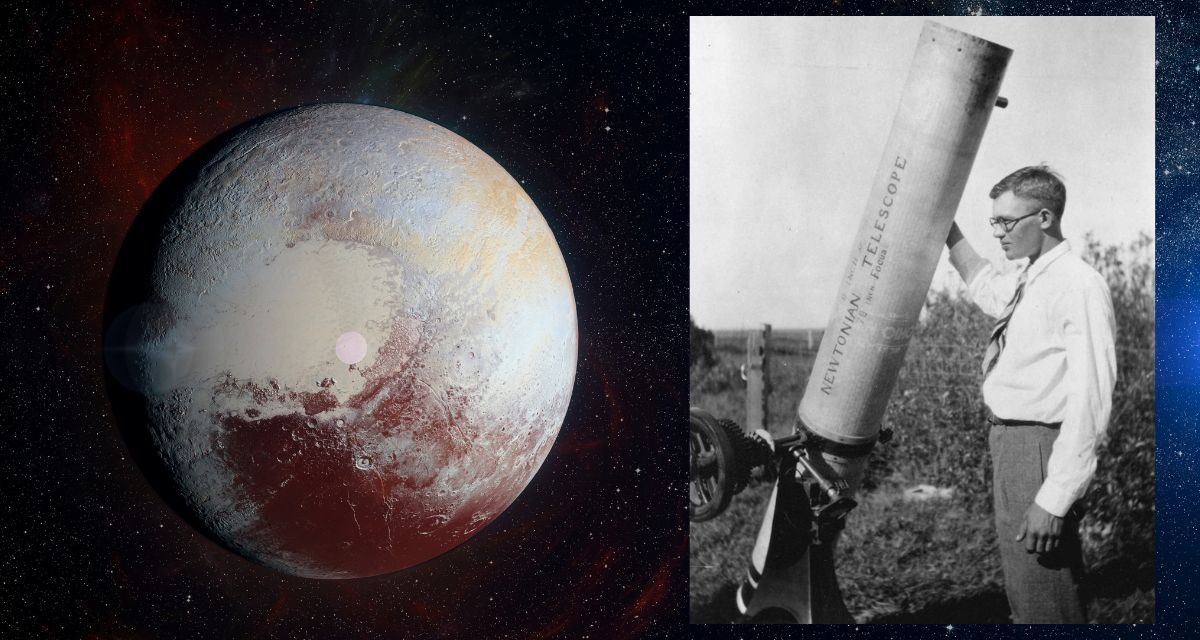
Clyde Tombaugh’s passion for astronomy began in 1918, when he was only 12 years old, sparked by an uncle who had given him his first small telescope and a few astronomy textbooks. However, Tombaugh’s finances didn’t support this passion. Due to a bad corn harvest in 1920, Tombaugh dropped out of high school for a year to help restore his family’s farm in Kansas. Then in 1928, a hailstorm yet again ruined the family’s crops, as well as the young man’s hopes for attending college. And yet, what Tombaugh lacked in resources, he made up for in determination and resourcefulness. In 1926, he began building his own telescope using objects he found around the farm. According to The Saturday Evening Post, Tombaugh’s makeshift device was made up of an axle from his father’s old Buick, metal tubing from a grain elevator, an outdoor water faucet, and assorted machine gears. Using this DIY telescope, Tombaugh was able to make observations about Mars and Jupiter. He sent drawings of those observations to Lowell Observatory in Flagstaff, Arizona for feedback. Instead, they offered him a job. Tombaugh in 1930 at his family’s farm with his homemade telescope. Wikipedia His assignment? Find a planet no one had ever seen By 1929, Tombaugh was tasked with helping to seek out Planet X, a mysterious celestial body that the Lowell Observatory founder, Percival Lowell, thought might have caused irregularities in the orbits of Uranus and Neptune. He primarily did this by photographing the same sections of sky on different nights. Then, using a device called a blink comparator to switch between the images rapidly, he’d look for objects that seemed to move among the stars. On February 18, 1930, Tombaugh finally spotted it: a tiny dot that had indeed moved across the sky. The elusive Planet X. “It took the right person with the right amount of focus, because it was a needle in a haystack looking at dots—a dot that moved against the background of hundreds of thousands of dots,” says Kevin Schindler, the longtime historian and public information officer at the Lowell Observatory. Of course, a few months later, Planet X would be renamed Pluto, thanks to an 11-year-old girl from Oxford, England named Venetia Burney, whose submission beat out 1,000 other suggestions worldwide. Her cleverness was twofold: the name Pluto both remained in the realm of Greek mythology, keeping it in theme with the other planets, and it also honored Percival Lowell’s initials. Even though Pluto would be demoted to a “dwarf planet” in 2006, Tombaugh’s scientific contributions never diminished in their impact. His career spanned decades, including other discoveries like stars, star clusters, asteroids (some UFOs, at that), as well as teaching at New Mexico State University. Adding some poetic sense of culmination, when NASA’s New Horizons spacecraft finally reached Pluto in 2015, it carried a vial of Tombaugh’s ashes. The essence of the man who discovered Pluto came closer to it than any human that had ever lived. A heart-shaped region on the dwarf planet was also named Tombaugh Regio in his honor. Today, if you find yourself at Lowell Observatory, which is now part science center and part science museum, you’ll be able to take a look at Tombaugh’s farmhouse telescope that helped shape his destiny. The astrograph Tombaugh used to find Planet X. Pretzelpaws/Wikipedia Life repeatedly gave him reasons to abandon his dream. Poverty, failed crops, missed schooling…circumstances beyond his control could have ended his journey before it truly began. Instead, he kept looking up, and kept finding a way to do the work with whatever was in front of him. In the end, Clyde Tombaugh didn’t just discover a world at the edge of the solar system. He became a reminder that sometimes the distance between an ordinary life and an extraordinary one is simply the refusal to stop searching.
A ’20s farm boy couldn’t afford a telescope, so he built one. Later, he discovered a planet.
Full Article
Original Source
Read the full article at Upworthy →KhanList aggregates and links to publicly available news content. We do not host full articles from third-party sources. Always verify important information with original sources.