
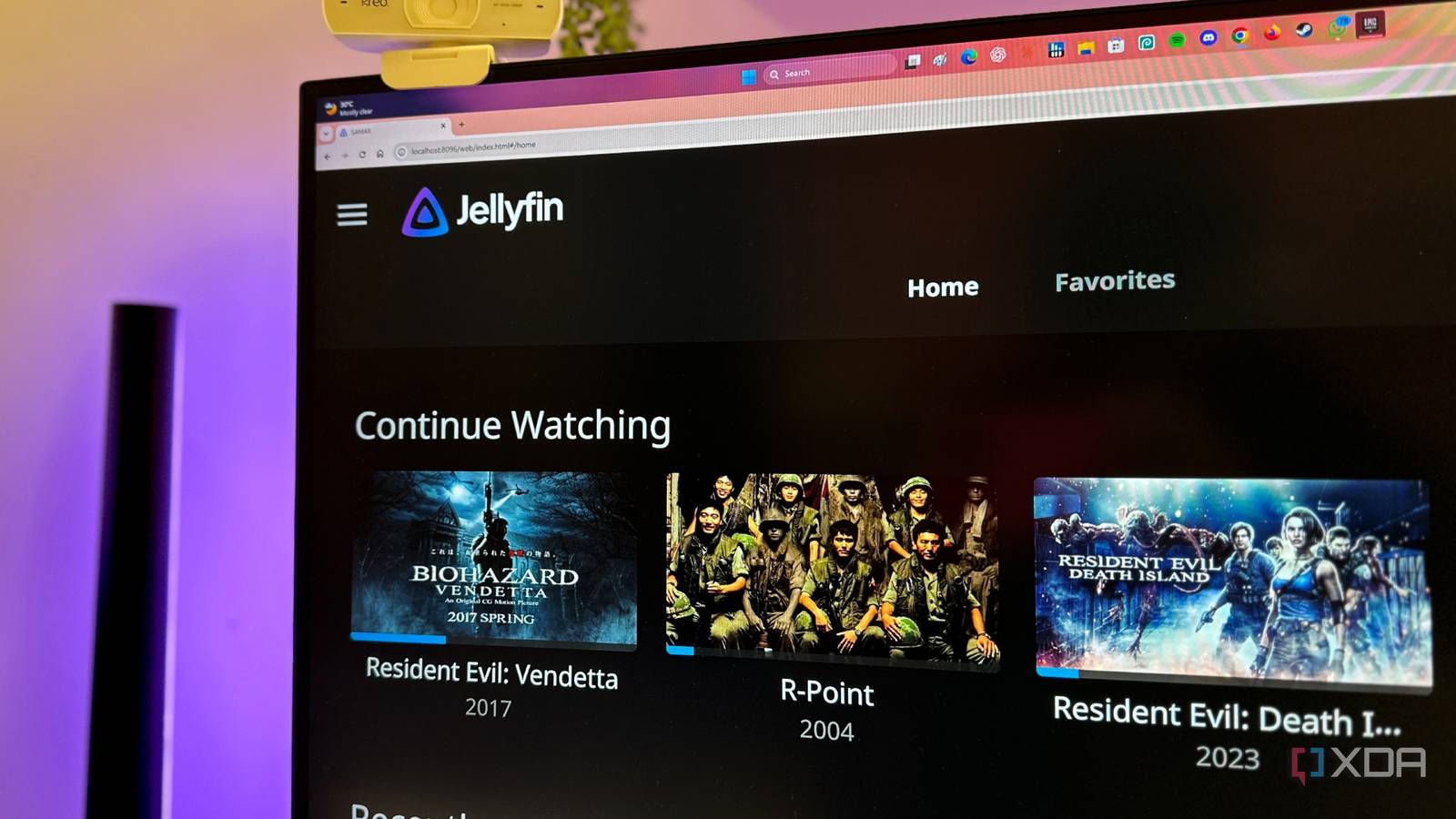
Published Aug 30, 2026, 11:30 AM EDT Shekhar Vaidya is a veteran technology journalist and computer science engineer. He is the founder of TechLatest, where he has spent years providing technical analysis on hardware and Windows ecosystems. Now a Computing Writer at XDA, Shekhar leverages his deep background in NAS, storage solutions, and PC internals to help readers master their tech. People naturally assume that a powerful modern GPU is the best choice for a media server because it has more raw compute power. In my case, it is the opposite: my ten-year-old Intel chip, designed for laptops, handles more transcoding work than my RTX 4070 Ti, a modern high-end desktop GPU. On paper, there is no realistic scenario in which the old Intel chip beats a high-end desktop GPU, because the RTX has more raw compute, VRAM, and CUDA cores. The RTX should have won without breaking a sweat. The GPU that should have won this On paper, there was no contest I use an RTX 4070 Ti GPU on my main workstation, and it is, no doubt, a powerful GPU. From AAA titles to editing 4K videos, it can handle almost anything I throw at it. And specs-wise, it is obviously much more capable than my ten-year-old Intel chip because it has more CUDA cores, VRAM, and raw compute power. Whereas my home server is a repurposed Dell laptop featuring a 2015-era Intel Core i5-6300U’s integrated Intel HD Graphics 520. Before you scroll down to the comments and tell me it is ridiculous to even think of comparing these two, hold on a second. I know, on paper, there is no way to place them beside each other. The RTX 4070 Ti could have easily won if I had asked about overall graphics performance. But treating video transcoding like any other GPU workload is flawed, even to start with. An integrated GPU (iGPU) is limited to a few specific tasks, whereas a modern dedicated GPU (dGPU) has more resources, like raw processing power, to handle multiple tasks. When building a homelab, it is natural to assume that getting a better dGPU will ultimately improve transcoding performance. It is half true, and I will explain why. The myth that doesn’t hold up is that throwing more GPU compute at video transcoding improves results. A GPU, whether dedicated or integrated, has several components, and video transcoding uses only one specialized part rather than general-purpose compute resources. A modern GPU can be better at general workloads, but that says nothing about whether it has an efficient media engine. Regarding my RTX 4070 Ti, it is well established that it is a powerful GPU. I never had an issue with the encoder; the issues only appeared when I started pushing multiple simultaneous streams. It didn’t matter how powerful a GPU was; it only mattered how many streams Nvidia could handle at once. Nvidia doesn't want you doing this at scale The wall you don't see coming The limit isn't in the GPU — it's in the driver. The GPU hardware can handle as many streams as you throw at it, but NVIDIA enforces a driver limit on its consumer GPUs. On the software/driver end, Nvidia limits the number of concurrent NVENC encoding sessions. And this is nowhere mentioned in the raw spec sheet you get. The hardware can encode indefinitely, but you are not supposed to keep on adding NVENC sessions. So, this isn't a hardware limitation; it's a software policy. Now you might ask me, since it is a software policy, can it be bypassed? Yes, there are unofficial patches available, but today I won’t go into them in depth. For instance, my RTX 4070 Ti comes with dual physical NVENC encoding chips, and NVIDIA limits the number of streams to just eight, regardless of whether they are 1080p or 4 K. But realistically, a 1080p stream takes around 250 to 400MB of video memory for the frame buffers, and 1.5 to 2 GB for a 4K stream, so if my math is right, there's VRAM headroom for 20 to 30 1080p streams or five to six 4K-heavy transcoders simultaneously. If I am paying high triple digits for a GPU just to transcode, I better get the value I paid for. But that's exactly where the 4070 Ti falls short. These mid- to high-end GPUs are meant for gaming and high graphics performance, and these gaming workloads don’t care about multiple NVENC sessions. Whereas a media server is different; users usually request several transcoding sessions at the same time. When it comes to my server’s i5-6300U and its iGPU, although the hardware is relatively much weaker than my gaming GPU, that is not the point here. The point is, there is no such hard limitation because Intel isn’t using NVENC. The small media engine inside the Intel HD Graphics 520 is working via QSV/VAAPI. So, when it comes to the media server, the question changes from “which GPU is more powerful?” to “which platform lets me run more simultaneous transcodes?” That’s what a media engine really cares about. No gatekeeping, just an honest limit It doesn't say no until it actually means it Coming back to my exact scenario, I have an old Dell Latitude, almost 10 years old. It features a Core i5-6300U CPU, 12GB of RAM, and a 256GB SSD. I’ve repurposed it as my bare-metal Debian server. Currently, it has more than 20 stacks running 24/7. For Jellyfin, since the hardware supports Intel’s Quick Sync, I use the QSV/VAAPI platform to transcode the streams. I alone (including members of my household) have more than eight devices on which Jellyfin is regularly used, and outside my home I share the same Jellyfin with my relatives and friends. I am not saying they all run at the same time, but that's the real device pool I have. The devices range from 1080p mobile devices to 4K TVs, and the streams range from local to remote. So, with the other 20 stacks running, the CPU started showing bottlenecks around five to six simultaneous 1080p streams. And honestly, the number doesn’t really matter here because the hardware I am comparing is totally different. In NVIDIA's case, it was a policy-driven limitation, but for the 6300U, even though the number was less than NVIDIA’s 8, the hardware was giving out. Nobody told it to stop. It just did. Obviously, with so many simultaneous streams, my server’s CPU utilization and thermals skyrocketed; the telemetry showed it clearly, resulting in dropped frames, buffering, and slower responses from other services, but that’s what we can expect from this old Intel chip. In the end, I'm not claiming whether the ten-year-old 6300U is faster than my RTX 4070 Ti or if Quick Sync isn't universally superior to NVENC. I am also not asking you to ditch your plans for a new GPU and get a ten-year-old GPU. The lesson here is that specialized hardware can remain extremely useful even after almost a decade, and the chip's ceiling was real, not decided by a company somewhere. And finally, for a media server, an integrated media engine matters more than a high-end gaming GPU sitting in the PCIe slot. The real winner was never the hardware The RTX 4070 Ti didn’t lose because it had a weaker encoder, nor did the 6300U win because it had better hardware. NVIDIA puts a hard ceiling on its consumer GPU for concurrent NVENC sessions, whereas Intel’s dedicated media engine, Quick Sync, doesn't have any artificial limitations of that sort. Even though RTX had every raw spec advantage over the old Intel chip, it didn’t matter when it came to a media server. The real takeaway from this is that when building a dedicated media server, don’t focus on CUDA cores or VRAM; focus on the media engine inside it and its real-world limitations. Jellyfin iOS compatible Yes Android compatible Yes Jellyfin is one of the best Plex alternatives you can get, and that's thanks to its open-source nature and powerful set of features. There are apps for basically every platform and it's completely free to run your very own server.
A 10-year-old Intel chip transcodes more Jellyfin streams than my graphics card ever could
Full Article
Original Source
Read the full article at Xda-developers →KhanList aggregates and links to publicly available news content. We do not host full articles from third-party sources. Always verify important information with original sources.