
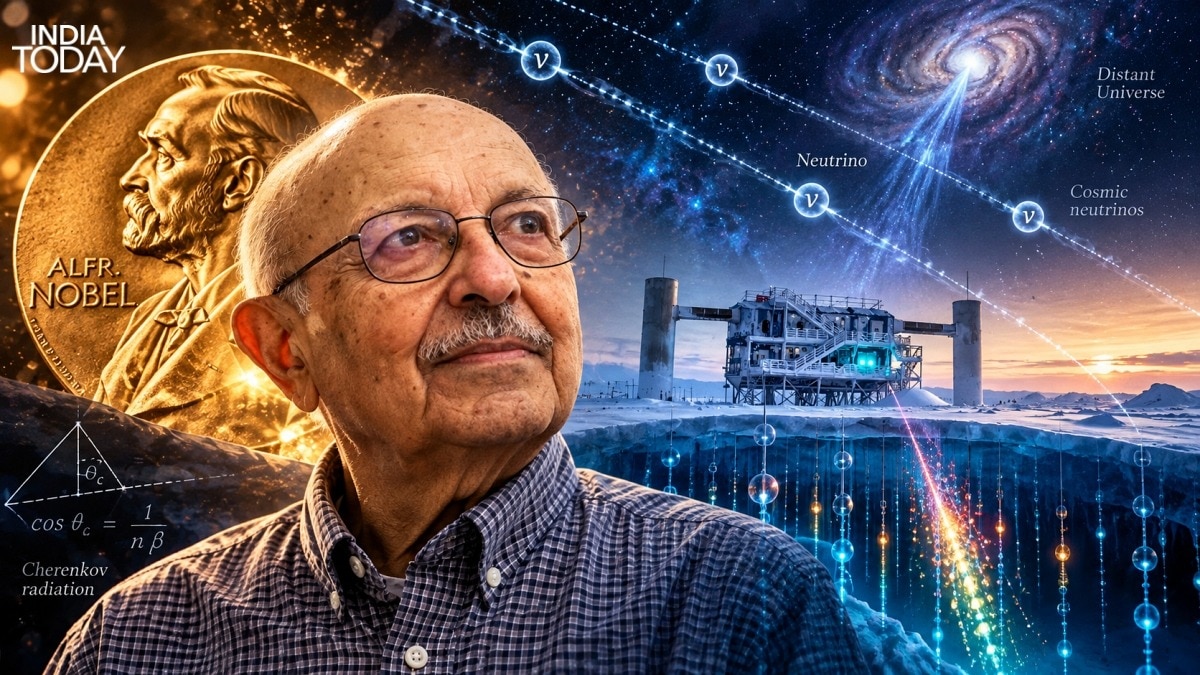
Gaurang Bhaskar Yodh's early work on cosmic rays and neutrino detection intersected with Francis Halzen's path to IceCube. His career links an Indian chapter to the 2026 Physics Nobel and the rise of neutrino astronomy.In 1956, he returned to India and joined TIFR. His ambition was to help establish an accelerator-based particle-physics programme. (Photo: Generative AI by India Today)New Delhi,Oct 8, 2026 15:22 ISTDecades before scientists buried thousands of light sensors beneath the Antarctic ice to listen for ghost particles arriving from the deepest corners of the universe, an Indian physicist was trying to understand what cosmic rays could tell us about the invisible world.His name was Gaurang Bhaskar Yodh.Born in Ahmedabad in 1928, Yodh would go on to work with some of the biggest names in particle physics, return to India to build a particle-physics programme at the Tata Institute of Fundamental Research (TIFR), and later become one of the early contributors to the scientific effort that eventually led to the IceCube Observatory in Antarctica.On October 6, 2026, Belgian-American physicist Francis Halzen was awarded the Nobel Prize in Physics for “decisive contributions to the IceCube Neutrino Observatory and the discovery of high-energy neutrinos of astrophysical origin.” “Beyond all the other risks, this was what really made the project possible – and that was pure luck.” We got hold of the new physics laureate Francis Halzen right after he learned of his Nobel Prize. In this conversation, he speaks about the hurdles that he and his team had to overcome in the process of creating the neutrino detector on the South Pole – and how one of the crucial discoveries was ’totally unexpected.’ Halzen also talks about how his work on neutrino detection could lead to clues about the universe’s black holes.— The Nobel Prize (@NobelPrize) October 6, 2026 And somewhere in that extraordinary story is Yodh's Indian chapter.FROM AHMEDABAD TO FERMI'S LABORATORYYodh completed his BSc from the University of Bombay in 1948 before travelling to the University of Chicago. There, he worked in the orbit of legendary physicists Enrico Fermi and Herbert Anderson, earning his PhD in 1955. He subsequently moved to Stanford for postdoctoral research. In 1956, he returned to India and joined TIFR. His ambition was to help establish an accelerator-based particle-physics programme in the country.But the timing was difficult. The large investment required for the programme was not immediately available, and Yodh returned to the US in 1958.His scientific journey, however, increasingly moved from accelerators towards something much larger: the Universe itself. The IceCube Observatory in Antarctica. THE COSMIC-RAY CLUEYodh became deeply interested in cosmic rays, the high-energy particles that constantly bombard Earth from space.In 1972, he worked with TIFR physicist Yash Pal and James Trefil on cosmic-ray data that showed something important: the strength of proton interactions increased with energy. The result was controversial at the time, but subsequent accelerator measurements at CERN supported their finding.That work helped strengthen the connection between particle physics and cosmic-ray astrophysics — the idea that the Universe itself could act as a gigantic natural particle accelerator.Yodh's career then moved further into developing ways of detecting particles arriving from space, including work on transition-radiation detectors and ground-based gamma-ray telescopes. Dr Gaurang Yodh photographed with a picture of Enrico Fermi, a Nobel laureate physicist and Yodh’s PhD adviser at the University of Chicago. (Photo: Faisal Abdu’Allah/IceCube Observatory) FROM ANTARCTIC ICE TO ICECUBEThis is where his story intersects with Halzen's.In the 1990s, Yodh worked with Francis Halzen and Steve Barwick on efforts that helped kick-start AMANDA, the Antarctic Muon And Neutrino Detector Array.AMANDA was an ambitious idea: instead of building an enormous conventional detector, scientists could use the clear, deep ice at the South Pole as a natural detector. Light sensors buried deep inside the ice could capture tiny flashes produced when neutrinos interacted with matter.AMANDA became the technological and scientific predecessor to IceCube. Its experiments demonstrated that deep Antarctic ice could work as a neutrino telescope and helped establish the techniques later used by the much larger IceCube detector.Deep beneath the Antarctic ice, the IceCube Neutrino Observatory is helping scientists uncover the secrets of the cosmos through neutrinos, often called "ghost particles." Discover how 2026 physics laureate Francis Halzen's vision helped make it possible. Read here: https://t.co/oERMBmUeQv— The Nobel Prize (@NobelPrize) October 6, 2026IceCube eventually transformed a cubic kilometre of Antarctic ice into a giant particle detector, allowing scientists to identify high-energy neutrinos arriving from outside our Solar System.A NOBEL STORY WITH AN INDIAN CONNECTIONThere is another remarkable twist.Yodh died on June 3, 2019. Just weeks later, on July 25, his daughter Jaya Yodh presented Francis Halzen with the 2019 Yodh Prize in Madison, Wisconsin.The prize had been established by Gaurang and his wife, Kanwal, in 1998 to recognise major contributions to cosmic-ray research. Halzen received it for his leadership and landmark contributions that helped clear the path for neutrino astronomy.So, in a sense, Yodh's legacy was being honoured by the very scientist whose work would eventually receive the world's most famous physics prize for opening a new window on the Universe.And there was an unexpected second side to Yodh.He was also an accomplished sitar player. In 1956, he made one of the earliest recordings of Indian music in the United States, and music remained part of his life alongside physics.From Ahmedabad to TIFR, from cosmic rays to Antarctic ice, Yodh's journey shows how major discoveries are rarely the work of one person.Sometimes, a Nobel-winning discovery begins decades earlier, with a scientist asking a seemingly simple question about particles falling from the sky.- Ends
70 years ago, an Indian set in motion the work behind the 2026 Physics Nobel
Full Article
Original Source
Read the full article at Indiatoday →KhanList aggregates and links to publicly available news content. We do not host full articles from third-party sources. Always verify important information with original sources.