
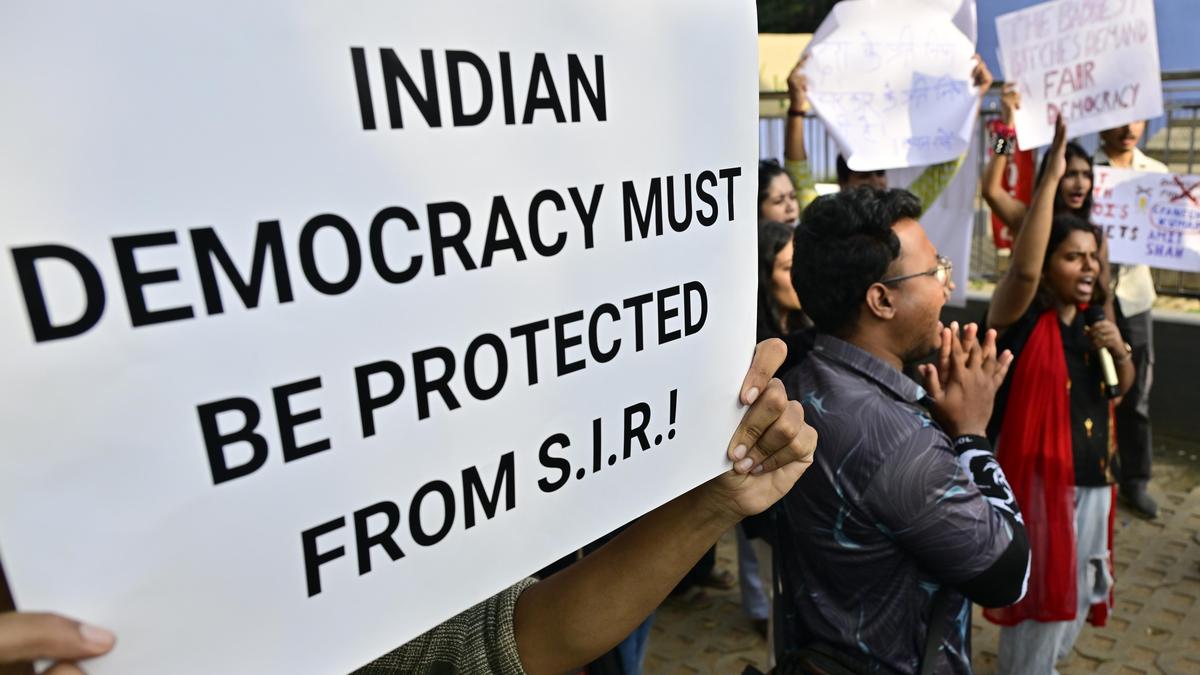
For more than 75 years, the defining preoccupation of the Election Commission of India (ECI) has been “inclusion”. The first general election of 1951-52 had to enrol an electorate of around 17 crore from scratch, many of whom were illiterate. Successive Commissioners treated universal adult franchise as a promise to be fulfilled rather than just a principle to be stated on paper. India could genuinely be proud of being an electoral democracy where voter turnout among the poor is higher than that among the rich, unlike in many western democracies.Editorial | Obstacle race: On Special Intensive Revision exerciseThe Special Intensive Revision (SIR) of electoral rolls launched by the Chief Election Commissioner (CEC) of India, Gyanesh Kumar, has reversed this progressive direction. It was termed an exercise to “purify” the electoral rolls, but in practice, it is riddled with methodological flaws and ad hoc rule changes, resulting in the deletion of a large number of genuine voters.The names of 13.37 crore people were struck off during the draft stage across 30 States and Union Territories in the three phases of the SIR. The figure includes 65 lakh in Bihar, 6.57 crore in the 12 States and Union Territories covered in Phase 2, and 6.15 crore in Phase 3, whose final rolls are yet to be published. The deletion rate doubled as SIR progressed — from 8.3% in Bihar to 12.9% in Phase 2 and 17% in Phase 3 (it was 32.8% in Delhi and 21.7% in Telangana). In Phases 1 and 2, even after names were added back, net deletions were about 6.2 crore.In Delhi, the draft roll has only 97.54 lakh electors, barely above the 94.95 lakh who voted in the February 2025 Assembly election. In 24 of Delhi’s 70 constituencies, the draft roll now has fewer electors than the number who voted in the election. The ECI has in effect conceded the point about disenfranchisement. It has now directed officials to run a “special drive” to enrol anyone “whose name has got left out” — an implicit admission that its rolls are missing eligible voters.Flaws by designFirst, enumeration. The ECI’s Manual on Electoral Rolls (2023) describes an intensive revision as a “denovo process without reference to the earlier existing roll” (paragraph 9.3.1); enumerators visit every house and record the particulars of each eligible resident. If a particular elector’s citizenship is in doubt, the Manual requires officials to give “probative value” (paragraph 7.4.2) to their presence on the preceding roll, and places the onus on the objector and not the elector.The SIR inverts this procedure. It shifts enumeration on to electors and presumes that they are ineligible until they can trace themselves or a parent to the last intensive revision conducted more than two decades ago, or produce documents to establish their eligibility in what resembles a citizenship test.Electors who could not be found, did not receive or return the form, or were unable to fill it — due to illiteracy, for example — were dropped from the draft roll, even if they had voted in the last election. All this was done at breakneck speed, on the eve of elections in several States.Second, re-entry. A deleted voter cannot be easily restored, even if he or she has merely shifted address within the constituency. They must apply through Form 6 — the application for new voters — as though they had never been on the rolls. Since newly eligible 18-year-olds also use Form 6, the ECI has made it impossible to distinguish new voters from returning voters in the published figures, preventing a proper audit.Third, “logical discrepancies”. Software matched electors against two-decade-old rolls and flagged mismatches for scrutiny. These included spelling differences, more than six voters linked to one ancestor, and parent-child age gaps outside 15 to 45 years, among other arbitrary criteria.This was first fully applied in West Bengal, where 60 lakh names were flagged and judicial officers deployed by the Supreme Court of India struck off 27 lakh names. Appellate tribunals appointed since then have restored electors in 93% of the cases, bringing back about one lakh names onto the rolls. But by early September — months after the Assembly election — they had disposed of only 1.22 lakh of more than 38 lakh appeals, or 3.2%. Moreover, 16.1 lakh appeals were filed to remove electors whom judicial officers had found eligible. Who authorised this on the ECI’s behalf remains unanswered. Meanwhile, another 19.33 lakh electors on Delhi’s draft rolls have been flagged for “logical discrepancies”.Fourth, centralisation. Changes to the rolls increasingly flow through the Electoral Roll Officers’ Network (ERONet) database, overriding Electoral Registration Officers, who are the statutory authorities on eligibility. State election officials have complained that they cannot see centrally made changes to the rolls in their own constituencies.Fifth, lack of a baseline. Without the latest Census — which has been delayed by the Centre — there is no firm population baseline to check the rolls. The ECI also dismisses projected population figures as mere estimates. For example, in Tamil Nadu, the final roll of 5.67 crore is about 33 lakh short of the projected 6.02 crore.The impact of these flaws was drastic but varied across States. In Bihar, where migration for work is overwhelmingly male, more women than men were struck off the rolls, particularly those aged 18-29 years and recorded as “permanently shifted”. The gender ratio in the final SIR rolls fell to 892 from 907 in the 2024 Lok Sabha rolls.In West Bengal, statistical analyses by the Kolkata-based SABAR Institute, a public policy and research organisation, estimated that 65% of those deleted after adjudication for “logical discrepancies” were Muslims, despite Muslims accounting for roughly 27% of the State’s population. A protest in Bengaluru | Photo Credit: THE HINDU/ALLEN EGENUSE J. A deferential CourtFor months, the Court confined itself to managerial interventions on the SIR. It ruled only on May 27, after Phase 2 had ended and Phase 3 was notified, upholding the SIR.Legal scholars have raised three broad substantive objections to the judgment. First, Section 21(3) permits a special revision “for any constituency or part of a constituency” — an exceptional and targeted power. Yet, the Court allowed the ECI to use it for a State-wide exercise, freeing it from the Registration of Electors Rules governing ordinary revisions.Second, rather than asking whether a less harmful method, such as door-to-door verification and enrolment, could achieve the same objective, the Court asked only whether the SIR was “manifestly excessive”.Third, the Court sidestepped its own three-judge ruling in Lal Babu Hussein (1995), which struck down a “sweeping” revision that demanded citizenship documents from nearly 18,000 residents of Delhi’s Matia Mahal. The ruling, also incorporated into the ECI’s Manual, held that a name on the electoral roll is presumed valid and can be removed only after notice and a hearing.Essentially, the Court found that disenfranchisement was not “widespread or systemic” enough to warrant intervention, without specifying what would matter instead. The judgment emboldened the ECI to proceed with the flawed SIR in Phase 3, where deletions have risen sharply.Dissent from withinReports revealed that Election Commissioners Sukhbir Singh Sandhu and Vivek Joshi recorded at least 14 objections between October 2025 and August 2026. One concerned Form 6 being altered, without amending the rules, requiring applicants to state whether they or their parents or grandparents appeared on the “last SIR” roll. The ECI’s response to the revelations was mere window-dressing with some administrative changes. As the two Commissioners constituted a majority, they should have used it to stop these decisions, but did not.The Court is now hearing petitions concerning West Bengal and Delhi, as well as pleas seeking the CEC’s suspension over the ECI’s conduct. It should use these proceedings to revisit its judgment on review or before a Constitution Bench. It should halt the SIR and order an audit of rolls finalised so far before any further deletions. Enumeration should return to door-to-door verification by Booth Level Officers, while States going to the polls soon should use their pre-SIR rolls, updated with fresh enrolments.Anything less would endorse a process that professes time and again that no eligible elector will be left out while patently doing the opposite. It has removed more than a lakh genuine voters for certain, and possibly crores. The ECI, built to widen India’s adult franchise, has instead spent more than a year narrowing it.srinivasan.vr@thehindu.co.inponvasanth.ba@thehindu.co.in
Flawed by design, exclusionary in impact
Full Article
Original Source
Read the full article at Thehindu →KhanList aggregates and links to publicly available news content. We do not host full articles from third-party sources. Always verify important information with original sources.