
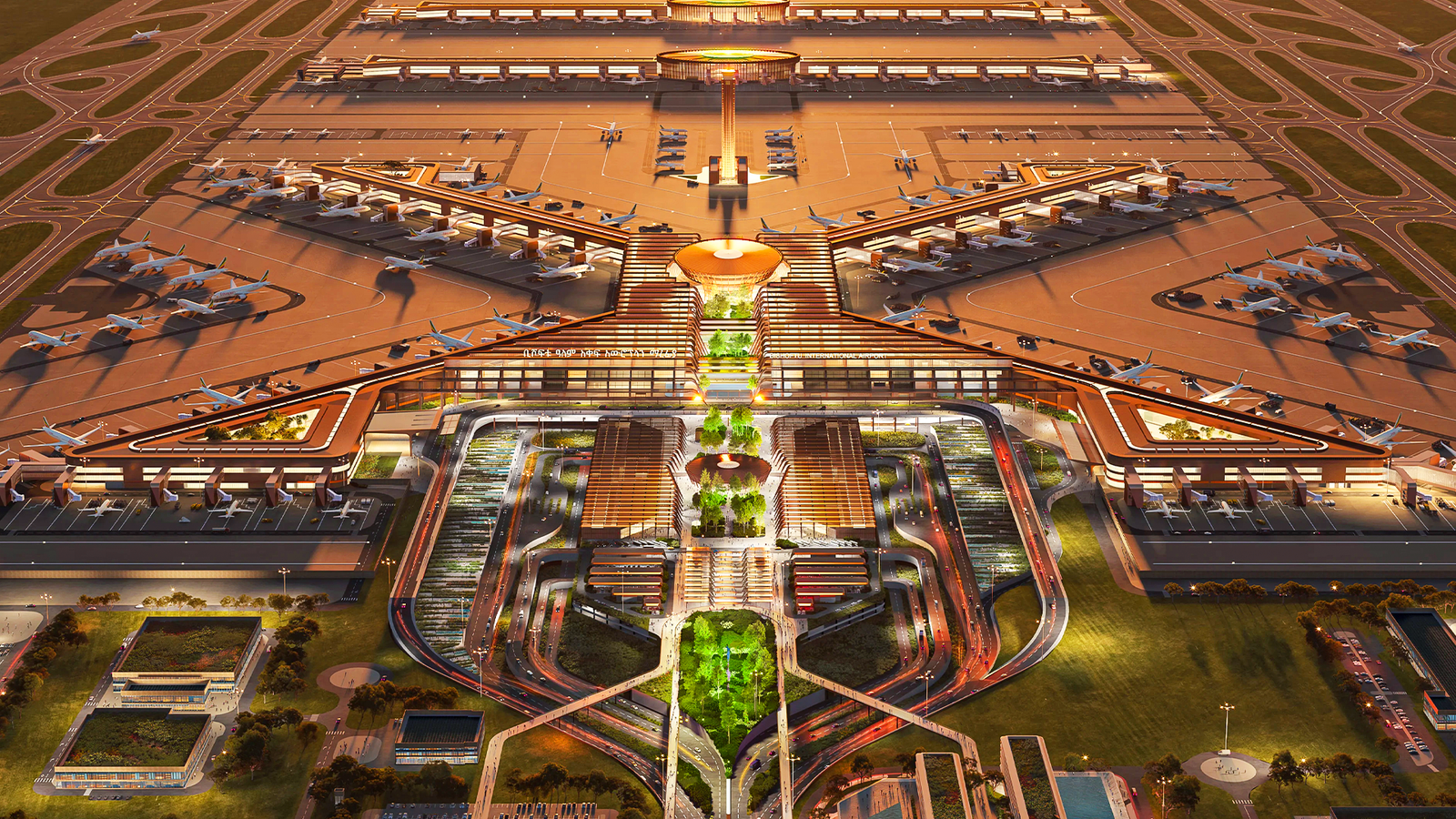
Credit: ZHA Architects, Simple Flying Published Oct 7, 2026, 12:00 PM EDT Passionate about promoting aviation, the beauty of flight and the science behind it, Antonio is an avid reader of aviation magazines and books, and he loves visiting airshows all over the world, taking photos and writing about airplanes and helicopters as well. He is currently based in Palermo, Sicily. Sign in to your Simple Flying account Africa has never had an airport quite like this one. In the farmland outside the town of Bishoftu, roughly 28 miles (45 km) southeast of Addis Ababa, Ethiopian Airlines has broken ground on a Zaha Hadid Architects-designed mega-hub, considered by its backers as the largest aviation infrastructure project in African history. Construction officially began on January 10, 2026, according to Ethiopian Airlines, and when the first phase opens in 2030, as reported by Simple Flying, it will change how much of the African continent connects to the rest of the world. This list looks at five ways Bishoftu International Airport (BIA) is set to reshape air travel across the region, ranked from meaningful to transformative. The criteria are straightforward: raw capacity, the ability to relieve existing bottlenecks, the design choices that shape how passengers actually move through the terminal, and the airport’s potential to pull traffic away from hubs outside Africa altogether. Along the way, it’s worth comparing Bishoftu to some of the world’s most established mega-airports both in Africa and outside, including O.R. Tambo (JNB), Hartsfield-Jackson Atlanta International Airport (ATL), and Addis Ababa Bole International Airport (ADD), to see just how ambitious this $12.5 billion project really is, and why Ethiopia isn’t the only country betting big on a next-generation hub: similar mega-projects are underway or planned in Dubai, Riyadh, and Singapore, all chasing the same wave of long-term global air-travel growth. It Expands Africa’s Cargo Capacity A new logistics backbone for the continent Credit: KITTIKUN YOKSAP | Shutterstock Passenger numbers get most of the attention, but Bishoftu’s long-term plan also calls for handling nearly 4.1 million tons of cargo a year, according to figures cited by Le Journal de l’Aviation. That would place BIA among the busiest freight gateways on the continent, at a time when African air cargo still lags far behind Asia, Europe, and North America both in volume and reliability, and when e-commerce and pharmaceutical logistics are growing faster than most of the continent’s airports can handle. As already examined by Simple Flying, Ethiopian Airlines already operates one of Africa’s largest cargo divisions, flying pharmaceuticals, fresh flowers, fruit and vegetables, and manufactured goods between the continent and the rest of the world on a fleet of dedicated freighters. A purpose-built cargo zone at Bishoftu, separate from the passenger terminal complex, should let that business scale without competing with airline traffic for gates, runway slots, or apron space, something that constrains freight operations at Bole today. Cargo growth ranks fifth on this list because it reshapes trade corridors. Still, faster and cheaper air freight can have effects on fares beyond the airport itself, lowering costs for exporters, speeding up cross-border e-commerce delivery, and making Ethiopia a more attractive logistics base for companies serving eastern, central, and even parts of Southern Africa that currently route cargo through Gulf hubs. A more capable freight operation also strengthens Ethiopian Airlines’ negotiating position with global logistics partners, since guaranteed capacity and modern handling facilities are often what wins long-term freight contracts in the first place. It Adds Enormous New Passenger Capacity From 60 million seats at opening to 110 million at full build-out Credit: X Universe Phase one alone is designed to handle 60 million passengers a year once it opens in 2030, according to African Review. At full build-out, with all four runways and 270 aircraft parking stands complete, capacity rises to 110 million passengers annually, a figure confirmed by both Ethiopian Airlines and Airways Magazine, which places Bishoftu among the largest aviation hubs anywhere in the world, on paper at least. To put that in perspective, Ethiopia’s current main airport, Addis Ababa Bole International (ADD), tops out around 25 million passengers a year. Bishoftu’s eventual capacity is more than four times that figure, and it would also exceed the 106.3 million passengers ATL handled in 2025 to remain the world’s busiest airport for total traffic, according to data published by Airports Council International (ACI) World. Capacity on this scale invites airlines, both Ethiopian and its Star Alliance partners, to add frequencies, launch new long-haul routes, and treat Addis Ababa’s air-travel market as a global hub rather than a regional stopover on the way somewhere else. It also gives Ethiopian Airlines room to keep growing its own fleet and network well past the point where Bole would have forced a slowdown, at a moment when the carrier is already pushing into new long-haul markets across the Americas and Asia-Pacific. It Relieves An Overloaded Bole International Airport Ethiopia’s current hub is running out of room to grow Credit: EQRoy | Shutterstock Bole International Airport has absorbed years of expansion, yet it is nearing its practical ceiling of around 25 million passengers a year. Ethiopian Airlines alone carried 19.1 million passengers in the fiscal year ending June 30, 2025, according to figures Group CEO Mesfin Tasew shared at a briefing reported by IndiaOutbound. Add the dozens of other airlines that also use Bole, and the airport is already pressing hard against its physical limits. That squeeze shows up in ways travelers notice directly: congested taxiways, tighter connection windows during peak banks of flights, and gate constraints affect delays across Ethiopian’s growing international network, which now spans 126 global destinations. Bishoftu is explicitly designed to take over as Ethiopian Airlines’ primary hub once phase one opens, freeing Bole to handle overflow traffic, general aviation, or a reduced schedule going forward. Prime Minister Abiy Ahmed Ali described the project as part of a “multi-airport strategy” meant to future-proof Ethiopia’s role as Africa’s leading air-transport gateway, in comments carried by Reuters, and the plan includes a new freeway and a high-speed rail link running at up to 124 mph (200 kph) to connect the two airports and the capital. It’s Purpose-Built For Connecting Passengers An X-shaped terminal designed to keep transfer times short Credit: X Universe Up to 80% of Bishoftu’s traffic is expected to be transit passengers rather than travelers starting or ending their journey in Ethiopia, a ratio that puts BIA in the same league as Dubai or Doha, hubs built almost entirely around connecting flows rather than local demand. Zaha Hadid Architects designed the terminal with an X-shape, with four piers radiating outward from a central spine, specifically to compress the distance and time between arriving and departing gates for passengers who never plan to leave the airport. The firm’s director of aviation, Cristiano Ceccato de Sabata, described the project as one meant to “connect every region of the continent as Africa’s global gateway” in comments published by Dezeen. The phase-one terminal itself spans about 7.1 million square feet (660,000 square meters), giving planners room to separate international, domestic, and pure transfer flows rather than funneling all the travelers through a single congested spine, as detailed by Futura Sciences. The design also folds in amenities travelers won’t expect at a brand-new African airport, including a 350-room hotel, gardens, and courtyards meant to make long layovers feel less punishing. For a traveler routing between West Africa and Southeast Asia, or between Europe and Southern Africa, a fast, well-organized transfer hub can be the difference between a manageable layover and a missed connection. If Bishoftu delivers on its design promise once it opens, it becomes an alternative to routing through Gulf or European hubs for intra-African and Africa-to-world itineraries. This is precisely the kind of shift that reshapes how an entire region flies rather than just how one airline operates. Ethiopian Airlines is effectively trying to make the hub itself part of the reason passengers choose its network, following a model in which airports such as Dubai International Airport (DXB) and Singapore Changi Airport (SIN) became places travelers were willing to route through rather than simply pass through. It Could Become Africa’s Primary Aviation Gateway Bigger than O.R. Tambo, built for the whole continent Credit: X Universe With four runways, parking for 270 aircraft, and a full build-out capacity of 110 million passengers a year, Bishoftu is designed from day one to outgrow Johannesburg’s O.R. Tambo International Airport, currently Africa’s busiest hub with capacity for roughly 28 million passengers annually. Once complete, BIA would become Africa’s largest and most expensive airport project by a wide margin, according to Simple Flying’s reporting on the project, and it would do so while serving a fundamentally different role: it will be a continental connector positioned along the routes linking Africa, Europe, Asia, and the Middle East. The strategic bet is bigger than domestic bragging rights. As Al Arabiya English reported, officials say the airport is meant to strengthen Ethiopian Airlines’ global competitiveness, expand trade and tourism corridors, and position Ethiopia as a major intercontinental hub. The language echoes the ambitions Dubai and Doha voiced years before they became indispensable connecting points between continents. Financing reflects that ambition as well: Ethiopian Airlines is funding almost 30% of the project itself, with the African Development Bank, KPMG, and a consortium of international leaders covering the rest, as outlined by industry tracker CAPA-Centre for Aviation. The construction of this airport is of the utmost importance for many African travelers because it will drastically reduce time, stress and the overall complexity of the trip. Currently, most citizens from African countries require a layover, in most cases, either in Istanbul Airport (IST) or Dubai, to visit Europe or the Americas. The problem for travelers is that such a simple layover might require a transit visa, which takes more time, money and sometimes, can be refused at all. Traveling via Ethiopia will eliminate the need for a transit visa, as the majority of African countries require either an e-visa or a visa on arrival there.
5 Ways The World’s Newest Mega Airport Could Reshape Air Travel Across An Entire Region
Full Article
Original Source
Read the full article at Simpleflying →KhanList aggregates and links to publicly available news content. We do not host full articles from third-party sources. Always verify important information with original sources.