
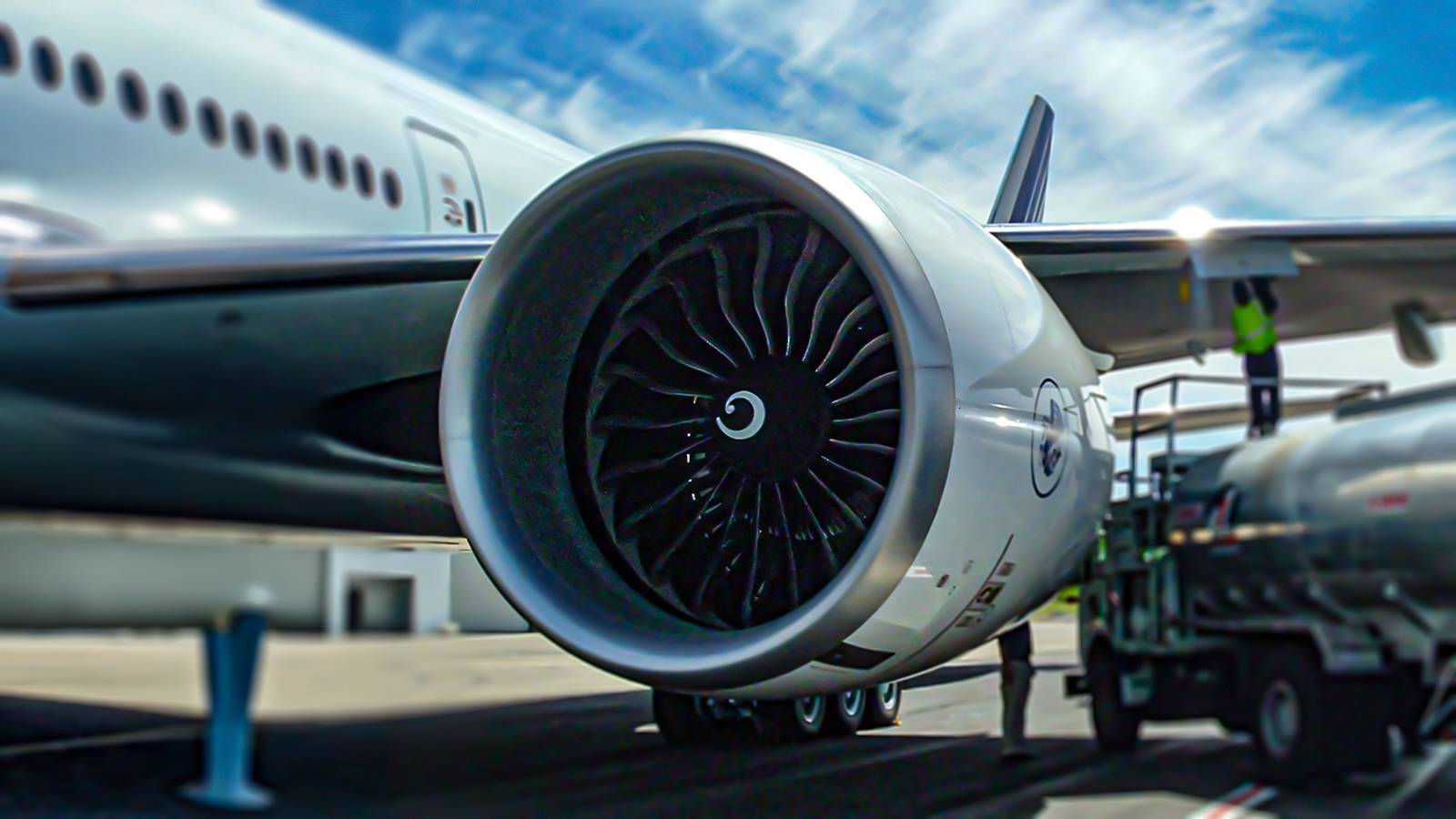
The cost for an engine overhaul on a widebody runs about $3 million to $8 million or more, according to publicly available data, such as figures from Air Cargo Week. Specifically, repairing the massive General Electric GE90, which powers the popular Boeing 777 jets well at the high end of that range. At the same time, once airlines count the parts, the people, the freight, and the idle aircraft, a single event can pass $10 million. The majority of the cost still comes down to parts and hardware, but the process of inspection and certification also adds a significant sum to the final price. Complex twinjet powerplants demand thousands of hours of work and testing from specialized technicians. When a widebody jet engine undergoes a full overhaul, the actual invoice dramatically inflates due to how the material and labor costs split. Off-Wing Time: Engine Removal, Handling & Install Credit: MC MEDIASTUDIO | Shutterstock Before any shop work starts, the engine has to come off the wing.Moving a 15,000-to-20,000-pound widebody engine, securing it, and transporting it is an exercise in caution as much as it is heavy lifting. The baseline cost for the physical swap ranges from $8,000 to $30,000 per engine event. Before the power plant goes anywhere near a stand, the crew uncouples the engine’s electrics, fuel lines, hydraulic lines, and pylon fasteners. An engine cannot simply sit on a flatbed or warehouse floor. It requires a dedicated, OEM-certified engine stand consisting of a transport base and an integrated structural cradle. If an airline does not own a matching stand pool, renting a stand adds $1,000 to $3,000 per day. Moving the engine via road must be done with air-ride low-boy trailers that typically cost another $3,000 to $8,000 per trip. For international or highly urgent Aircraft-on-Ground scenarios, the engine must be flown to the maintenance, repair, and overhaul facility using a nose-loading or large side-door cargo freighter. Air freighting a massive widebody engine between continents costs anywhere from $10,000 to $50,000 for standard transport, and can skyrocket past $150,000 for an emergency delivery. Then there are the insurance considerations. Since giant turbofans are valued between $15 million and $35 million or more, physical transit represents an extraordinary financial risk. This premium typically sits at 0.2% to 0.5% of the engine’s declared asset value, adding an extra $20,000 to $50,000 in pure insurance costs per one-way journey. After considering all of these expenses, the operator is also likely to be keen on keeping the jet flying to earn back some of the cost. Keeping The Airplane On The Go: Spare Engine Leasing $3,500 to $6,500 daily lease rates Credit: Sergey Kustov | Shutterstock A spare engine is a stand-in unit that goes on the wing, so the jet does not sit idle. Airlines that don't have spare carriers have no choice but to rent them, and the rent is steep. When a widebody’s main engine goes into the shop for a heavy overhaul or a full-life performance restoration, the aircraft cannot simply sit idle. Grounding a widebody jet destroys its utilization value, forcing the operator into short-term engine leasing. As cargo airlines often operate older, thin-margin fleets, a prolonged engine overhaul can quietly double the overall expense of the maintenance event through leasing overhead alone. Daily lease rates typically range from $3,500 to $6,500 per day. For more modern powerplants, those rates can easily cross $10,000 per day. Historically, a standard wide-body engine overhaul took 60 to 90 days, but industrial constraints have severely impacted timelines in recent years. Considering present-day global supply chain bottlenecks, parts shortages, and MRO labor constraints, power plant turnaround times have crept to 150, 200, or even 300 days. At a lease rate of $5,000 a day, a 200-day shop stay adds $1,000,000 in raw leasing costs entirely separate from the actual mechanics' labor and replacement parts. The Trent 1000 crisis of 2018 shows how fast spares run out. Faults in the Rolls-Royce engine's intermediate pressure turbine blades surfaced late in 2017 after two Air New Zealand incidents, according to AirlineGeeks. Rolls began inspecting 383 Package C engines and pulling any with cracks. By June 2018, The Seattle Times reported, almost 50 Boeing 787s sat grounded waiting for engines. British Airways, Norwegian and Virgin Atlantic were among the carriers affected. The cumulative cost of a long-term engine lease during a delayed overhaul is high. As such, large operators are increasingly forced to tie up massive amounts of capital to buy and hold their own dedicated pool of spare engines. If an operator looks at an older engine that needs a $4 million performance restoration plus $6 million in Life-Limited Parts (LLPs), they must balance that against the lease cost of a replacement. MRO Shop Labor: A 68% Spending Surge 68% cost to 10% use disconnect Credit: Hsu-Yu Cheng | Shutterstock Labor is the cost most people picture when they hear the word overhaul. Technicians take the engine apart module by module, measure each part against its limit, repair what can be saved, and rebuild the engine for a test run. The work is slow because every part is inspected and logged. Meanwhile, the global shortage of skilled aircraft maintenance technicians has steadily made labor a much more volatile and expensive factor of a widebody engine overhaul bill. In 2026, shop spending keeps climbing. Labor ranks above freight and rental because the hours add up over a visit that can last months. BNN Bloomberg broke down how six large US airline operations saw more spending on labor and materials at a rate of 68% between 2019 and 2025, while flying hours only rose by 10%. This surging cost is driven directly by the extreme complexity of modern turbofans. Technicians must meticulously strip the engine down to its individual modules and thousands of fan blades, shafts, and fuel nozzles. Inspectors utilize eddy-current, ultrasonic, and fluorescent penetrant testing to hunt for microscopic structural fractures or thermal fatigue in high-stress zones. Then, reassembling a multi-stage compressor or high-pressure turbine module requires microscopic tolerance alignments and complex rotor balancing. Lost Aircraft Utilization: The Norwegian Air Case Study $120 million in penalties Credit: Emptywalls.uk | Shutterstock Utilization means the hours a jet spends in the air earning money. Each day the jet waits for an engine, that income stops while ownership and lease payments carry on. The Norwegian Air Shuttle crisis provides a devastating real-world case study of how lost aircraft utilization, engine overhauls, and replacement leasing costs can combine to bring a major airline to the brink of financial collapse. During its rapid transatlantic expansion, Norwegian built its entire business model on high-utilization, low-cost long-haul flights using a fleet of brand-new Boeing 787 Dreamliners. However, when premature turbine blade wear issues emerged on its Rolls-Royce Trent 1000 engines, the airline was thrust into a multi-year financial nightmare. Blade durability problems in the engines of its 787s cost the airline $120 million in passenger compensation alone, according to Aviation International News. Because multiple global airlines are competing for the exact same limited pool of uninstalled spare engines, lease rates have skyrocketed. Paying $5,000 to $10,000 a day for a replacement engine is a direct premium an airline pays simply to protect its aircraft utilization. If a spare engine cannot be sourced on the open market, the airline is forced to pull the aircraft from service entirely. To maintain its routes, Norwegian had to charter legendary but incredibly fuel-inefficient aircraft, including the massive Airbus A380 and older Boeing 747s. Because the chartered wet-lease aircraft frequently suffered from formatting mismatches and scheduling delays, Norwegian's on-time performance nose-dived. The airline was hit with massive penalties that far exceeded the compensation received from the manufacturer responsible for its fleet grounding. Norwegian Air Shuttle's experience completely transformed how the aviation industry models risk. Life Limited Parts The $10 million component burden Credit: Cangavi | Shutterstock Life-limited parts, or LLPs, are rotating pieces such as discs and shafts that may fly only a fixed number of cycles, where one cycle is one takeoff and one landing. Nobody waits for a crack to appear. Unlike standard engine components that can be inspected, repaired, and welded back together, LLPs are bound by strict, non-negotiable legal lifespans that cannot be extended under any circumstances. LLPs are the critical structural backbones of a turbofan engine, including the high-pressure compressor rotors, turbine disks, hubs, and main fan shafts. These parts endure the most extreme rotational speeds, centrifugal forces, and thermal stress in all of aviation. A full set of LLPs for a widebody engine usually costs more than a complete performance restoration, according to Air Cargo Week. That is how a heavy GE90, GEnx or Trent visit reaches $10 million or more. Because the stack is that expensive, the remaining life sets the engine's price. Safe Fly Aviation high-time GE90s trade for between $4.2 million and $7.8 million depending on how many cycles are left, which means an engine nearing its limits is sold with a repair bill attached. LLP replacements occur in massive, irregular cycles rather than smooth monthly operational expenses. As such, they create immense balance sheet volatility. Today, planners build data models to align shop visits with matched cycle parts, hunting for used, partial-life LLPs on the secondary market to match an aging aircraft's remaining lease term, ensuring that not a single expensive flight cycle is left wasted when the airframe is eventually retired.
5 Costs Airlines Face When A Widebody Jet Engine Needs An Overhaul
Full Article
Original Source
Read the full article at Simpleflying →KhanList aggregates and links to publicly available news content. We do not host full articles from third-party sources. Always verify important information with original sources.