
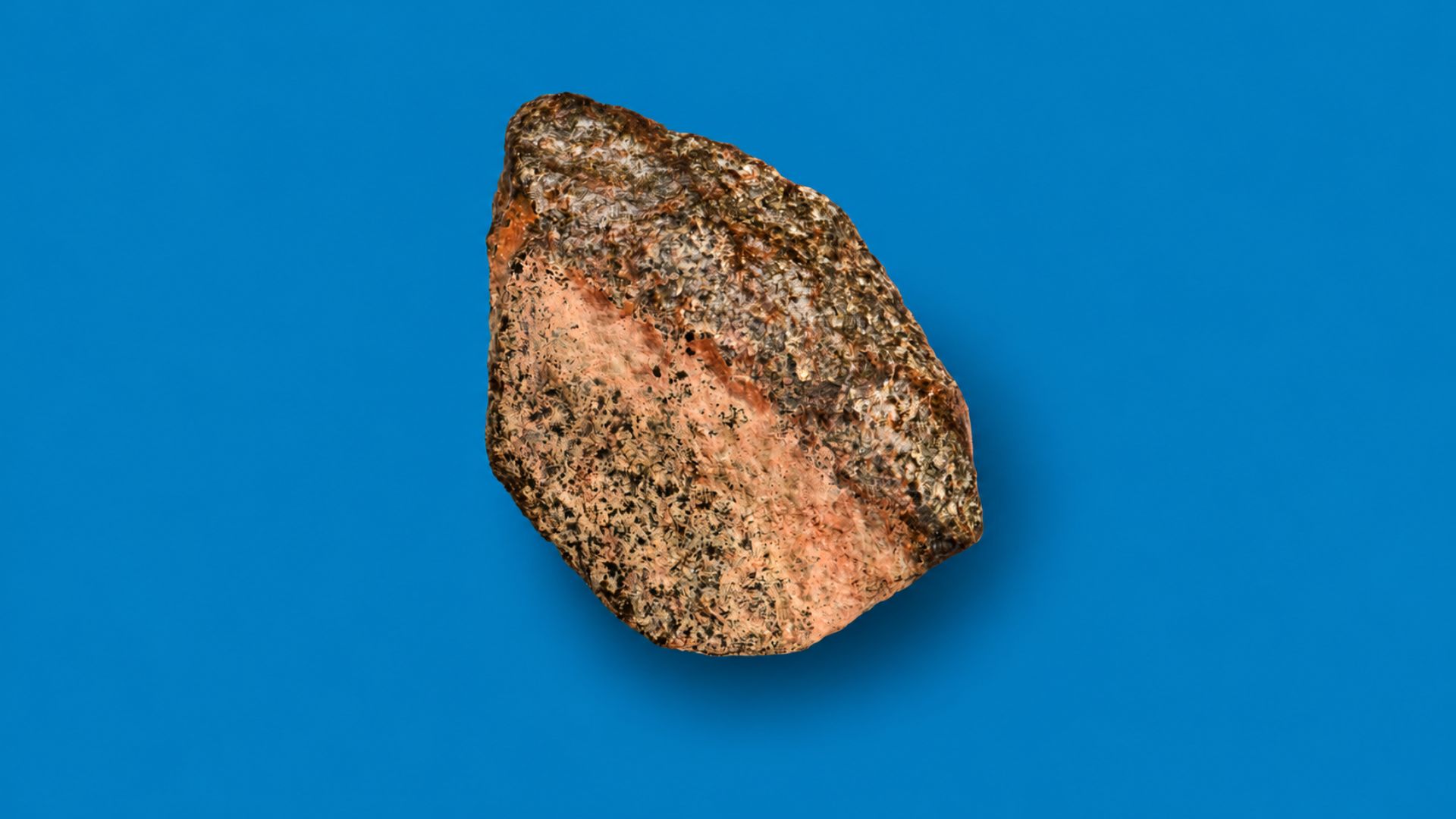
When nomadic prospectors stumbled across a curious rose-tinted rock scattered across Mali’s desolate salt plains in 2022, they had no idea they were holding a lost piece of planetary history. It was nearly ignored. Researchers initially suspected the 800-gram (2-pound) specimen was just another common shergottite — a familiar class among the roughly 435 Martian rocks that have crashed into Earth. And now, it turns out the experts were initially wrong. In a new study, NASA-funded researchers revealed that the meteorite, dubbed Teghaza 001, is actually a 4.1-billion-year-old fragment of the primordial Martian crust. The discovery makes it one of the absolute oldest rocks from the Red Planet ever identified, offering humanity a rare glance back to a time when Mars looked like Earth. Mineral and isotopic analyses reveal that subsurface water altered the rock around 4.1 billion years ago, pointing to a far more dynamic early Martian water cycle than previously understood. Scientists identified 13 locations on Mars that match the mineralogy and chemistry of Teghaza 001, one of the most ancient Martian meteorites ever found on Earth. Credit: NASA/JPL-Caltech/USGS Evidence of ancient water What makes the meteorite remarkable is not just its age, but what happened to it. Teghaza 001 sets itself apart from rare peers like ALH84001 and “Black Beauty” through its complex, multi-mineral volcanic structure rather than a single mineral or fragmented composition. “It was only after we started looking closely that we realized this meteorite is really unique. One of the paper’s reviewers called it a Rosetta Stone for Mars,” said Yang Liu of NASA’s Jet Propulsion Laboratory in Southern California. Unlocking the rock’s secrets required precision techniques that seem pulled from science fiction. To date the sample without destroying it, Caltech geochemist Francois Tissot applied a precise rubidium-strontium method directly to the rock’s surface. Most of the age-dating methods dissolve an entire specimen in acid, but this advanced approach preserved the rare Martian sample. The team targeted microscopic zircon grains across a tiny patch smaller than a fingernail, achieving accurate results while keeping the meteorite intact for future research. The results shocked the lab. The chemical signatures confirmed that a dynamic, active water cycle altered Martian geology 4.1 billion years ago. It was the time when the planet began losing its ancient atmosphere to space. “This is really our first piece of Martian crust from a part of Mars we’ve never had a sample of before. It records interactions of water and rock and maybe even an imprint of the Martian atmosphere as it was losing water,” said Lee Saper, the new paper’s second author. Part of Mars’ highlands Scientists cross-referenced Teghaza 001’s mineral signature with remote sensing data from NASA’s Mars Reconnaissance Orbiter, indicating its chemical twin in the heavily cratered southern highlands of Mars. Somewhere in those ancient hills, a violent cosmic collision blasted the rock into space. The blast sent the rock on an interplanetary journey that ended thousands of millennia later in the sands of the Sahara. Now safe in university vaults, the rose-colored stranger is forcing geologists to rethink how quickly Mars cooled, formed continents, and dried up. As Liu put it: “We’ve only scratched the surface.” The study findings were published in the journal Science. Get the latest in engineering, tech, space & science - delivered daily to your inbox.Mrigakshi is a science journalist who enjoys writing about space exploration, biology, and technological innovations. Her work has been featured in well-known publications including Nature India, Supercluster, The Weather Channel and Astronomy magazine. If you have pitches in mind, please do not hesitate to email her.
4.1-billion-year-old rock among oldest pieces of Mars ever discovered on Earth
Full Article
Original Source
Read the full article at Interestingengineering →KhanList aggregates and links to publicly available news content. We do not host full articles from third-party sources. Always verify important information with original sources.