
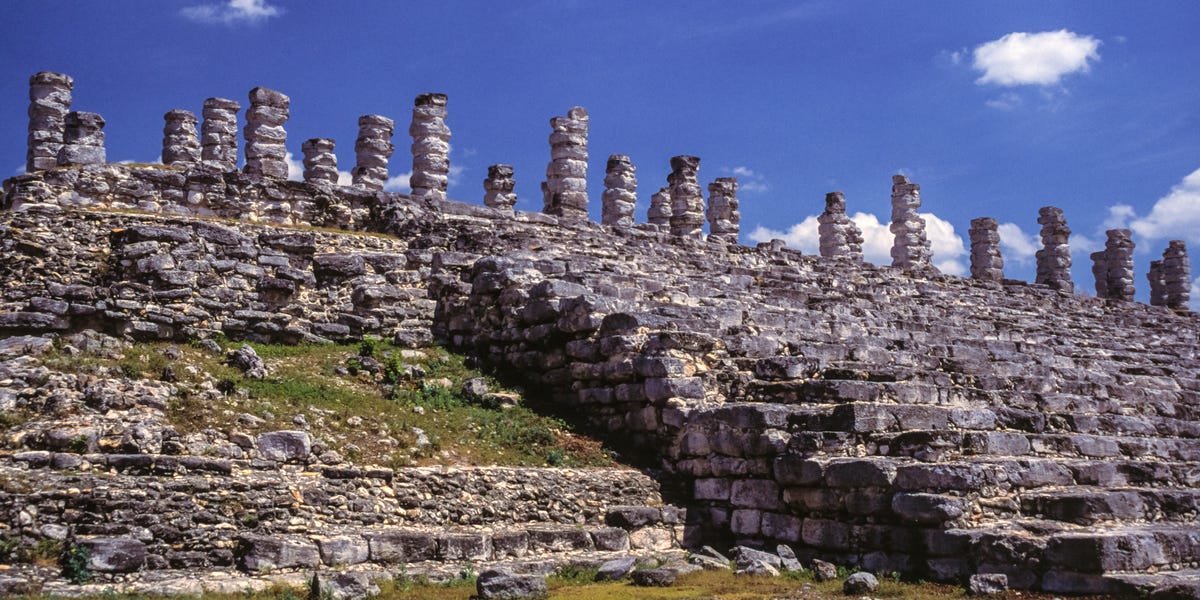
3 min readEven when the stone temples and impressive pyramids of Maya culture started to crumble into ruin at the end of the Classic Period, the people didn’t leave. Instead, it seems, the local population created homes among the decaying structures, at least until they were forced to leave by Europeans. That revelation comes from a new study focused on Ake, an ancestral Maya city in present-day Yucatan, Mexico.Archaeological research published in Latin American Antiquity by University of Virginia anthropologist Roberto Rosado-Ramirez shows that Ake fell from power, but its people refused to abandon it.While many thriving Maya cities in the northern Yucatan Peninsula fell into ruin at the end of the Classic Period, sometime between 300 to 900 C.E., that wasn’t the end of their story. “On the contrary,” Rosado-Ramirez wrote in the study, “the transformation of monumental Maya architecture to heaps of rubble fostered new relations among humans, matter, and other-than-human entities in ancestral places.”By 1000 C.E., shifting political power had left Ake’s monumental stone buildings neglected and falling into ruin. Gravity, erosion, humidity, and vegetation growth furthered the decay. The ruins soon drew new occupants, both wildlife and people searching for homes in the wake of political collapse. As Rosado-Ramirez wrote, the new discovery challenges a “modern, Western understanding of ancestral Maya ruins as abandoned spaces, devoid of vibrancy and liveliness.”Inside the walled city center, the new community built homes of poles and thatch, each no larger than 500 square feet. Today, 96 small mounds mark where they stood. Even the blocks from the once-impressive stone structures were reused as foundations for this new neighborhood. The artifact record shows no gaps until around 1550, further highlighting that for roughly 450 years—from 1100 to 1550 C.E.—a thriving society lived within the crumbling stone site.“The ruins of Ake, as well as those of many other ancestral cities in northern Yucatan, were vibrant because they had the power to congregate life and matter, and to territorialize community in the Postclassic era,” Rosado-Ramirez wrote.At its height, Ake featured a paved plaza ringed by seven stone buildings. A 42-foot-wide road linked the city to the regional center of Izamal, about 20 miles away. But between 1000 and 1100 C.E., political turmoil and drought struck the region, and upkeep of the site declined. Yet even as its inhabitants changed, Ake was never entirely abandoned.Excavations among the fallen stones and house mounds uncovered pottery bowls, animal bones, grinding stones, and spindle whorls, all dating from 1100 to 1550 C.E. Digging beneath the collapsed rubble revealed more artifacts from the same 450-year span, along with burials and signs of religious practice, such as incense burning.According to Rosado-Ramirez, people lived at Ake into the late 1500s. The site’s last known mention is in an official letter from 1567, and it never appears in historical records again. Based on that silence, Rosado-Ramirez suggests that Spanish authorities forcibly removed the residents and moved them to another town.Today, Ake is home to about 350 people. A playing field runs alongside the ancient walls, and a Catholic church stands on top of the old Maya pyramid. Life still goes on within the city’s borders, as it nearly always has.Tim Newcomb is a journalist based in the Pacific Northwest. He covers stadiums, sneakers, gear, infrastructure, and more for a variety of publications, including Popular Mechanics. His favorite interviews have included sit-downs with Roger Federer in Switzerland, Kobe Bryant in Los Angeles, and Tinker Hatfield in Portland.
Experts Thought This Ancient City Was Abandoned. But Life Still Flourished in Its Rubble for Centuries.
Full Article
Original Source
Read the full article at Popularmechanics →KhanList aggregates and links to publicly available news content. We do not host full articles from third-party sources. Always verify important information with original sources.