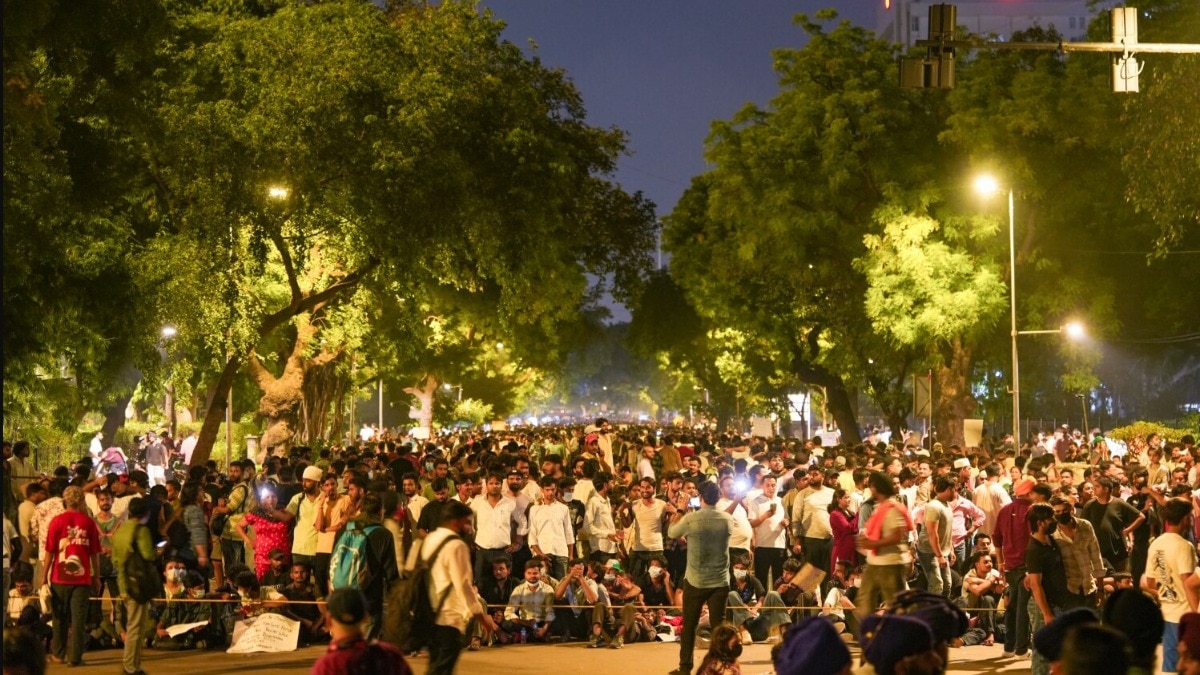
Delhi Police has identified nearly 2,900 people with criminal records who were present during the anti-NEET paper leak protests held at Jantar Mantar in New Delhi last week, but the disclosure has also raised a key legal question: can a person be treated as criminal merely because facial recognition technology matched their face with police database?According to a document tabled in Parliament, facial recognition system (FRS) vans deployed during the protest identified 2,873 individuals with criminal antecedents in real time.Of these, 2,402 were matched through the Crime-Kundli database and another 471 through Dossier records.The protests, organised by student groups demanding action over the alleged NEET paper leak, were held between July 20 and July 25. The document categorised the identified individuals according to offences recorded against them. It said 101 were linked to murder cases, 62 to attempt to murder, and 284 to dacoity and robbery cases.It also listed 61 people connected to rape cases, six linked to offences under the Protection of Children from Sexual Offences (POCSO) Act, 25 in molestation cases, 229 under the Arms Act, 135 in snatching cases, 19 in kidnapping cases and 67 in narcotics-related cases. The largest category comprised 1,884 individuals booked under various provisions of the Indian Penal Code, the Bharatiya Nyaya Sanhita and other special laws.However, the document does not state that these people committed violence during the protest. It also does not specify whether the facial recognition matches led to arrests, preventive action or further investigation.Delhi Police has not publicly claimed that all the identified individuals were involved in disorder at Jantar Mantar.Officials have indicated that any such involvement would have to be examined separately during investigation.The distinction is significant because criminal records and pending criminal cases are not the same as a conviction. Under Indian law, a person is presumed innocent until proven guilty by a court.The disclosure has also prompted wider questions about the use of facial recognition technology at public gatherings and the possibility of creating a narrative around a protest based solely on the background of some participants.LEGISLATORS WITH CRIMINAL RECORDAdding to the debate is the fact that elected representatives themselves include a substantial number facing criminal cases.According to the Association for Democratic Reforms (ADR), 251 Lok Sabha MPs and 73 Rajya Sabha MPs have declared criminal cases against themselves, including several facing serious charges. These cases too remain allegations unless courts establish guilt.Meanwhile, the Delhi government has decided to close cases registered against participants in the student protests, except for individuals with criminal antecedents.In an order issued on July 30, the government said no adverse action would be taken against protesters who participated in the agitation, while verification of persons with criminal backgrounds would continue in accordance with Supreme Court directions. Delhi Police had registered 13 cases related to the protests till July 29.Similar decisions to withdraw or review cases against NEET protest participants have also been announced in Bihar, Assam and West Bengal.For now, the central issue remains unresolved: identifying faces in a crowd is not the same as proving participation in a crime, and any determination of criminal liability will ultimately depend on evidence gathered during investigation and tested in court.- EndsPublished On: Jul 30, 2026 23:58 IST
2,900 criminals at Jantar Mantar, say cops. But did they commit crimes during stir?
Full Article
Original Source
Read the full article at Indiatoday →KhanList aggregates and links to publicly available news content. We do not host full articles from third-party sources. Always verify important information with original sources.