
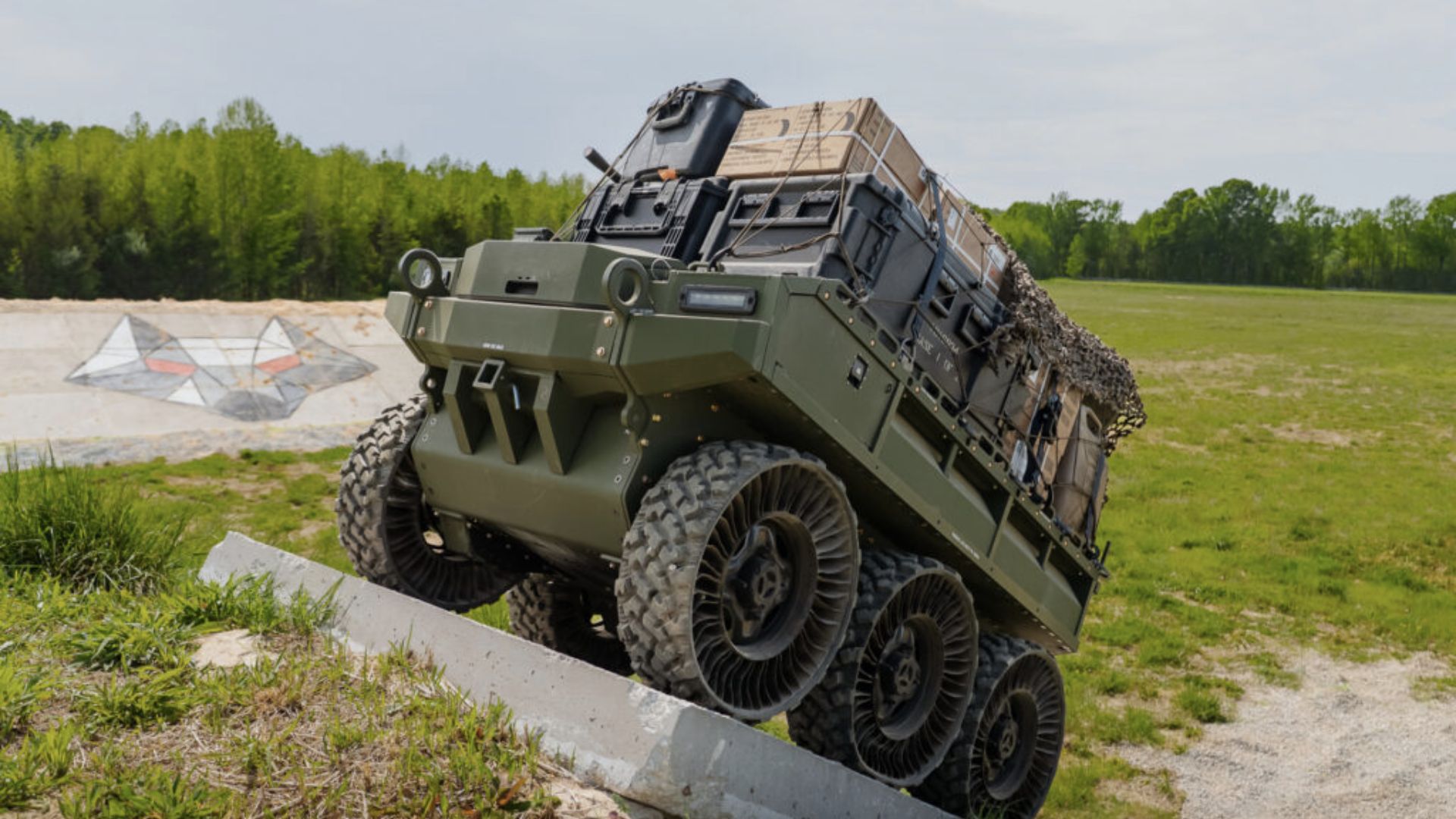
A new type of unmanned ground vehicle with higher payload capacity is set to showcase its battlefield power. The Hunter WOLF multi-mission unmanned ground vehicle has been selected to advance to Phase II of the GroundBreaker 1 unmanned ground vehicle demonstration. The Hunter WOLF is a multi-mission unmanned ground vehicle engineered to reduce soldier workload, extend operational reach and keep personnel farther from dangerous tasks. Its adaptable architecture supports missions including tactical logistics, intelligence, surveillance and reconnaissance, casualty evacuation, communications support and other mission-critical applications. Mature, and mission-ready platform “Hunter WOLF was built for exactly this kind of challenge,” said Tom Van Doren, President, Robotics Sector at BLADE. “This is a mature, mission-ready platform that has been tested alongside warfighters in demanding environments. GroundBreaker 1 gives us the opportunity to demonstrate why the Hunter WOLF is ready to support the warfighter now.”GroundBreaker 1 is designed to evaluate unmanned ground vehicle technologies for potential employment across tactical and non-tactical missions. During Phase II, Government evaluators will assess technology maturity, operational readiness and cross-domain interoperability.BLADE announced that HDT Robotics, LLC, doing business as BLADE, has been selected to advance to Phase II of the GroundBreaker 1 unmanned ground vehicle demonstration with its Hunter WOLF multi-mission unmanned ground vehicle. Hunter WOLF combines high payload capacity, off-road mobility Designed for complex and austere environments, Hunter WOLF combines high payload capacity, off-road mobility, onboard power, autonomous and remote-control capabilities. The system has been evaluated through military exercises and training events and has supported operational use in Ukraine, providing BLADE with real-world insight into evolving unmanned ground requirements, according to a press release.The GroundBreaker 1 selection comes as the Department of War places increasing emphasis on rapidly fielding autonomous and robotic systems capable of operating alongside warfighters. Following Phase II, companies whose demonstrations are successfully evaluated may be invited to Phase III to submit a full proposal for a Prototype Other Transaction Authority award, as per the release. The Hunter WOLF is designed to support a broad range of military missions through an adaptable, multi-mission architecture. Its intended applications include tactical logistics, intelligence, surveillance and reconnaissance (ISR), casualty evacuation (CASEVAC), communications support, and other mission-critical operations. By transporting supplies, supporting reconnaissance activities, and assisting with casualty evacuation, unmanned ground vehicles can potentially reduce soldiers’ physical workload while extending their operational reach. Their ability to perform selected tasks remotely may also help keep personnel farther away from dangerous situations. BLADE’s selection for Phase II highlights the continuing development of unmanned ground systems designed to support military operations in demanding environments. With its multi-mission configuration and experience in military exercises and operational settings, Hunter WOLF will now face a further assessment of its capabilities at Camp Grafton. Get the latest in engineering, tech, space & science - delivered daily to your inbox.Prabhat, an alumnus of the Indian Institute of Mass Communication, is a tech and defense journalist. While he enjoys writing on modern weapons and emerging tech, he has also reported on global politics and business. He has been previously associated with well-known media houses, including the International Business Times (Singapore Edition) and ANI.
2,800-lb unmanned vehicle with higher payload, weapon firing system to showcase battle power
Full Article
Original Source
Read the full article at Interestingengineering →KhanList aggregates and links to publicly available news content. We do not host full articles from third-party sources. Always verify important information with original sources.