
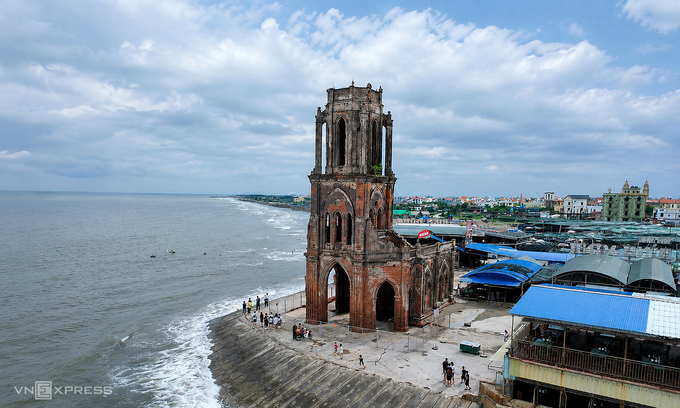
An abandoned church by Hai Ly Beach in the northern Vietnam's Ninh Binh Province, whose bell tower now stands next to the sea, has been recognized as a "climate change heritage tourism site." The century-old structure, which stands outside the current sea dike, is the Church of the Sacred Heart, which is associated with the birth and development of the former fishing village of Xuong Dien, now part of Hai Tien Commune.It is known more commonly as Hai Ly church.Xuong Dien was a coastal settlement in the late 17th and early 18th centuries. As people came to settle in the area, they built dikes and reclaimed land from the sea for agriculture and protecting their homes.In 1885, the Ngo Ham Dike was built to a length of nearly 12 km, helping protect the reclaimed land.But the place has been constantly affected by storms, waves, and coastal erosion. In 1925, the dike in Hai Ly Beach was breached for three kilometers. In 1990, around 1.5 km was destroyed and a new one had to be built 150 m inland.By 2005, a 700 m section of the coastline in Xuong Dien was eroded.Over the last century or so, the sea has swallowed almost a kilometer of coastal land in the area.The Xuong Dien shoreline has retreated inland due to the combined effects of waves, currents, winds, and storms, with climate change being a contributing factor. The bell tower of the abandoned Hai Ly Church in Ninh Binh Province. Photo by VnExpress/Le Hoang Managing tourism siteNow, authorities in Hai Tien Commune have been tasked with developing and managing the tourism site.Associate Professor and Doctor of Science Vu Cao Minh, former deputy director of the Institute of Geological Sciences at the Vietnam Academy of Science and Technology, said the current location of the bell tower provides visible evidence of changes in the shoreline and the process by which people reclaimed and protected coastal land."The fact that a structure built about 100 years ago now stands on the beach, outside the dike, provides valuable material for studying the history of shoreline changes. It also shows how people have had to continuously reinforce dikes and protect land and production from the forces of nature."He said the church is not just a relic but also important for its connection with the shoreline, dike, and history of human settlement.He called it "a special type of heritage in Vietnam and rare in the world."Internationally, structures affected by erosion, rising sea levels, and natural disasters are preserved for research, community education, and tourism.In the U.K., for instance, the twin towers of the St Mary's Church in Kent have been preserved as a navigation landmark, and the surrounding ruins illustrate the effects of centuries of coastal erosion. Visitors gather at Hai Ly Church in Ninh Binh Province, August 2026. Photo by VnExpress/Le Hoang Minh said these models show that disaster heritage can become a valuable visual record if it is preserved, documented and appropriately developed."The value of a heritage site is not simply about preserving a structure, but about helping people understand why the structure is there, how the shoreline has changed and how people have responded. When this is achieved, the site can provide scientific, educational, and tourism benefits."The area around the Hai Ly church includes Thinh Long Beach with its distinctive culture, cuisine, and fishing life.Recognition as a tourism site will enable its development as a heritage site and the protection of the remaining structure, landscape, and records documenting changes to the shoreline.
100-year-old seaside church is Vietnam's first climate change heritage site
Full Article
Original Source
Read the full article at E →KhanList aggregates and links to publicly available news content. We do not host full articles from third-party sources. Always verify important information with original sources.