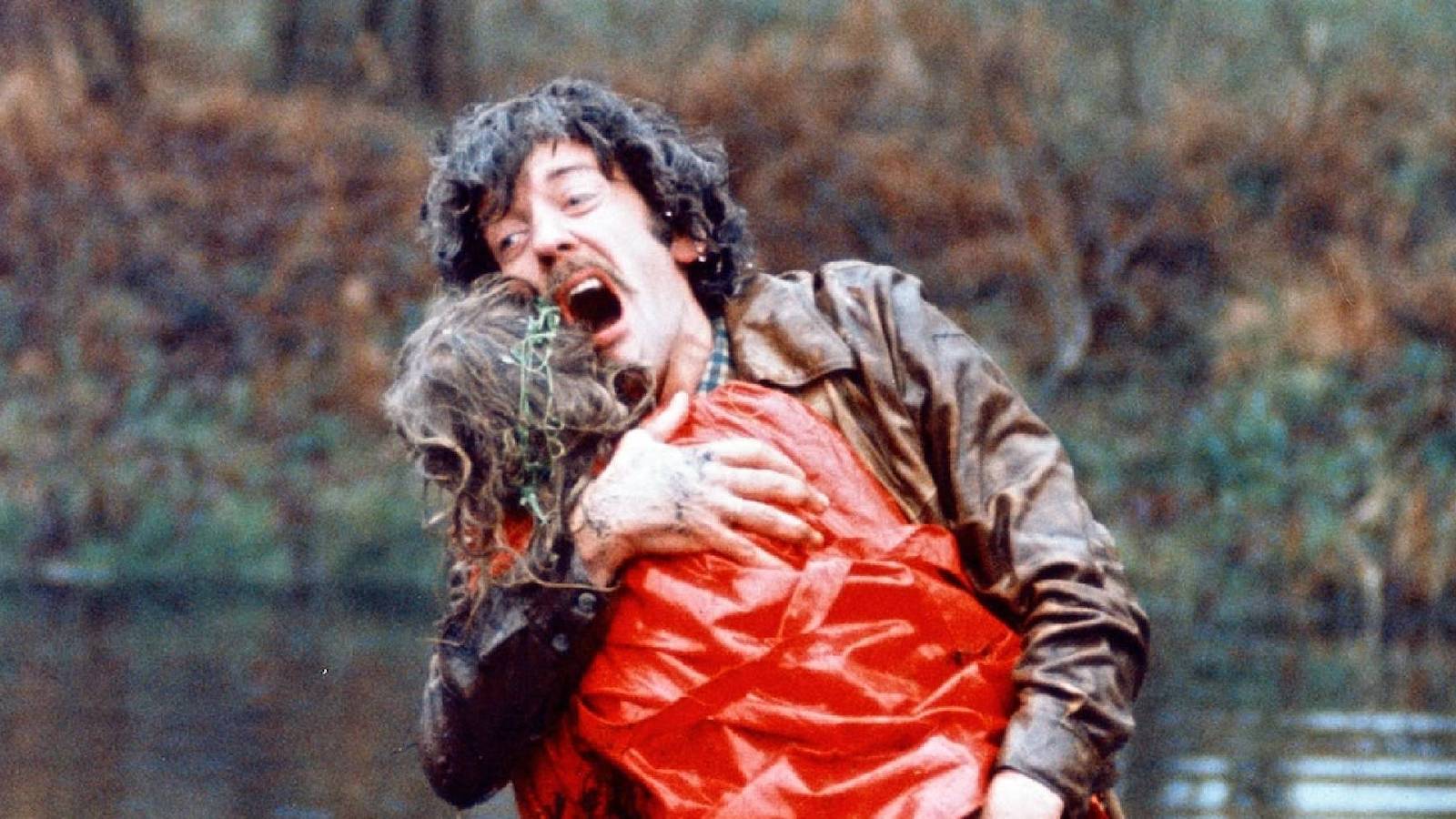
Image via Paramount Pictures Published Jul 25, 2026, 4:04 PM EDT Luc Haasbroek is a writer and videographer from Durban, South Africa. He has been writing professionally about pop culture for eight years. Luc's areas of interest are broad: he's just as passionate about psychology and history as he is about movies and TV. He's especially drawn to the places where these topics overlap. Luc is also an avid producer of video essays and looks forward to expanding his writing career. When not writing, he can be found hiking, playing Dungeons & Dragons, hanging out with his cats, and doing deep dives on whatever topic happens to have captured his interest that week. Sign in to your Collider account This list looks at the thrillers that stick with you long after the credits roll, those with an impact too strong to describe in mere words. Their images, endings, performances, and unsettling ideas continue resurfacing days, weeks, or even years later. They unsettle their viewers on an emotional or even philosophical level, offering much more than just a 2-hour entertainment experience. In other words, these movies haunt you. The titles below vary a lot in style, yet all conjure up powerful atmospheres of unease. Common themes among them are grief, obsession, guilt, identity, or humanity's capacity for evil. Often, they freak us out with what they imply as much as with what they show. 10 'The Vanishing' (1988) Image Via Argos Films "The worst thing isn't not knowing. It's finding out." At first, The Vanishing seems like a conventional movie about a disappearance — then it becomes a full-on deep dive into human darkness. Years after his girlfriend (Johanna ter Steege) mysteriously vanishes during a roadside stop, Rex (Gene Bervoets) continues searching obsessively for answers. Eventually, the man responsible (Bernard-Pierre Donnadieu) offers him an opportunity to discover exactly what happened... provided Rex is willing to experience the truth for himself. The movie's power comes almost entirely from psychology rather than violence, borrowing heavily from Hitchcock's well-known playbook. Take Rex's desperate need for certainty, which slowly becomes a destructive obsession. Likewise, the kidnapper is frightening precisely because he appears so ordinary approaching his crimes. It also helps that Donnadieu turns in such a darkly brilliant performance in the part. 9 'Memories of Murder' (2003) Image via CJ Entertainment "We're looking for someone who looks completely ordinary." Memories of Murder transforms a serial killer investigation into a statement on the limits of justice. Based on South Korea's first confirmed serial murder case, the movie follows local detective Park Doo-man (Song Kang-ho) and Seoul investigator Seo Tae-yoon (Kim Sang-kyung) as they struggle to identify a murderer whose crimes repeatedly expose the inadequacies of both police methods and human certainty. Bong Joon Ho masterfully balances procedural investigation with dark humor and sharp social commentary. A withering portrait of the police's failure, Memories of Murder is a mystery story that rejects resolution. The detectives (and the audience) gradually become consumed by frustration as every promising lead dissolves into ambiguity, culminating in an extraordinary final scene that lingers on the mind. 8 'Frailty' (2001) Image via 20th Century Studios "Sometimes evil wears an ordinary face." Frailty is one of the most underrated psychological thrillers of the 2000s. In it, a man (Levi Kreis) walks into an FBI office claiming that his recently deceased brother (Matthew McConaughey) was a notorious murderer known as the "God's Hand Killer." Through his account, we learn about their deeply religious father (Bill Paxton, who also directs), who became convinced that God had commanded him to destroy demons hiding in human form. He expected his two young sons to help him carry out that mission. This family dynamic also elevates Frailty way above your average slasher or serial killer horror. There's real conflict here between faith, obedience, and morality, with the viewer continually questioning whether the father is suffering from delusion or confronting something genuinely supernatural. This premise could have collapsed into a melodramatic mess, but committed work from everyone involved makes the movie soar. 7 'Jacob's Ladder' (1990) Image via Tri-Star Pictures "If you're frightened of dying, you'll see devils." Tim Robbins leads this one as Jacob Singer, a Vietnam vet losing his grip on reality. Plagued by terrifying hallucinations, mysterious strangers, fragmented memories, and increasingly impossible events, Jacob desperately searches for an explanation while questioning whether anyone around him can truly be trusted. Every move seems to drag him deeper into his psychological nightmare. Rather than relying on gore or violence, the movie unnerves you with psychological horror. The aesthetics are creepily creative, too, all twisted faces, unsettling movements, and dreamlike transitions. This imagery has inspired countless psychological thrillers and horror movies in the decades since, to the point that Jacob's Ladder has been cited as an influence on everything from Silent Hill to Oppenheimer. The remake sucks, but the original is a cult classic for a reason. 6 'Se7en' (1995) Image via New Line Cinema "What's in the box?" Se7en is a dark moral statement disguised as a procedural. Here, detectives William Somerset (Morgan Freeman) and David Mills (Brad Pitt) investigate a serial killer (Kevin Spacey) staging murders inspired by the seven deadly sins. These crimes turn out to be components of an elaborate philosophical design that threatens to ensnare the detectives themselves. The movie's worldview is unrelentingly bleak, with even the most optimistic character, Somerset, unable to call the world a good place. David Fincher amplifies this philosophy through grungy cinematography, depicting a city defined by endless rain and looming, decaying buildings that make for one of the most oppressive environments in film. It all lends itself to a lot of analysis, with fans viewing Se7en as a comment on everything from religion and apathy to art, celebrity culture, and modern masculinity. 5 'Vertigo' (1958) Image via Paramount Pictures "Only one is a wanderer; two together are always going somewhere." Considered by many to be Hitchcock's masterpiece, Vertigo starts out as a detective mystery but ends as a study of obsession. Former police detective Scottie Ferguson (Jimmy Stewart) is hired to follow the wife (Kim Novak) of an old acquaintance, believing she may be possessed by the spirit of a long-dead ancestor. Scottie becomes increasingly consumed by the enigmatic Madeleine, and his fragile mental state begins unraveling in tandem. From here, the movie blurs the line between romantic longing and psychological horror. Scottie's inability to distinguish love from obsession drives every decision he makes, and the story grows increasingly disturbing as we recognize the depth of his fixation. Not for nothing, Vertigo is widely considered a foundational entry in cinema, topping the prestigious Sight & Sound list in 2012 and appearing on multiple AFI lists. 4 'The Devil's Backbone' (2001) Image via Sony Pictures Classics "What is a ghost?" One of Guillermo del Toro's earliest projects, and one of his best, too. Set during the final years of the Spanish Civil War, The Devil's Backbone follows young Carlos (Fernando Tielve) after he arrives at an isolated orphanage where unexplained events suggest the restless spirit of a murdered child still wanders the grounds. The orphanage is practically a character in its own right, replete with abandoned corridors, hidden secrets, and an unexploded bomb lodged in the courtyard. Drawing on inspirations like The Haunting of Hill House, del Toro treats ghosts not simply as frightening apparitions but as manifestations of grief and unresolved history. The horror and supernatural elements are inseparable from the characters' trauma, predating "elevated horror" by decades. Not to mention, and as per usual with del Toro, the most evil forces here are living people. The themes are rich, tinged with sadness and tenderness, making it a lot more interesting than most ghost stories. 3 'Eyes Without a Face' (1960) Image via Lux Compagnie Cinématographique de France "I only wanted to give her a face." After his daughter Christiane (Édith Scob) is horribly disfigured in a car accident, brilliant surgeon Dr. Génessier (Pierre Brasseur) becomes obsessed with restoring her beauty. His experiments grow more and more horrific, and he eventually commits crimes in pursuit of a breakthrough. Dr. Génessier genuinely believes he is doing all this out of love, making his moral descent all the more disturbing. Paying homage to German Expressionism, director Georges Franju creates horror through atmosphere, melancholy, and visual poetry. Infamously, Christiane's expressionless white mask has become one of cinema's most unforgettable images, a symbol of sadness, unease, and, ultimately, the absence of will. All in all, Eyes without a Face is an intelligent and incredibly unsettling horror that went on to be deeply influential. Michael Myers' mask in Halloween, for example, draws on Christiane's mask, while Pedro Almodóvar's film The Skin I Live In clearly borrows from its plot and themes. 2 'Don't Look Now' (1973) Image via Paramount Pictures "Nothing is what it first appears to be." In Don't Look Now, married couple John (Donald Sutherland) and Laura Baxter (Julie Christie) travel to Venice after the death of their young daughter, hoping that work and distance will help them recover from their grief. Instead, mysterious encounters, unsettling coincidences, and disturbing premonitions gradually convince Laura that their daughter may somehow still be reaching out to them. Every scene feels charged with hidden meaning, encouraging viewers to search constantly for connections that only fully emerge in retrospect. Director Nicolas Roeg (originally an editor) constructs the film through fragmented editing and recurring images that subtly blur past, present, and future. This approach was groundbreaking at the time and paved the way for many thriller classics that would follow. The Venice setting also becomes central to the atmosphere, with the city's labyrinthine canals, narrow alleyways, decaying architecture, and perpetual mist helping sell the dreamlike mood. 1 'Rebecca' (1940) Image via United Artists "Last night I dreamt I went to Manderley again." Hitchcock strikes again. Rebecca centers on a shy young woman (Joan Fontaine) who marries the wealthy widower Maxim de Winter (Laurence Olivier) and moves into his magnificent estate, Manderley. However, instead of domestic bliss, the protagonist finds herself living under the overwhelming shadow of Maxim's glamorous first wife, Rebecca. Although Rebecca is dead before the story begins, her influence seems to permeate every room. Hitchcock spins this intriguing premise into a delectable psychological drama. It's a dark story by way of surprising humor and endless visual inventiveness. The movie conjures up a deeply Gothic vibe the whole way through, and Fontaine's vulnerable performance is the perfect counterpart. That said, the best performance in Rebecca belongs to Judith Anderson as Mrs. Danvers, Manderley's housekeeper, a whisperer of poisonous words and a walking embodiment of obsession and devotion. Rebecca Release Date March 23, 1940 Cast Laurence Olivier, Joan Fontaine, George Sanders, Judith Anderson, Nigel Bruce, Reginald Denny, C. Aubrey Smith, Gladys Cooper Runtime 121 minutes Director Alfred Hitchcock Writers Daphne Du Maurier, Robert E. Sherwood, Joan Harrison, Philip MacDonald, Michael Hogan
10 Most Haunting Thrillers of All Time
Full Article
Original Source
Read the full article at Collider →KhanList aggregates and links to publicly available news content. We do not host full articles from third-party sources. Always verify important information with original sources.