
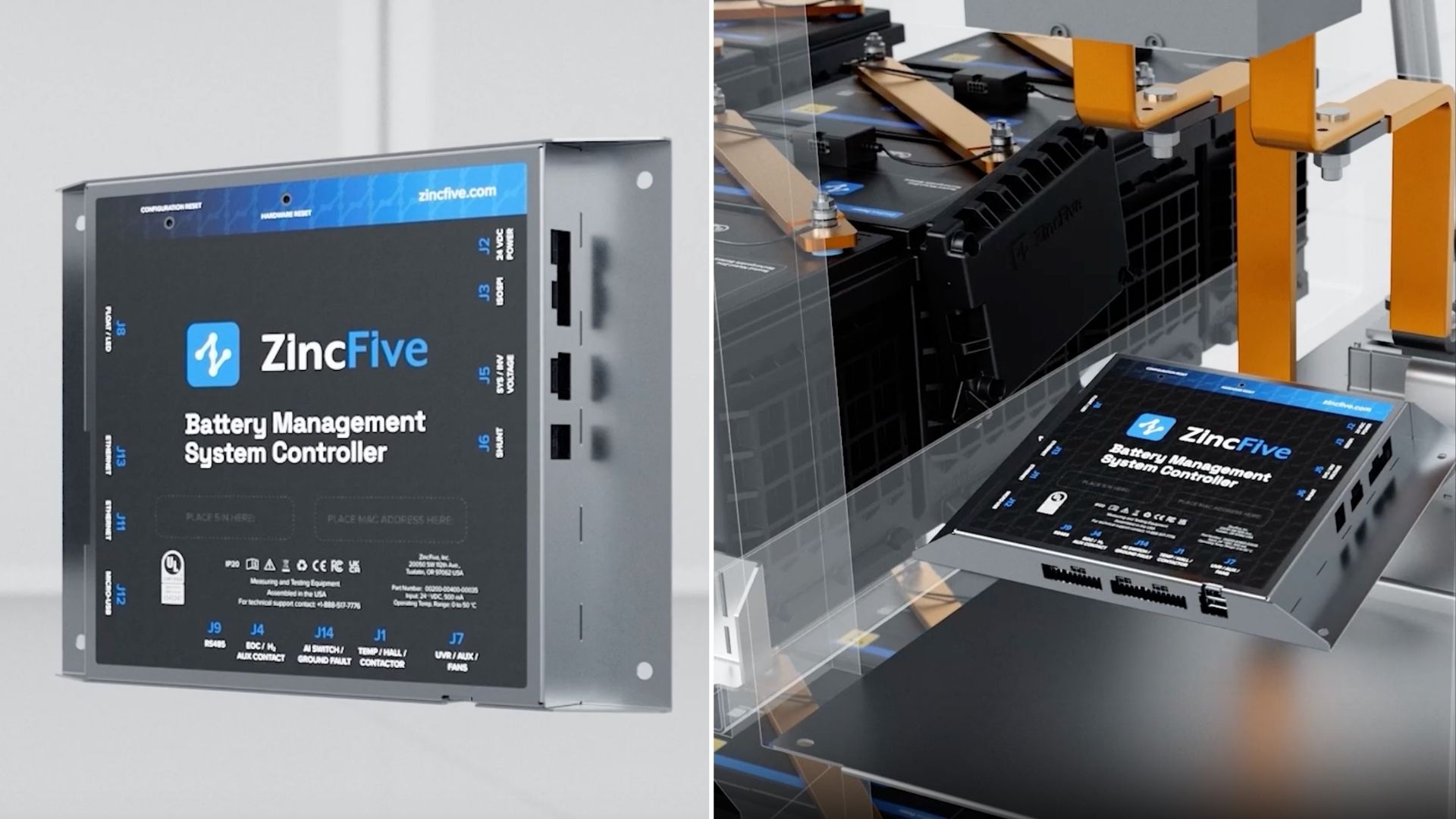
ZincFive has launched a new battery management system (BMS) designed specifically for its nickel-zinc (NiZn) batteries, as data centers face increasingly demanding power requirements from artificial intelligence workloads. The company says the new ZincFive BMS is designed and assembled in the US and will ship as standard with its BC Series UPS Battery Cabinets. It serves as the main interface through which data center operators, UPS OEM partners, and system integrators can monitor and manage the battery systems. Unlike battery management platforms adapted from lithium-ion or lead-acid systems, ZincFive says it built its BMS around the characteristics of its nickel-zinc chemistry, drawing on years of deployment experience in data center environments. A simpler two-tier architecture The new system uses a two-tier hardware architecture consisting of the ZincFive Controller and ZincFive Tray Monitor. The Tray Monitor measures individual battery voltage and temperature using the isoSPI protocol, while the cabinets connect through dual Ethernet ports. According to ZincFive, this eliminates the need for third-party unmanaged network switches and an additional data aggregation layer. The company says the approach reduces cabinet wiring, installation time, infrastructure complexity, and hardware costs while providing high-resolution telemetry throughout the battery cabinet. The BMS can also integrate with a data center’s building management system, providing operators with information including state of charge, voltage, time-series data, alarms, and alerts. For multi-site deployments, the redesigned interface provides fleet-wide visibility and a user and permissions hierarchy. Operators can also remotely configure systems and deploy firmware updates. Built for AI-driven power fluctuations One of the more notable features is AI pulse intelligence, which is enabled through the ZincFive BMS in the company’s BC 2 AI UPS Battery Cabinets. ZincFive says the feature allows the system to respond to the high-frequency power pulses associated with AI training and inference workloads. AI data centers are creating new challenges for power infrastructure as increasingly dense computing systems place greater demands on UPS and backup-power equipment. Rather than simply providing stored energy during a prolonged outage, these systems must also manage rapid changes in electrical demand. The company says its BMS is designed to provide the monitoring and control needed for those changing power profiles. Cybersecurity built into battery management ZincFive has also emphasized cybersecurity as part of the new BMS architecture. The system incorporates encryption, authentication, hardened communications, and access controls, which the company says are intended to help meet increasingly stringent operational technology security requirements. Because the hardware, software, and firmware are all developed by ZincFive, the company says it can manage upgrades and customer-requested improvements without relying on third-party vendors. The BMS is also assembled in the US, with the company saying that its hardware, software, and firmware are developed entirely at its US headquarters. ZincFive CEO Tod Higinbotham said the platform reflects the company’s experience deploying nickel-zinc batteries at scale and gives it greater control over how the system develops alongside customer requirements. ZincFive says it has delivered or contracted more than 2 gigawatts of nickel-zinc power globally. The new BMS will be included with its BC Series UPS Battery Cabinets, extending the company’s existing NiZn battery platform with a management system specifically designed around the chemistry. The company positions nickel-zinc as a safer and more sustainable alternative for mission-critical immediate-power applications, although the new announcement primarily focuses on the BMS architecture, monitoring, cybersecurity, and AI-related power management rather than providing comparative performance figures against competing battery chemistries. Get the latest in engineering, tech, space & science - delivered daily to your inbox.Kaif Shaikh is a journalist and writer passionate about turning complex information into clear, impactful stories. His writing covers technology, sustainability, geopolitics, and occasionally fiction. A graduate in Journalism and Mass Communication, his work has appeared in the Times of India and beyond. After a near-fatal experience, Kaif began seeing both stories and silences differently. Outside work, he juggles far too many projects and passions, but always makes time to read, reflect, and hold onto the thread of wonder.
ZincFive builds new battery management system around nickel-zinc chemistry
Full Article
Original Source
Read the full article at Interestingengineering →KhanList aggregates and links to publicly available news content. We do not host full articles from third-party sources. Always verify important information with original sources.