
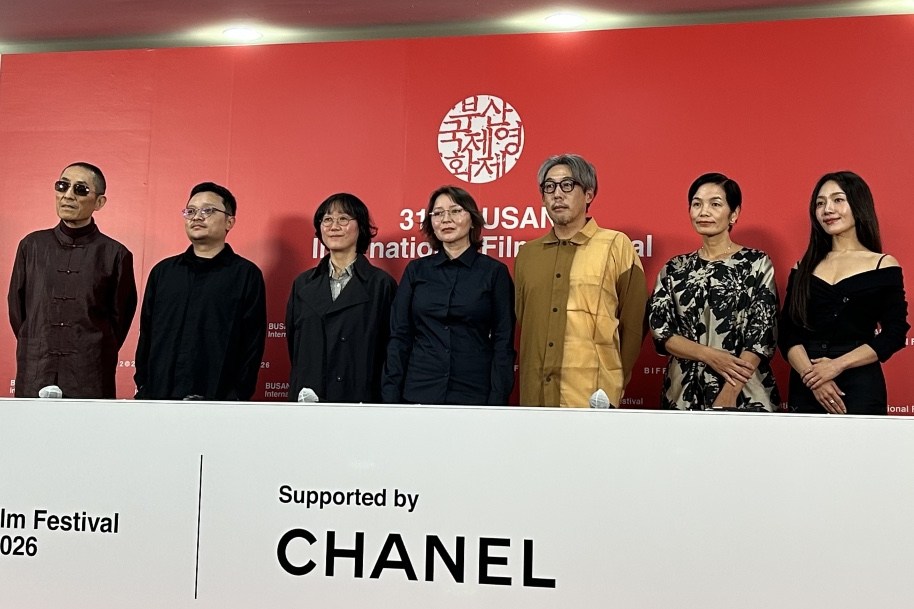
Chinese filmmaker Zhang Yimou, who is serving as president of Busan International Film Festival’s competition jury, offered some details of his upcoming adaptation of sci-fi epic The Three-Body Problem at the festival’s opening ceremony on Tuesday night. First announced at Shanghai film festival in 2024, there hasn’t been much news about the project recently, but Zhang explained that it’s moving steadily ahead: “The Three-Body Problem is a great work of science fiction, but it’s hard to photograph, so we spent several years polishing the script,” he said on stage at Busan Cinema Center. He added that his team has collected around 400,000 online comments from fans of the novel about their hopes for the film: “In this era of AI, with its democratization of images, audience expectation is extremely high so we hope to live up their expectations and make a good movie.” Watch on Deadline One of China’s most acclaimed works of science fiction, Liu Cixin’s The Three-Body Problem is the first book in a trilogy that begins with a scientist who discovers that an alien civilization is planning to take over Earth as their own planet is too unstable. It has already been adapted by Netflix as an English-language series and has had two Chinese-language adaptations – a live-action series produced by Tencent and an animated series from Bilibili. The property has had a colourful history with one Chinese-language feature adaptation left unfinished and an executive involved in handling the rights murdered by a colleague in 2020. Zhang’s version is being produced by Beijing Enlight Media, the studio behind blockbuster animation Nezha 2, and is understood to involve a significant AI component. One of China’s most acclaimed directors, with a career stretching back to the Fifth Generation, Zhang continues to make hit films in China today, most recently with spy thriller Scare Out over Lunar New Year. The day after the BIFF opening, Zhang gave a typically diplomatic answer at the jury press conference when asked about the controversy that has erupted in Korea over Hur Jin-ho’s political thriller The Assassin(s). The film, which premiered at Toronto International Film Festival, revolves around the attempted assassination of South Korean President Park Chung-hee in 1974, which resulted in the death of the First Lady. Right-wing groups have attacked the film for lack of historical accuracy, with the issue even being debated in Korea’s National Assembly, forcing the film to cancel its planned promotional activities at BIFF due to security risks. When asked about the relationship between historical accuracy and freedom of speech, Zhang replied: “Creation is creation and sometimes what we create is not historical fact. We may ask ourselves, should this be based on our lives? But often we need to go beyond our lives to make a good film.” He continued: “I haven’t seen the film in question, but we have to respect the creators – history is distant from us, but we can use it to tell stories to audiences living in current times, so in some ways it’s a form of art. What the audience feels or thinks after watching the film is up to them – everyone has different opinions – and this is the charm or beauty of the film.” Korean filmmaker and jury member July Jung (Dora) added: “I feel discouraged by this situation as a filmmaker. Due to the way this film depicts certain people, it means that some people could be damaged or hurt by his film. On the other hand, as filmmakers we need to accept that some people will criticize our work and take full responsibility for the worlds we create.” The BIFF jury also debated the impact of the festival’s competition section, now in its second year, which this year has a selection of 13 films, with the jury handing out six prizes. Under new Academy rules, the winner of the festival’s Best Film Award will automatically qualify for submission to the Best International Feature category of the Oscars. Chinese director Bi Gan (Resurrection) said: “Busan was already a strong festival without the competition, but it’s now a core component of the festival for filmmakers in China, Japan and Korea because it creates a new trend. It’s not just about selecting prize winners, but it gives people more reason to discuss the selected films. It’s a good way to open the discourse between people.” Vietnamese producer Tran Thi Bich Ngoc (Skin Of Youth) said: “Busan has always been a crucial place to discover new talent and New Currents [previously the main competition section at BIFF] did a great job in recognizing emerging directors who needed a platform for us to discover their voices. But Asian cinema is growing fast in terms of quality and the number of great films coming from the region. So the festival’s new competition section matches that growth and demand.” BIFF’s seven-person jury also includes Korean actress Moon Choi, who produced and acted in Bedford Park, which is screening at the festival this year; Japanese director Kei Ishikawa (A Pale View Of Hills); and Kazakh actress Samal Yeslyamova (Ayka). The jury will be handing out their awards at the closing ceremony on October 15.
Zhang Yimou Teases ‘Three-Body Problem’ At BIFF Opening; Jury Talks ‘The Assassin(s)’ Controversy & Competition Impact
Full Article
Original Source
Read the full article at Deadline →KhanList aggregates and links to publicly available news content. We do not host full articles from third-party sources. Always verify important information with original sources.