
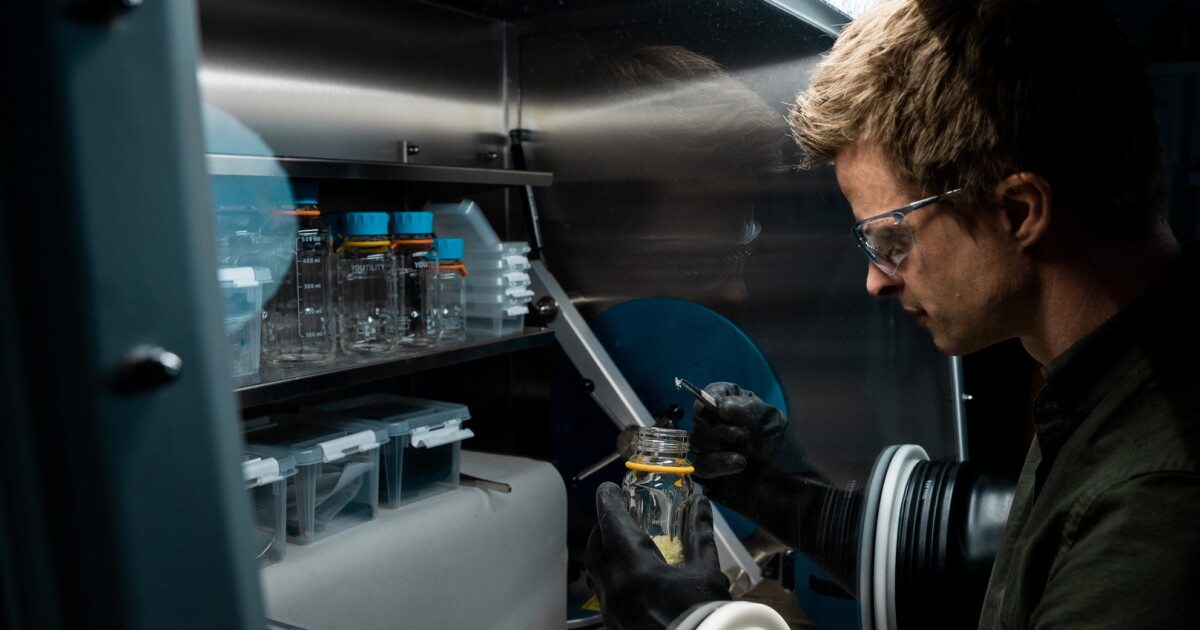
Aluminum has gone from being more valuable than gold in the 1880s to becoming the second-most widely used metal on Earth. Yet, over those 140 years, the basic process of producing it has remained largely unchanged. This wouldn't be much of a problem, except that the chemical process releases CO2 at roughly 1.5 times the weight of the aluminum produced. Researchers at Norwegian firm Hydro, working in collaboration with SINTEF and the Norwegian University of Science and Technology (NTNU), have developed an alternative production process called HalZero that they say could eliminate these emissions entirely. The team recently demonstrated the technology's viability by producing aluminum using the new process for the first time. Norway's Prime Minister Jonas Gahr Støre is handed the first metal made from HalZero electrolysis technology by Hanne Simensen, Executive Vice President of Hydro Aluminum MetalAnders Vindegg / Hydro Aluminum is the second most widely used metal in the world, surpassed only by iron, thanks to its abundance in the Earth's crust and its high strength-to-weight ratio, among other properties. The US Geological Survey (USGS) estimates that in 2025 alone, the world produced about 74 million metric tons of primary aluminum (excluding recycled material) for automotive parts and bodies, beverage packaging, aircraft, construction, electrical equipment, and countless other applications. The problem is that aluminum production is incredibly carbon-intensive.Before we even account for emissions from mining, transportation, electricity generation, and other production activities, the chemistry of extracting aluminum releases about 1.5 kg (3.3 lb) of CO2 for every kilogram (2.2 lb) of metal produced. Hydro's HalZero technology aims to eliminate these direct emissions by fundamentally changing the chemistry involved in producing the metal.To understand the company's process, we first need to look at how aluminum is conventionally produced. Although the metal is abundant in the Earth's crust, it doesn't naturally occur in its pure metallic form. Aluminum is found chemically bonded to other elements in minerals, particularly bauxite ore, which is refined to produce aluminum oxide, also known as alumina.To extract the metal, manufacturers use Hall-Héroult electrolysis, a process first developed in 1886 and still used in practically all primary aluminum production today. The process involves dissolving alumina in a molten electrolyte, typically based on cryolite, at temperatures approaching 1,000 °C (1,832 °F). A powerful electric current is then passed through the mixture using carbon electrodes, triggering a chemical reaction that separates the aluminum from the oxygen to which it is bonded.The aluminum collects in molten form at the bottom of the electrolytic cell, while the liberated oxygen reacts with the carbon anodes to form the problematic CO2, which escapes into the atmosphere. The reaction also gradually consumes the carbon anodes, which must be replaced periodically. Now, this emission source cannot be eliminated by merely powering the entire process with renewable electricity, as the CO2 is an unavoidable product of the reaction itself.One possible solution is to capture the CO2 before it escapes, but that presents another challenge. The exhaust gases from conventional smelters are mixed with large volumes of ventilation air, leaving CO2 at concentrations of around 1%. Separating and capturing such a diluted gas is technically challenging and expensive.Hydro's solution is to change the chemistry of the process entirely. Rather than feeding alumina directly into an electrolytic cell, the HalZero process first converts it into aluminum chloride through a chemical reaction known as chlorination. The resulting aluminum chloride is then subjected to electrolysis, where an electric current separates it into pure aluminum and chlorine gas. A digital control panel is used to monitor the quantities of CO gas and Cl₂ gas that form aluminum chlorideMaria Sotberg/SINTEF As a result, unlike the conventional process, where oxygen reacts with carbon anodes and escapes as CO2, the electrolysis of aluminum chloride produces chlorine gas as its byproduct. “The even-more poisonous gas?” you ask. In a clever chemical move, the chlorine is collected and circulated back into the chlorination process, where it can be reused to produce more aluminum chloride, creating a neat loop.Now, the chlorination stage itself still involves carbon and generates CO2. However, Hydro says it has also developed a way to capture this gas and convert it back into carbon monoxide (CO), which is then reused in the chemical process. Therefore, both chlorine and carbon circulate continuously through the system in separate closed loops. The CO2 to CO conversion process also releases some good ol’ oxygen (O₂).By keeping all the carbon circulating within the system, HalZero could eliminate the direct CO2 emissions associated with both aluminum electrolysis and conventional carbon anode production. The result, at least in principle, is a process that produces aluminum while releasing oxygen instead of CO2.Interestingly, the idea of producing aluminum through aluminum chloride electrolysis isn't entirely new. According to Egil Skybakmoen, a research manager at SINTEF, American aluminum producer Alcoa experimented with a similar process as far back as the 1980s. Hydro has since revisited and further developed the technology, spending the last decade working on its own patented process. The challenge has been turning the chemistry into a practical production system that can operate continuously, recycle its gases, and eventually compete with conventional smelters.Last month, after a decade of work, the Hydro researchers successfully produced aluminum from aluminum chloride using the HalZero electrolysis technology for the first time at the company’s research and test facility in Porsgrunn, Norway, proving that the core electrolysis technology works beyond the laboratory-scale experiments conducted during its development.“This is an important milestone for Hydro and Norway's technology and research communities, and a significant step forward in the development of HalZero,” said Eivind Kallevik, President and CEO of HydroHowever, as is almost always the case, there are some important caveats. First of all, despite its name, HalZero hasn't actually achieved zero-emission aluminum production yet. Hydro acknowledges that the current experimental process still generates CO2, as researchers have yet to integrate and demonstrate all the steps needed to keep carbon circulating in a closed loop. In particular, the process for converting captured CO2 back into reusable CO has yet to be tested. Furthermore, the company hasn't disclosed detailed figures on the quantity of aluminum produced, its purity, or the demonstration's energy consumption.Nevertheless, the preliminary findings appear to be encouraging, especially from an economic standpoint. According to Skybakmoen, studies and tests conducted so far suggest that an industrial-scale HalZero facility could require roughly the same amount of energy and capital investment as a conventional aluminum smelter. If these projections hold up, the technology could potentially eliminate direct process emissions without substantially increasing the cost of producing aluminum. Of course, these claims need to be demonstrated at an industrial scale. HalZero also specifically addresses emissions in the chemical process itself, not the entire aluminum production supply chain, which sits at about 14.8 kg (32.63) pounds of CO2 equivalent per kilogram of aluminum. Technicians developing and testing the technology at SINTEF's Tiller laboratory in Trondheim, NorwayMaria Sotberg/SINTEF As next steps, Hydro plans to develop a much larger industrial concept pilot that will bring all the individual stages of HalZero together into one integrated production system. Unlike the current facility, which tests the various processes separately, the new pilot would enable researchers to investigate how they work together under conditions closer to an actual aluminum smelter. This includes demonstrating continuous aluminum production while recycling chlorine and carbon without releasing CO2.The company has received an additional NOK 82 million (about US$8,725,000) in funding from Enova, a Norwegian state enterprise, to support planning and feasibility studies for the next phase. The proposed pilot would be built in Norway's Grenland region, pending final construction approval. Even if everything goes according to plan, Hydro acknowledges that several more years of testing, development, and piloting will be necessary before HalZero is ready for commercial deployment; an understandable timeline considering that it aims to overthrow a 140-year-old standard.HalZero is part of the company’s ambition to achieve net-zero carbon emissions in aluminum production by 2050. While the technology is primarily being developed for new aluminum production facilities, Hydro hopes it could eventually replace outdated production lines at existing smelters.Sources: Norwegian SciTech News, Hydro
'Zero-emission' aluminum production switches up the chemical equation
Full Article
Original Source
Read the full article at Newatlas →KhanList aggregates and links to publicly available news content. We do not host full articles from third-party sources. Always verify important information with original sources.