
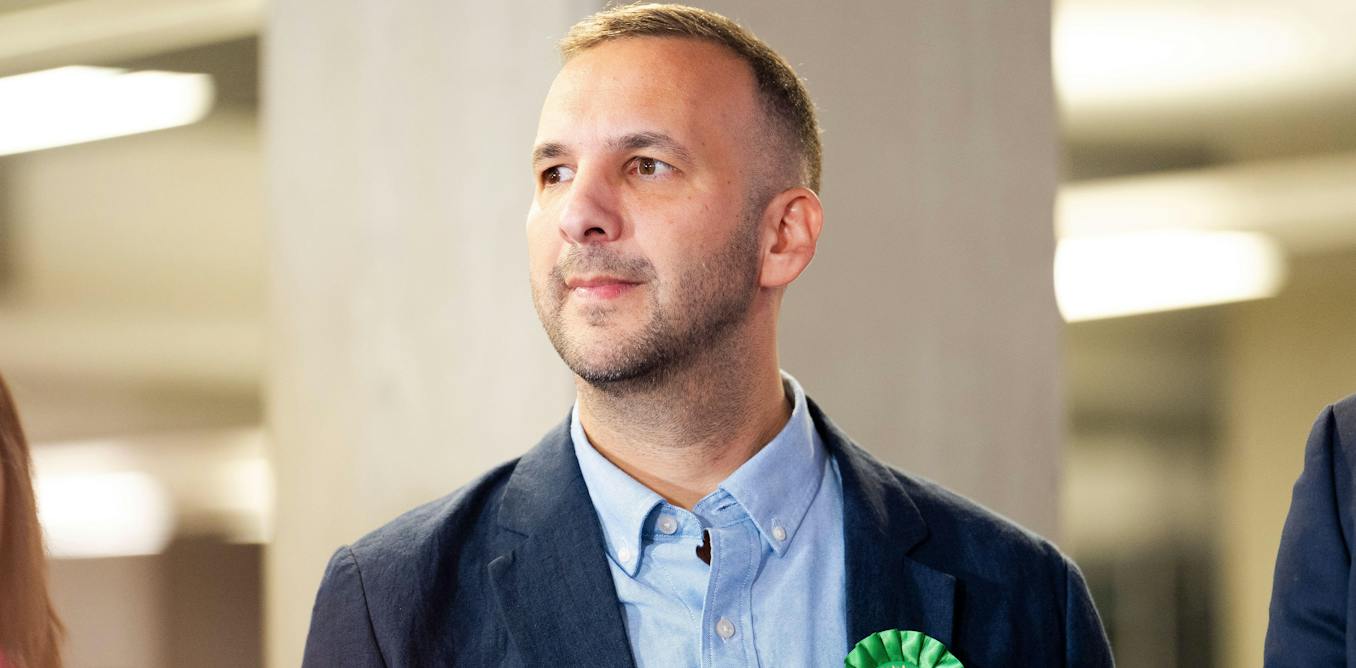
It has been a rollercoaster year for the Green Party of England and Wales. It’s little more than 12 months since the election of the charismatic Zack Polanski as party leader. And months later, the equally charismatic Hannah Spencer became the Greens’ fifth MP. But Polanski couldn’t repeat this win in Keir Starmer’s former constituency of Holborn and St Pancras in London, losing to Labour’s Sagal Abdi-Wali. Back in February, when Spencer won the Greater Manchester seat of Gorton and Denton, it was the party’s first ever Westminster byelection win and the Greens were in the pink. There had been a string of positive opinion polls, and Starmer’s Labour party was in the doldrums. Such was the party’s confidence and momentum that Polanski even voiced his ambition for the Greens to “replace” Labour as the anchor party of the UK centre-left. But now, that optimism has evaporated. The party is in the spotlight – and split along ideological lines – following its conference adoption of a “Zionism is racism” policy motion. Read more: What is Zionism? The different meanings of a contested term The motion, supported by 1,022 conference votes from a party membership of almost a quarter of a million, is important because it makes the Greens the first UK political party to formally adopt a policy defining Zionism as racism. In doing so, it has endorsed a one-state vision for Israel-Palestine. Polanski did not vote but later said that he would not have backed the motion in the form that was passed by conference . The decision unleashed a media backlash, but it was not just media reaction that was hostile. The Israeli government immediately banned Polanski, who is Jewish, from entering Israel and accused the party of antisemitism. These sentiments were echoed by the US and UK governments, some of whose backbenchers have referred the Greens to the UK police. Jewish organisations in the UK and beyond were also angry and dismayed. This was not unexpected. But more worrying for the Greens was the reaction from sister parties and organisations across Europe. Closest to home, the Scottish Greens’ reaction was muted. Co-leader Ross Greer backed the Zionism is racism message, while other MSPs were similarly behind the motion of the party in England and Wales. The party north of the border does not advocate for a single state, however. The view from Europe Across the channel, the reaction of the German Greens was vehement, with co-leader Felix Banaszak describing the motion as “intolerable and unacceptable”. Veteran German Green Jutta Ditfurth was even more robust, stating on X that “we could never have imagined an antisemitic Green party in the UK. I despise Jew-haters. They are preparing pogroms.” And the European Green Party – which represents 47 Green parties across the continent including the Green Party of England and Wales – stated that the party’s position was incompatible with its own. This leaves Polanski’s party in a difficult position in the short run. In theory it runs the risk of being suspended or possibly even expelled from the European Green Party if the German Greens in particular were to pursue the issue through the European Green Party’s governance structures. At the same time, however, Green parties in European countries have historically taken different positions on Israel-Palestine without internal sanction. So the storm may blow over in time. This would be more likely if the Green Party of England and Wales were to moderate, amend or even abandon its controversial position on Zionism. But this seems unlikely, given how much party activists have invested in it. There is certain to be much more debate on the pros and cons of this. But the question remains; beyond the byelection, how will this play with the UK electorate in future? It would be wrong to assume that the Greens’ resolution has been universally condemned, and many on the Corbyn-adjacent left in particular have welcomed the move. The confidence Polanski took from the polls earlier in the year spurred him to try to enter parliament and consolidate his power within the party. But his bid failed and there is no doubt that – rightly or wrongly – much of the blame for will be placed on the party’s position on Zionism. Had Polanski won, despite concerted pushback from the political establishment at home and abroad, British politics would have been ushering in an era of even more polarisation. But as it is, as far as fraternal relations with Europe are concerned, the party appears to be in danger of engineering its very own mini-Brexit. And it has created a situation in which Britain’s Jewish community feels even less safe among its fellow citizens.
Zack Polanski loses his byelection bid – and the Green party’s Zionism motion has outraged its closest allies in Europe
Full Article
Original Source
Read the full article at Theconversation →KhanList aggregates and links to publicly available news content. We do not host full articles from third-party sources. Always verify important information with original sources.