
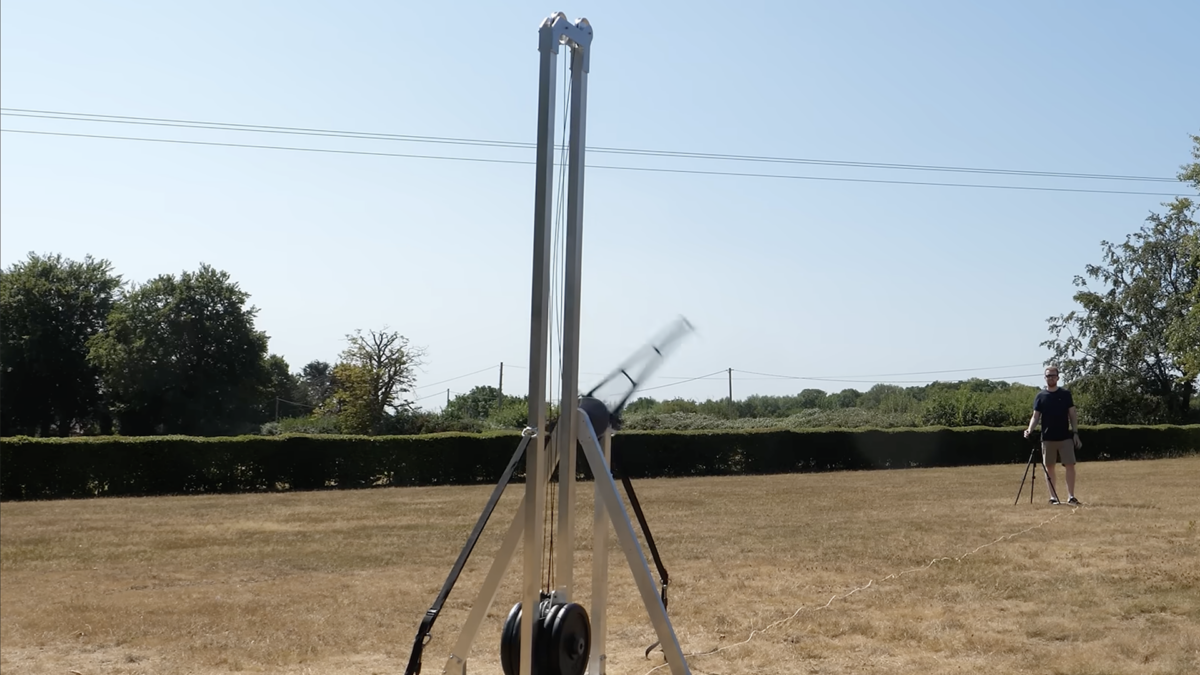
YouTuber Tom Stanton has, by his own telling, been building trebuchets since the age of 12. The adult Stanton is an aerospace engineer, but trebuchets clearly remain his passion—and in the intro to his latest video, he explains that “accelerating a projectile to [the speed of sound in air] using a purely mechanical launcher like a trebuchet has been a dream of mine for several years now.” Come for the big dreams, stay for the fascinating engineering, because for all the exuberant nerdiness of a man in cargo shorts doing an impromptu dance at hearing a sonic boom reverberate across his backyard, there are some genuinely interesting pieces of design and problem solving here. As Stanton explains in his intro, his trebuchet design is based around the use of a counterweight, which is the design you probably think of when you think of a trebuchet. (That’s assuming that you do, in fact, think of trebuchets—but, I mean, you’re reading this article, so…) Anyway, the counterweight trebuchet works by dropping a heavy weight from an elevated position. The weight is attached to one end of an arm that pivots on a fulcrum; at the other end of that arm is a sling in which the projectile is placed. As the weight falls, it pulls its end of the arm down with it. This causes the other end of the arm to rotate skyward, which in turn causes the sling to whip around in an arc and release its projectile toward whatever unfortunate target stands in its path. This is great if you want to hurl heavy projectiles at a stationary fortification, which is of course what trebuchets were designed to do. Stanton’s design, however, has a different objective: to maximize the projectile’s speed. To this effect, he starts with a projectile that weighs a mere six grams (about 0.21 ounces), which he reduces to four grams (about 0.14 ounces) midway through the video. The reason that the projectile is so light is that, as Stanton explains fairly early on, there’s a fundamental limit on the counterweight trebuchet: gravity. The counterweight can only fall so fast, which means it can only provide so much energy to the arm. It can also only fall so far, unless you fancy building a trebuchet that involves dropping a weight from several stories up. The majority of the engineering challenges for Stanton’s design involve working around these limits. His solution is both simple and clever: rather than attaching the weight directly to one end of the arm, he uses a pulley system to link the falling weight and the arm with a rope that wraps around a 3D-printed spool. This effectively acts as something like a gear mechanism: the pulley system he uses means that the rope unspools significantly faster than the weight, and that velocity is transferred to the trebuchet’s arm. To allow the arm to spin at the velocities he needs, he 3D prints it out of lightweight filament, working through several designs until he hits on one that combine aerodynamic efficiency with sufficient strength. He also makes the arm significantly shorter than it would be on a normal trebuchet; most of the length of the lever that imbues the projectile with its speed is provided by the sling, which begins wrapped around the arm’s long axis, releasing with the help of a mechanical trigger when the rope fully unspools. The result is a trebuchet that would be as useful as a lemonade sandwich as a siege weapon, but as a means of using purely mechanical forces to accelerating a small projectile, however, it’s frankly terrifying. The initial test run, using a 10kg (22lb) counterweight, takes 1.3 seconds to accelerate the arm from a stationary position to spinning at 1100rpm. The 6g projectile rockets out of the sling at 328mph, and Stanton is just getting started. First it’s back to the drawing board to redesign the arm, and then more testing, and then several spool iterations. Finally, after 20 minutes worth of YouTube video, six years of design work, and untold hours of testing, thinking and, yes, dreaming: success. Equipped with a 40kg (88lb) weight, and several miles’ worth of reassuringly empty field to fire into, the now-4g projectile from Stanton’s trebuchet does indeed go supersonic. The arm whips around at 2342rpm and the projectile emerges from the sling traveling at 346.6 meters per second, which works out at 776mph—9mph faster than the speed of sound in air. So, there we have it. And there’s something strangely affecting about this whole thing, a real sense of humanity—one that’s perhaps easier to embrace here because this particular trebuchet doesn’t exist for the purposes of war and destruction. I mean, does anyone need a supersonic trebuchet? No. But we humans do many things we don’t need to do; it’s a big part of what makes us who we are. And when we put our minds to it, we can send people to the moon on the basis of calculations done with a slide-rule, or build something as wondrous as the Antikythera mechanism with hand tools and patience, or figure out that the mold growing on a Petri dish might just save untold millions of lives. Or we can build something in the backyard that breaks the sound barrier. Just because.
YouTuber Fulfills Lifelong Dream by Blasting Through the Sound Barrier With a Home-Built Trebuchet
Full Article
Original Source
Read the full article at Gizmodo →KhanList aggregates and links to publicly available news content. We do not host full articles from third-party sources. Always verify important information with original sources.