
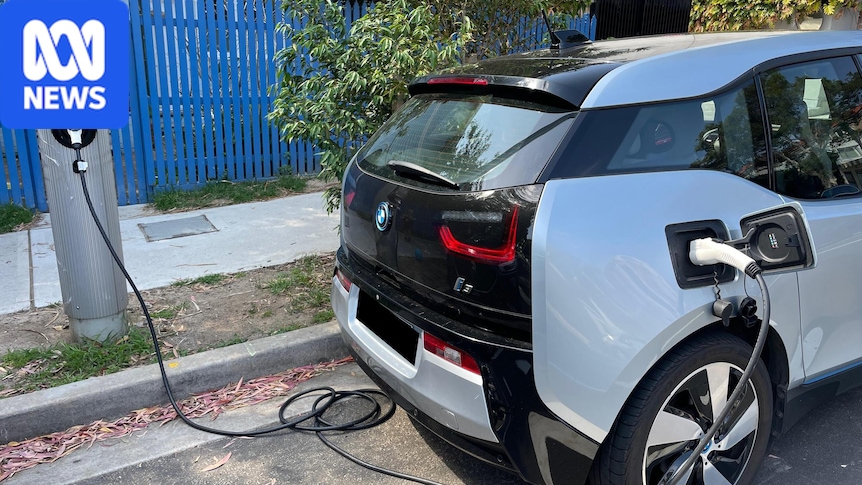
Many electric vehicle (EV) drivers know the frustration of rolling up to a public charger and finding a petrol car parked in the way.Getting "ICEd" by an internal combustion engine (ICE) car means expensive charging infrastructure goes unused and EV drivers waste time finding the next available plug.Now, neighbourly conflict over blocked chargers may be coming to a street near you.From 2027, the federal government's Accelerating EV Charging Program will see about 14,000 EV chargers installed on power poles in high-density areas in cities where residents have limited access to off-street parking.The pole-mounted EV chargers installed under the program will fully charge a typical EV in about eight hours. (Supplied: Ausgrid)Under the program's rules, installers aren't required to negotiate with councils for dedicated EV-only parking.Many in the EV industry expect the vast majority of kerbside chargers will be "undedicated", meaning they won't have EV-only parking.Data shared with the ABC suggests many newly installed chargers, partly funded through households paying higher power bills, will end up being obstructed and remain largely idle.As a result, the program's modelled emissions reductions may be wrong.Tension over parking and EV charging in congested areasAbout a quarter of motorists don't have off-street parking, making it difficult to charge an EV at home.In inner-city areas, the proportion is much higher.But setting aside precious parking for public EV charging can be unpopular, with EVs only accounting for about 3 per cent of cars on the road.Tensions created by high EV uptake and lack of off-street parking are already apparent in Sydney's eastern suburbs.This undedicated EV charger on Curlewis St, Bondi, has been used four times in the past 12 months. A comment on Plugshare reads: "ICEd as usual". (Supplied: Plugshare)In the Waverley, Woollahra and Randwick council areas, more than half of residents live in apartments and EV ownership is more than three times the state average.The area has 320 public charging ports, of which 90 are undedicated and sit mostly unused due to obstruction, Anthony Weinberg, program manager for the EV charging program across the three councils, told the ABC."Utilisation of these spots is about 5 to 10 per cent of the dedicated spots," he said."People get frustrated. After you've driven to that site three or four times and it's always occupied, you essentially just give up."A dedicated charger on Ocean St, North Bondi has had 988 sessions over the past year. One kilometre away, on Glenayr St, an undedicated charger of similar power has racked up 40 sessions. Another, on nearby Curlewis St, has had just four charging sessions in 12 months."A lot of the dedicated ones are getting between two and three sessions a day, and the undedicated ones are getting a session every two days," Mr Weinberg said."We won't install an EV charger now unless it has dedicated parking."Other councils report a similar pattern.Sydney's Inner West Council found its 78 chargers with dedicated parking were used four times more than the 68 chargers without, according to an internal report tabled in May.The report recommended "that Council gradually transition non-dedicated EV charging spaces to dedicated charging spaces".Inner West Council did not respond to requests for comment.Questions over program's modelled emissions reductionThe Accelerating EV Charging Program will support emissions reductions of 9.8 million tonnes of CO2, worth $802 million in value, according to modelling by the Department of Climate Change, Energy, the Environment and Water (DCCEEW). The idea is more EV chargers will drive EV ownership, which will mean fewer ICE vehicles on the roads.The modelling estimates the program will fund about 14,000 new chargers, and each charger will support 30 EVs, or about 420,000 EVs in total.Most of Australia's existing 11,000 public chargers have dedicated parking, like these ones at Bondi Beach. (Supplied: Waverley Council)This estimate could be overly optimistic, according to a separate analysis of charger utilisation in the Waverley, Woollahra and Randwick council areas by Ross de Rango, director of Vehicle Charging Solutions Australia. He looked at the quantity of electricity delivered by undedicated chargers over a six-month period and compared this with the energy needs of a typical EV doing average driving.He found each charger supported about three EVs.If this figure holds true, the program's modelling may be out by a factor of 10."If we have pole-mounted chargers routinely blocked by petrol cars that's going to discourage EV uptake," Mr de Rango said."You can absolutely expect grief over who gets to park."Mr Weinberg said kerbside chargers being regularly blocked by ICE vehicles could generate anxiety about EV charging, rather than confidence."I think [the program] risks losing some of the broad support for EVs and EV charging that has been fought for, and built up, over a number of years." In a statement, a DCCEEW spokesperson said "a mix of dedicated and non-dedicated sites is expected" and "as the number of EVs on our roads increases, use of these kerbside chargers will grow".But analysis conducted by the Australian Energy Market Commission (AEMC) found "limited reliable evidence on increased EV uptake for AC kerbside charging infrastructure without dedicated parking bays".In fact, there was "significant uncertainty" chargers without dedicated parking would contribute to the uptake of 1.5-3.8 EVs over their lifetime, let alone 30.Despite these reservations, the AEMC backed the government's plan. AEMC chair Anna Collyer told the ABC in a statement: "Based on our analysis to date, the Commission is satisfied the Commonwealth program's likely benefits outweigh its costs to consumers, having considered its targeted and time-limited design."Why most kerbside chargers will probably be undedicatedUnder rules laid out in the AEMC draft decision, energy network operators (the companies that own the poles and wires that distribute electricity) will nominate which power poles may have chargers.Charge point operators (CPOs: companies like Evie Networks that operate EV chargers) can then choose to take up those sites and install chargers. Energy networks are required to install chargers on any nominated poles not used by the CPOs.CPOs argue energy network operators do not have a commercial incentive to nominate the most suitable charger sites that will have the highest use, as they don't rely on utilisation to earn their money back.Instead, they would recover the cost of installing chargers through higher household power bills (the DCCEEW modelled the cost of the program would be up to $1.44 per household per year).As a result, many expect CPOs to pass up most of the nominated sites, leaving network operators to install chargers without dedicated parking."I think 90 per cent of chargers installed under the program will be undedicated," Mr Weinberg said.The AEMC's analysis also concluded many of the sites "are unlikely to have dedicated parking".Pending the AEMC's final decision, which is expected by the end of the year, the program's first kerbside chargers are scheduled to be installed from March 2027.
Your street may soon have an EV charger. It could be unusable
Full Article
Original Source
Read the full article at Abc →KhanList aggregates and links to publicly available news content. We do not host full articles from third-party sources. Always verify important information with original sources.