
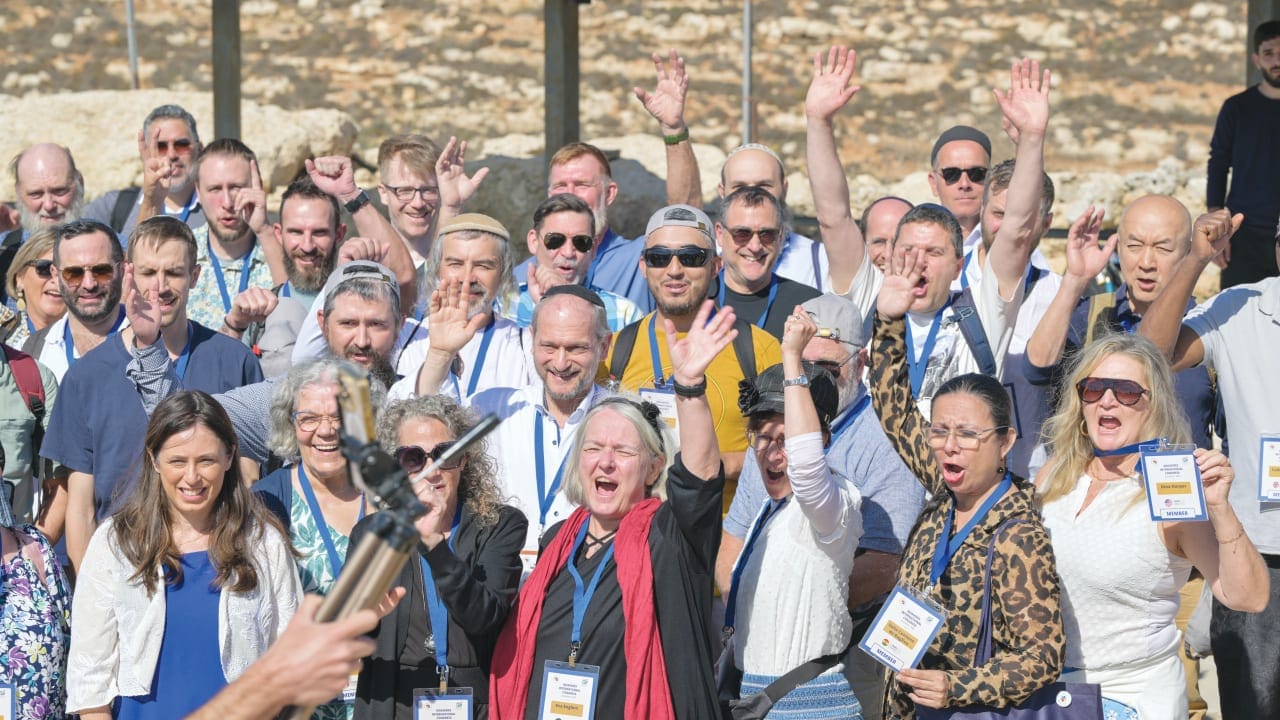
For many Jewish women, lighting Shabbat candles is a familiar ritual, repeated week after week. For Dina Harper of North Carolina, lighting two candles on Friday evening represents something quite different: a hard-won expression of a religious identity she is still struggling to define.Harper is not Jewish. She grew up in a Christian environment, has a husband and children who do not share her religious convictions, and lives more than an hour from the nearest rabbi with whom she has a relationship. Yet she has come to regard the Torah as the foundation of her spiritual life.“I know we don’t have to guard the Shabbat like the Jewish women do,” she explained, “but I believe at least acknowledging Shabbat by saying your own prayer would be beneficial. Since Hashem [God] called the seventh day holy, then shouldn’t that day be special to the whole creation?”It is the kind of question that captures the complexity of a little-understood religious phenomenon: non-Jews who have embraced the God of Israel, rejected central doctrines of Christianity, and turned to Jewish teachers for guidance about how to live.Some identify as Noahides, referring to the seven universal commandments traditionally understood in Judaism to apply to all humanity. Others prefer the term “ger toshav” (resident alien), although its formal halachic application is limited since Israel does not currently observe Yovel (the Jubilee year) and there is no active Sanhedrin or Temple infrastructure. Still others resist labels altogether.NOAHIDE LEADER Rod Bryant and Kirk at the Noahide Congress. (credit: COURTESY NETIV)They are not necessarily seeking conversion. Nor are they content simply to abandon their previous religious beliefs and live without a spiritual framework. They want to know what comes next.Their experiences offer Jewish readers an unusual opportunity to see Judaism through the eyes of people who did not inherit it, who sacrificed relationships and communities to pursue its teachings, and who believe that the Jewish people’s responsibility to be a light unto the nations is not merely an inspiring biblical metaphor. For them, it is a deeply personal expectation.A gathering of spiritual outsidersThe recent Noahide Congress in Jerusalem provided a meeting place for people whose religious lives are often conducted in isolation.For women who may be the only Torah-oriented non-Jew in town, the opportunity to meet others who share their convictions carried enormous emotional significance.Jeanne Montgomery (name changed for privacy), who lives in the US but considers Israel her spiritual home, has been searching for such a community for more than a decade.Raised in what she describes as a dysfunctional secular household, Montgomery experienced a profound spiritual awakening in midlife and became involved in Christianity. Yet she was increasingly troubled by negative portrayals of Jews in Christian teaching.Her growing interest in Tanach, particularly biblical prophecies concerning Israel, eventually led her away from the religious framework she had embraced. But finding others who shared her understanding proved difficult.“I have been on this journey for over a decade, and it is very lonely,” she said.When she saw an advertisement for the Noahide Congress, she hoped to meet like-minded people, although previous disappointments had taught her to keep her expectations low.“I was very pleasantly surprised to find a community with my heart for the God, land and people of Israel!” she recalled. The presence of Jewish leadership that welcomed participants’ attachment to Israel was particularly meaningful. “It felt like a dream,” she said.Harper had a similar response to the Noahide Congress. “I just kept thinking, I must be dreaming! I met so many new friends that I have needed for such a long time now!” she said.Teresa Kirk of Waco, Texas, wanted to discover whether the rabbis associated with Brit Olam, the organization that sponsored the Noahide Congress, would offer a more expansive approach than the restrictive guidance she had encountered elsewhere.She also came to hand over a donation, collected over several years, for the Temple Institute.For these women, the congress was more than an educational gathering. It was an opportunity to discover that their spiritual journeys, however unusual, were not entirely solitary.Leaving Christianity means leaving a communityFor Jewish readers accustomed to thinking of religious change primarily in terms of belief, the women’s stories reveal another dimension. Leaving Christianity means losing an entire social world.Bethanne Boyd lives in Caneyville, Kentucky, a small town where, she says, some residents have never met a Jewish person.She received a Bible as a gift at age 30 and spent the following 25 years studying different Christian denominations, attempting to understand their disagreements. Eventually, she became sufficiently knowledgeable that others regarded her as a religious leader.Her transition toward Torah therefore involved more than changing her theological conclusions. It meant relinquishing a position of authority and belonging.“Leaving the church and all my social connections and serving in the church was hard.”She also encountered a problem that Jewish educators might not anticipate. “More rabbis seem willing to teach men. I would not be where I am without a woman teacher.”Kirk’s experience was similarly painful. In 2000, she and her husband left organized Christianity and began searching for what they considered a more authentic way to worship God.Their journey eventually brought them to Vendyl Jones, the Texas-based biblical researcher whose interest in Jewish texts and archaeology influenced generations of non-Jewish seekers.But the transition came at a cost. “When we left the church and JC, we lost our families and friends,” she recalled, using a pejorative abbreviation for Jesus Christ.For Kirk, another unexpected loss was music. Deeply involved in her church choir, she found herself without the familiar songs that had accompanied her spiritual life.“At first the biggest sacrifice was the music,” she said.Today she finds comfort in the increasing availability of Jewish music.Montgomery describes the cost of her journey even more starkly. Asked what she has sacrificed, she answered, “Pretty much everything, but it is so worth it!” Her immediate family, she says, thinks she is crazy. She now regards her Jewish friends and those who support Israel as her extended family.ENTHUSIASTIC PARTICIPANT and Q&A (bottom) at congress. (credit: BRUNI SHARVIT)When a marriage contains two religious worldsFor some women, the most difficult challenges are not theological but domestic. Boyd did not tell her husband about her changing beliefs for an entire year. “I was afraid he would divorce me,” she admitted.When she finally explained her position, she reassured him that she would continue to respect his beliefs and accommodate the family’s holiday traditions.Christmas remains part of family life, but Boyd has replaced overtly Christian decorations with snowflakes and gingerbread. Her children still receive Christmas presents, although she does not accept them herself.She observes Hanukkah, but her husband does not participate.“We do not do Shabbat,” she said. “While my husband is with me, I have just accepted this.”The compromises are neither simple nor entirely satisfying. Boyd would like to incorporate more Jewish practices into her life, but she fears doing so incorrectly.“Like I’m terrified of Shabbat,” she confessed. “I can’t fulfill it fully, so I don’t try a little. Is it better to do something halfway if you can’t do it right?”Harper faces similar tensions. Her husband and daughter want to maintain family holiday traditions. They argue that exchanging gifts need not carry religious significance. Harper disagrees, yet acknowledges that she sometimes participates to avoid hurting anyone’s feelings.Her local rabbi has advised her that maintaining peace in the home is especially important at this stage of her life. Conversion, she believes, could jeopardize her marriage.“I may convert in the future, but right now I’m taking it step by step and day by day,” she said.Why not simply convert?It is perhaps the most obvious question a Jewish reader might ask. If these women love Torah, why not become Jewish?Their answers challenge the assumption that conversion is necessarily the natural destination of every serious non-Jewish Torah student.Boyd says conversion would be incompatible with her present family circumstances. “I cannot fulfill the commandments with my life. I will not convert to be a sometimes Jew.”Kirk notes that living far from an Orthodox synagogue presents practical obstacles. She also values the freedom to study and incorporate certain Jewish practices without assuming the full obligations of Jewish law.Harper remains open to the possibility of conversion in the future, but does not regard it as appropriate for her current situation.Montgomery offers a different perspective, one rooted in her understanding of the relationship between Israel and the nations. For her, remaining a non-Jew is not a disappointment but an opportunity to fulfill a different role.For Kimberly Kornmeier, an American-born woman now living in Kurdistan, the answer is more definitive. Kornmeier, who often uses the name Rahab in honor of the biblical woman who sheltered the Israelite spies, spent 18 years as a Muslim before turning toward Torah. She had long felt drawn to Judaism, even while practicing Islam.“Even as a Muslim, my Jewish books never left my library,” she recalled.She once wanted to convert but eventually came to believe that her inability to do so was not a spiritual failure. “These days I realize that was because I didn’t have to.”She sees Judaism’s recognition that righteous non-Jews can have a relationship with God and a share in the World to Come as one of its most compelling teachings.“If I was meant to convert, Hashem would have opened that door,” she said. “I am exactly where Hashem wanted me.”For these women, the possibility of serving God without becoming Jewish is not a second-best alternative. They understand that the Torah does not demand that everyone join the Jewish people in order to have spiritually significant lives.The battle over names and boundariesAlthough outsiders may speak of a single Noahide movement, the women themselves reveal substantial differences in terminology, philosophy and practice. Harper is comfortable with several designations, including “Noahide” and “ger toshav.” Boyd sometimes uses “Noahide” simply because it is easier to explain. Kirk identifies as a ger toshav, particularly in connection with the possibility of living in Israel.Montgomery distinguishes between her inward spiritual identity and the language she uses when speaking to others.“Inwardly facing, I feel I am a ger toshav and aspire to be one of hassidei umot ha’olam [the righteous among the nations],” she explained, while outwardly identifying herself to non-Jews as a “biblical Zionist.”Kornmeier, however, rejects the “Noahide” label altogether.“I definitely don’t identify as a Noahide, and I’m very against that word and the movement,” she declared.She believes the contemporary movement has created an artificial religious identity, emphasizing prohibitions while neglecting the positive spiritual possibilities available to non-Jews.Her preferred identity is ger toshav, which she understands in a spiritual sense since the conditions for formal recognition don’t currently exist.The interviewees’ personal use of these terms does not necessarily correspond to their technical halachic meanings. Nevertheless, their differing preferences reveal something important: participants are struggling not only with Jewish law, but with the language used to describe their place in the world.ENTHUSIASTIC PARTICIPANT and Q&A (bottom) at congress. (credit: BRUNI SHARVIT)What does a non-Jewish Torah life look like?Without a synagogue nearby, a standardized prayer book universally adopted by Noahides, or an established network of local communities, these women have developed different religious routines.Kornmeier begins her day with Modeh Ani, offers blessings over food and drinks, and practices hitbodedut, the personal, informal conversation with God associated particularly with Breslov teachings. She studies Jewish texts and watches lectures online. On Fridays, she lights candles, speaks with God, and drinks wine. Saturdays are devoted to study and a special meal.“I have a small morning prayer. I sit on my balcony and do hitbodedut,” she explained. “If I’m learning and feeding my soul and connecting to God, that’s all I need.”Kirk’s Friday preparations look more familiar to an observant Jewish household. She bakes challah, sets a table with candles, lights them at the appropriate time, recites blessings, and shares a meal, followed by Torah study.Boyd, by contrast, avoids adopting a full Shabbat routine, because of her husband’s religious commitments.Harper lights candles and offers her own prayers.For Montgomery, Friday evening is generally a time of rest, unless she is visiting friends for Shabbat.These differing practices raise genuine halachic questions. A non-Jew’s relationship to Shabbat, Jewish liturgical blessings, and commandments specifically given to Israel is not identical to that of a Jew. Nor does every practice described by an interviewee necessarily reflect an accepted halachic ruling.But the diversity illustrates a practical challenge for Jewish educators.The seven Noahide commandments establish a fundamental moral and religious framework. They do not, by themselves, provide the complete rhythm of daily life that observant Jews receive through Halacha, communal institutions, and inherited customs.For women who have left religious traditions rich in ritual, fellowship, and family observance, that absence can feel especially acute. They are asking not merely what they must refrain from doing, but how to fill their days with awareness of God.Kornmeier is particularly critical of Jewish teachers who focus primarily on what non-Jews are not permitted to do.“They are drying out and killing souls,” she said.Her criticism echoes a concern expressed more gently by other interviewees. They understand that certain commandments are specifically Jewish. What they want is greater attention to the positive spiritual life available to them. The issue is not necessarily resistance to boundaries. It is the desire for guidance that does more than define those boundaries.Another theme emerging from the interviews is the importance of female religious leadership. Recorded lectures can transmit knowledge. They cannot always replace the personal relationships through which religious identity is nurtured. For women scattered across small towns and distant countries, the Internet has become an indispensable lifeline. But the interviews suggest that online learning is only a partial substitute for belonging to a community.Discovering the Jewish people anewPerhaps the most striking transformation described by the women concerns their understanding of Jews themselves.Boyd once believed Judaism emphasized ritual more than spiritual substance. She also assumed Christianity offered the exclusive path to heaven. Now she describes Jews as “the most godly beautiful people on earth.”Harper remembers viewing Jews as a peculiar religious group, rejected by society for reasons she did not understand. Today she speaks with admiration of Jewish scholarship and wisdom.Kirk once imagined that Jewish people were virtually perfect. Her studies taught her a more realistic lesson: Jews, too, are human beings struggling to do what is right.Montgomery’s transformation was particularly dramatic. During her years studying Christianity, she repeatedly encountered negative depictions of the Jewish people, both ancient and modern. She recalls being taught that Jews neglected the Bible in favor of the Talmud and being given an image of Jews as stern, cold, and spiritually hardened.Her study of Tanach, combined with personal relationships with Jews, overturned those assumptions. She was astonished to discover how much Scripture is incorporated into daily Jewish prayer. Most significantly, she came to reject the idea that God’s covenant with Israel had been superseded.For Montgomery, the return of the Jewish people to its ancestral homeland represents visible evidence of God’s continuing relationship with Israel. She now describes the Jews she knows as “the most incredible, God-fearing, God-loving, and incredibly gracious people I know.”Kornmeier remembers walking through an Orthodox Jewish neighborhood as a child, drawn to the clothing, head coverings, and atmosphere.“I saw their light,” she recalled.These women have not simply exchanged one set of beliefs for another. They have also reconsidered deeply rooted assumptions about the Jewish people. They see extraordinary beauty in practices that many Jews take for granted.'Your God is also our God'For Jewish readers, one of the most significant messages in these interviews concerns the women’s understanding of the relationship between Israel and the nations. They are not asking Jews to abandon their distinctiveness. On the contrary, they see the Jewish people’s unique relationship with Torah as the very reason they turn to Jewish teachers.Harper expresses the relationship plainly. “More Jewish people need to understand that Noahides love and support the Jewish nation because you have the words of God (Torah), which is what we all need to learn!” Then she adds a sentence that could serve as the theological foundation of the entire movement: “Your God is also our God.”Boyd makes a similar point, emphasizing that Jewish chosenness does not imply exclusive ownership of God. “You are chosen. That doesn’t make Him your God exclusively.”Montgomery believes non-Jews who recognize the God of Israel have a responsibility not only to learn from Jews but also to encourage them. She is particularly moved by Psalm 126, which describes the nations recognizing God’s kindness toward Israel. For Montgomery, the words “Hashem has done great things for them” are not simply an ancient verse. They are a declaration she believes the nations should be making to the Jewish people today.Their journeys raise questions for the Jewish world that extend well beyond the Noahide movement itself.What responsibility do Jews have toward non-Jews who sincerely seek to learn Torah? How can Jewish teachers preserve halachic distinctions while offering encouragement and spiritual nourishment? What kinds of educational institutions, mentorship opportunities, and communities might help women whose commitment to the God of Israel has left them isolated from their former religious worlds?And how should Jewish communities respond when people outside the covenant express a passionate appreciation for the Torah that Jews themselves sometimes struggle to maintain?The women interviewed do not offer a single answer. What unites them is the conviction that the God of Israel has a place for them in His world.The women of the Noahide world are asking questions that many Jews have never needed to consider. They have found their way to the Torah without being born into the Jewish people. Now they are asking the people entrusted with that Torah to help them understand what their discovery means.And perhaps, in the process, they are offering Jews an opportunity to rediscover something precious about their own inheritance. ■The writer is a freelance journalist and editor of three books on the topic of the non-Jewish awakening to Torah: Ten From The Nations, Lighting Up The Nations, and Adrift Among the Nations.
'Your God is our God': Meet the women leaving Christianity behind to embrace the Torah
Full Article
Original Source
Read the full article at Jpost →KhanList aggregates and links to publicly available news content. We do not host full articles from third-party sources. Always verify important information with original sources.