
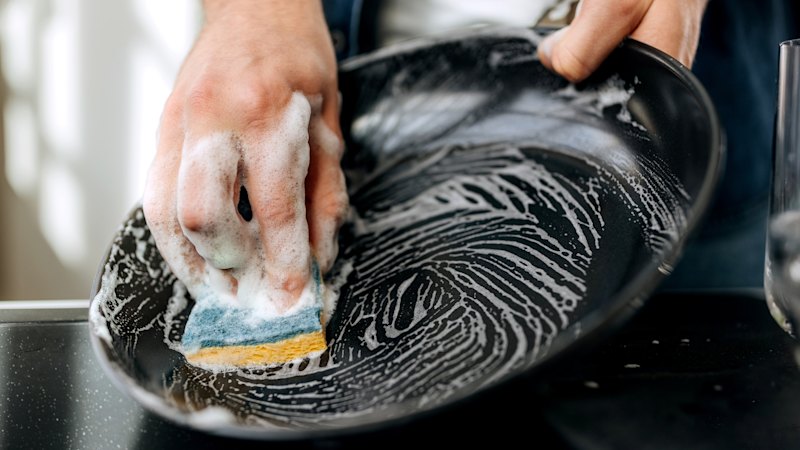
Lindsey BeverSeptember 19, 2026 — 5:00amDish sponges can be one of the most contaminated tools in your kitchen, depending on how you use them, how you care for them and how often you replace them.Sponges can trap food particles, and then if they sit warm and moist for hours, it may make them a reservoir of bacteria that can be transferred to your hands, dishes, countertops and other surfaces, research suggests.When sponges aren’t properly cared for, they can be a source of harmful bacteria, including E. coli and staph, says Don Schaffner, chair of the department of food science at Rutgers University. Certain strains of E. coli and staph can lead to infections and food poisoning in some cases.What would a food safety expert think of the sponge in your kitchen sink right now? It might alarm you. Getty ImagesThe risk for foodborne illness is why the World Health Organization advises against using sponges to clean plates and utensils.Knowing how to use sponges properly can help make them more sanitary. But there are also alternatives.We asked food safety experts what they use in their own kitchens and how they reduce the risk of bacterial contamination. Here’s what they told us.Use a brush for dishesNo cleaning tool is maintenance-free, but dish brushes have been shown in studies to be more hygienic than sponges. That’s because bristles dry faster than sponges, meaning the bacteria die off more quickly.The bristles, which may be plastic or made of natural materials such as bamboo or beechwood, also make it easier to see grime.“They tend to have a more open matrix, which makes it harder to trap food particles, and that also makes it much more readily amenable to sitting somewhere and draining and drying,” Schaffner says.In a 2021 study, brushes were found to have no residual water four and a half hours after being immersed in water, resulting in fewer bacteria compared with sponges. One type of sponge that was tested still held up to a teaspoon of water 24 hours after immersion. This created a humid environment for bacteria that can make you sick, such as salmonella and campylobacter, to grow.As with any cleaning tool, brushes must be regularly cleaned and sanitised or replaced, says Jason Bolton, a food safety expert and associate dean at the University of Maine Cooperative Extension.Wash dish brushes often – ideally, daily – with hot, soapy water and then set them in a place where they can drip-dry – bristles down, Bolton says. Then sanitise them. Often, plastic brushes can be placed in a dishwasher, but follow the manufacturer instructions.Bacteria can still hide in the crevices where the bristles come out of the handle, so brushes or replaceable brush heads should be disposed of once they start to appear stained or soiled, says Bolton, who uses a dish brush in his kitchen.That being said, brushes aren’t ideal for cleaning surfaces because the bristles don’t make as much contact with countertops or may scratch certain materials, such as some nonstick cookware. That’s where the dish cloth comes in.Beyond sponges, there are safer options that are just as effective. Getty ImagesUse a cloth or towel for washing and dryingDishcloths, which may be made of materials such as cotton, linen or even plant cellulose, can be useful both for washing and drying. When kept clean and dry, they can be more sanitary than sponges. The key is to have a set of dishcloths and, ideally, use a fresh one each day.“Using a dish towel that goes through a proper laundry cycle and high-temperature drying cycle, there’s a lower risk,” compared with sponges or towels that are not properly cleaned, sanitised and dried, says Bolton, who uses dishcloths as well.Dishcloths are easier to launder and more likely to be laundered, often making them a safer choice than sponges, Bolton says. Also, they tend to dry out faster, reducing the risk of bacterial growth.That said, dishcloths that are balled up or allowed to stay moist can harbor bacteria in much the same way as dish sponges, research shows.Cotton and biodegradable dishcloths made of materials such as plant cellulose usually can be washed in a dishwasher or washing machine, and go through a heated drying cycle. Synthetic materials can work, too, as long as they can be dried at high heat, Bolton says. With any material, follow the manufacturer instructions as they may not be designed to go through a washing and drying cycle, he says.Another option: single-use paper towels pose less risk from a food-safety standpoint because you’re not reusing them and potentially spreading bacteria, but they’re not as environmentally friendly. Schaffner says his used paper towels go into the compost, “but if you’re not composting, then that goes to a landfill”.Can’t quit your sponge? Here’s how to keep it cleanIf you prefer to keep your sponges, you should ideally sanitise them daily, assuming you use them frequently, Bolton says.Here are three ways to do that:Run your sponges through the dishwasher. If you have a sanitiser cycle, that can help both clean and sanitise them, Schaffner says.Place your sponges in a small dish and cover them slightly with clean water, then put them in the microwave for about a minute to kill any bacteria. Never microwave a sponge that’s dry because it can catch fire, he says. Once cool, wring them out and set them someplace where they can dry completely, he says.Put your sponges in the kitchen sink and pour boiling water from a pot or kettle over them. Again, once cool enough to touch, wring out the excess water and let them dry, he says. For best results when microwaving or boiling sponges, use a digital meat thermometer to make sure the water reaches at least 71 degrees, Schaffner says.Keep in mind that the data on these methods is mixed. Some research suggests microwaving or dishwashing sponges may help kill harmful bacteria. But one study found that microwaving and boiling treatments reduced bacteria in sponges in a laboratory but not in actual kitchens. The researchers also noted that “no method alone seemed to be able to achieve a general bacterial reduction of more than about 60 per cent.”Schaffner says he has “a multipronged system” in his house, using dishcloths, paper towels and sponges, which he makes sure are clean, wrung out and set to dry in a sponge rack inside his kitchen sink.As soon as you start to see wear and tear or soil that can’t be easily removed, the sponges should be replaced.You could also consider replacing your regular sponge with a silicone one. Silicone sponges, which are nonporous unlike traditional sponges, are made of foam-like natural or synthetic materials, don’t hold water and are easier to clean, Bolton says. Also, they are often dishwasher safe.Washington PostMake the most of your health, relationships, fitness and nutrition with our Live Well newsletter. Get it in your inbox every Monday.From our partners
Your dish sponge is gross. Here’s what food safety experts use instead
Full Article
Original Source
Read the full article at Smh →KhanList aggregates and links to publicly available news content. We do not host full articles from third-party sources. Always verify important information with original sources.