
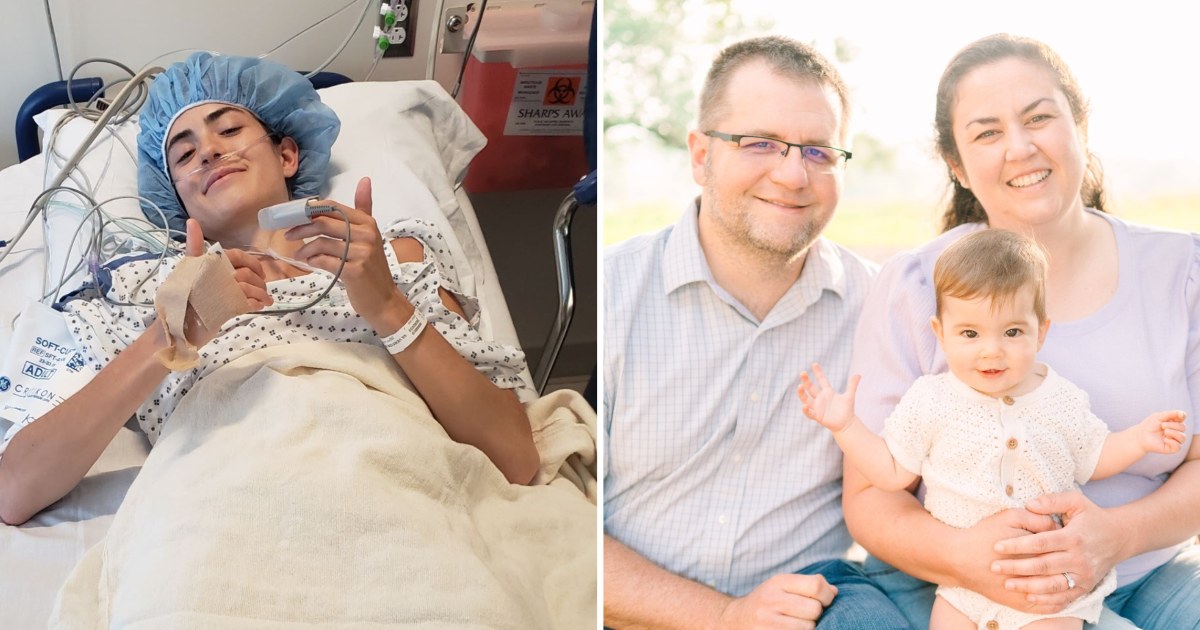
It had only been three months since Sage Silverstein learned she carried a BRCA mutation when she got even more shocking news: At 24, she was diagnosed with Stage 3 breast cancer.She lost her grandmother at age 60 to breast cancer, and she and her mom both learned they carry BRCA mutations. In particular, Silverstein is positive for BRCA2, a gene mutation that significantly increases the risk for breast, ovarian and other cancers.After learning about her genetic test results, Silverstein soon began to think about her reproductive future.“The counseling I got was (that) you should freeze your eggs because, in the future, when you want to have kids you can do (preimplantation genetic) testing for BRCA, which I had truly never heard of before,” she tells TODAY.com.Sage Silverstein was diagnosed with breast cancer at 24.Courtesy Sage SilversteinShe was already working with Dr. Jaime Knopman, a board-certified reproductive endocrinologist at CCRM Fertility of New York, to freeze her eggs to preserve her fertility. And, when Silverstein got the “curveball” news of her diagnosis, she says, that only accelerated the process. Before chemotherapy and radiation, she squeezed in two rounds of egg retrieval, which left her with about 28 eggs to be frozen. She remembers being impressed with the number and thinking, “I’ll never need all those!”On the other side of her cancer journey, Silverstein went to nursing school, and she and her fiancé were ready to start building a family.They thawed her eggs in the hopes of creating embryos, but the thaw of the first batch “went terribly,” Silverstein says. “Not one egg survived.” And in the second batch, testing revealed that three embryos were chromosomally normal, Silverstein says, “but out of those, every single one was affected with BRCA.”She spent the next two years undergoing four more IVF cycles, each time garnering only one or two embryos. Finally, she built up a store of seven viable embryos, only two of which were not affected by BRCA.Now 32, Silverstein is an IVF nurse at CCRM, working alongside Knopman. And her gestational surrogate is due in December.As overjoyed as she is to finally become a mother, Silverstein looks back on her fertility journey with mixed emotions. She sees BRCA as “this thing that’s plagued women in my family for generations, and like, how cool is it that I could potentially get rid of it?” Silverstein says. She felt like she had a “responsibility to eradicate BRCA from my lineage,” she explains.Silverstein gets cold-capping to preserve her hair during chemo.At the same time, “I think I was a little overly optimistic with my results,” she says.Now she, like many other prospective parents, is grappling with the surprises she encountered along her journey — and knows she may face tough choices if she and her husband want more children, including the possibility of using a BRCA-affected embryo in the future.What Is Preimplantation Genetic Testing?Preimplantation genetic testing (PGT) allows doctors and patients to learn about the genetic information of an embryo before it’s implanted through IVF.When testing for BRCA, the test is called PGT-M, where the M stands for “monogenic,” meaning a single gene is targeted, Dr. Terri L. Woodard, a reproductive medicine expert at the MD Anderson Cancer Center who specializes in working with people who’ve been diagnosed with cancer, tells TODAY.com.“It’s a form of genetic testing where we can identify whether or not a particular embryo carries a certain gene of interest,” she explains. That could be a genetic mutation that predisposes someone to cancer, like BRCA, or other diseases, such as Huntington’s disease or cystic fibrosis. The process involves building a “probe” based on samples (often saliva) from a patient and possibly from their family members, Woodard explains, which helps those interpreting the test results hone in on the right genetic information.The test is considered very reliable, Woodard says. “Nothing is 100%,” she notes, “but PGT-M is highly accurate, and typically we will quote that the accuracy is around 98-99%.” For some genes that are less commonly tested for than others, the accuracy may drop a little to around 95%, Knopman tells TODAY.com.“I want to make sure I can take out this factor so (my child) won’t have to consider the same decisions I had to make.”K.G.This test is different from PGT-A, which screens for chromosomal abnormalities, although the two are commonly performed together. There’s also PGT-P, which tests for conditions influenced by multiple genes, Knopman says, but it’s not offered in many places.As genetic tests for BRCA become more available and mainstream, employee fertility benefits (such as egg freezing) are also becoming increasingly common, Knopman explains. Now more than ever, people are learning about their BRCA status and may have the option to pursue PGT-M as part of their fertility journey.While many of Woodard’s and Knopman’s patients come to them after a cancer diagnosis, that’s not the case for everyone. Some patients, like K.G., 29, who works in consulting in Washington, D.C., pursue IVF after learning they carry a BRCA mutation solely to avoid passing it on to their children. She’s a member of the subreddit r/BRCA, where people regularly share their experiences navigating IVF as BRCA carriers, including asking difficult questions about implanting BRCA-positive embryos or choosing not to have PGT-M at all.She learned that she has a BRCA1 mutation “on a whim,” says K.G., who TODAY.com is identifying by her initials to protect the privacy of her genetic health information.Earlier in her 20s, she’d already had “a couple of scares,” she says, including one that required a breast biopsy. And she’d lost her grandmother to breast cancer. So, when she saw a QR code at her OB-GYN’s office to screen her eligibility for a genetic test, she decided to go for it.After getting her results, she decided to undergo a prophylactic double mastectomy and is considering an additional preventive surgery. Ahead of that decision, she and her husband reached out to a fertility clinic.As soon as she learned about PGT-M testing, it “immediately cemented in my head that, OK, I’m going to do this,” K.G. says. “I want to make sure I can take out this factor so (my child) won’t have to consider the same decisions I had to make.”What Does a BRCA Risk Really Mean?Stories like these show the potential of reproductive technology. But they also bring up some challenging questions, Vardit Ravitsky, Ph.D., president and CEO of the Hastings Center for Bioethics, tells TODAY.com. “The main ethical issue to me hovers around the concept of seriousness,” she explains, meaning decisions about “what kinds of diseases and levels of risk and conditions should be a target (for PGT-M).” And who makes those decisions?In other countries, the government may cover the costs of PGT-M to screen for certain genetic health issues but not others, Ravitsky explains. That’s more common in countries, like France and Italy, that have government-sponsored health care.On one end of the spectrum, there’s a condition like Tay-Sachs disease, she says, which is caused by mutations in a single gene. The most common form of the disease affects babies at around 3-6 months, the Mayo Clinic explains, and it leads to complications such as seizures, paralysis, vision and hearing loss, and eventually death in childhood. There’s no treatment for Tay-Sachs, and everyone with with two copies of the genetic mutation will develop some symptoms of the disease. For a condition like this, “Everybody would agree that it’s serious,” Ravitsky says.On the other end of the spectrum, you might have something like APOE e4, a genetic variant that has been linked to an increase risk for Alzheimer’s.Somewhere in the middle of the spectrum are BRCA mutations. Having a BRCA mutation is not itself a condition or disease. Not everyone who has one of these mutations will develop cancer, and not having a BRCA mutation is not a guarantee that someone will have a cancer-free life.But these mutations do significantly raise the risk for developing certain types of cancer. Among women with a BRCA1 or BRCA2 mutation, more than 60% will develop breast cancer in their lifetimes (compared to 13% in the general population), the National Cancer Institute explains. Some estimates put that number as low as 45% and as high as 85%. People with BRCA mutations also tend to develop cancers earlier in life.Having a BRCA mutation typically means more frequent breast cancer screenings, including mammograms and breast MRIs, the NCI explains. Some carriers choose to have preventive procedures, such as mastectomies and surgeries to remove the ovaries and fallopian tubes, which significantly reduce the risk for cancer but come with potential risks as well.Breast cancer is considered a serious condition and PGT-M to screen for BRCA mutations is, therefore, “ethically justifiable,” according to a 2024 ethics committee opinion from the American Society for Reproductive Medicine. The ASRM also acknowledges that decisions about whether to pursue PGT-M for a particular conditions “are personal ones that differ among patients, whose autonomy to make such distinctions should be supported as a matter of reproductive liberty.”For Knopman, who is also a breast cancer survivor, “it becomes a more challenging conversation as we decide what’s right and what’s wrong,” she says. “But I think the good news is that it’s available, and if you want to take advantage of it, you can.”Not everyone who is BRCA-positive pursues preimplantation testing, Woodard says.“There are patients that are like, ‘I am not going to have a baby without doing this because I don’t want them to go through what I’ve gone through,” she says. “And then I have other patients that are like, ‘That’s terrible. If my mom could have deselected me, I wouldn’t be here, and I have a good life.’”Helping patients balance all of these nuances and complexities as they work toward their reproductive goals is part of the process. “Our responsibility as fertility specialists is to educate and let the patients decide what is right for them,” Woodard says.But PGT-M is not regulated in the U.S. the way it is in other countries. Ravitsky describes it as a “free-for-all.”That often leaves doctors and patients to decide if testing is warranted or not in a particular case. And whether insurance will cover any of the often staggering costs of fertility treatment — and preimplantation testing on top of that — isn’t always clear.How Much Does Preimplantation Genetic Testing Cost?While insurance does sometimes cover the cost of IVF and PGT-M for people who are BRCA-positive depending on the state and the details of their plan, that is not always the case. Silverstein’s parents helped her cover the cost of her two egg freezing cycles before cancer treatment. She also received help with medication costs from a fertility preservation program called Heart Beat, which specifically works with cancer patients. And, after treatment, she and her (now) husband got a domestic partnership so that she could take advantage of the fertility benefits his employer offered.Silverstein with her family and the chemo bell.But that doesn’t touch the costs of surrogacy, which “is incredibly expensive and not attainable for a lot of people,” she says, adding that she and her husband are receiving financial help from their families. As for the total cost? “I really can’t put a number on it, but it’s a lot of money,” she says.The median cost of a single round of IVF is more than $19,000, the ASRM said in a 2021 ethics committee opinion explaining the persistent disparities in access to fertility treatments based on racial, ethnic, economic and sexual identity factors. But those costs can vary widely, as TODAY.com reported previously. And many patients need multiple IVF cycles to get a healthy live birth.Generally, a PGT-M test adds between $2,000 and $6,000 to the total costs of an IVF cycle, Woodard says. Knopman is also on the executive board of The Chick Mission, a non-profit organization that aims to increase access to fertility preservation for those diagnosed with cancer, including via direct financial support.For K.G., the cost of PGT-M testing was covered completely through insurance due to her BRCA status, which was a major factor in her decision to pursue IVF. “Had insurance not been able to cover it, then it may have been a totally different story,” she says.A former professional accountant, Katherine Johnson, 36, of Washington, Texas, kept close tabs on the expenses for her IVF journey. Including travel to Woodard’s office and hotel stays, the total was around $50,000 and took almost a full year from the first meeting with the fertility clinic to the birth of her daughter. Of that, the cost of PGT-M testing was between $3,000 and $5,000, says Johnson, who learned she carries a BRCA2 mutation after losing her uncle to prostate cancer. And PGT-A was “another couple thousand,” she adds.For her, the choice went back to eliminating the risk for her daughter. She remembers thinking, “If I could take my own BRCA2 gene away for $50,000, would I do it? And the answer was just yes.”‘All You Need Is One’For all the parents whom TODAY.com spoke to, the rate of attrition — the number of potentially usable eggs and embryos lost at each step of the process — was a surprise. K.G. had assumed that, since she didn’t have any fertility issues, IVF would be simpler for her. “You don’t realize it’s still a numbers game,” she says.Just two months after her mastectomy, she kicked off the egg retrieval process and was able to get 49 eggs from a single cycle. Of those, 33 eggs were mature and used to create 31 embryos. From there, 19 became blastocysts (a ball of quickly dividing cells that forms after fertilization) and were sent for PGT-M testing. “If I could take my own BRCA2 gene away for $50,000, would I do it? And the answer was just yes.”Katherine JohnsonUltimately, K.G. was left with seven embryos that were chromosomally normal and not affected by BRCA. But her first two embryo transfers failed, which sent her into a “pretty depressed state,” she says.After the failed embryo transfers on top of her recent mastectomy and reconstruction, “It was a bit of an identity crisis, and really made me question everything about being a woman,” she says. “It‘s like I can’t do anything right.”Finally, K.G. had a successful embryo transfer in October of last year and gave birth to her daughter this past summer. “So it all worked out,” she says. “But it was definitely a rough start to get there.”She did not choose the sex of the embryo that was implanted. Finding out she was having a daughter made the PGT-M decision “somehow more validating,” she says, “knowing that it was a girl and that she wouldn’t have to deal with BRCA.” (While men with BRCA mutations do have an elevated risk for certain cancers, the increase is not as great as in female carriers.)For patients who are BRCA-positive, there’s about a 50% chance that each of their embryos will be affected by BRCA. The more you start with, the better your chances of getting chromosomally normal, unaffected embryos. But in reality, the math doesn’t always work out so cleanly.“We have no way of predicting it until it actually happens,” Woodard says.Like others, Johnson was surprised by the rate of attrition — and how emotional the experience was. She now works as a cattle rancher and uses IVF with the cattle in her job, so she was familiar with the process. But it still caught her a bit off-guard.“(You) think, oh, these these could be my children,” she says, “and then your numbers just drop every time you hear from the lab.”Katherine Johnson and her family.Samantha O'Neal / Courtesy Katherine Johnson She got 12 eggs from a single retrieval cycle, 10 of which were mature. But only three became viable embryos. Of those, one had a lethal chromosomal abnormality, Johnson says, and another had a BRCA2 mutation. Only one was unaffected.“People love to say, ‘Oh, well, it only takes one.’ And for us, we were very, very lucky that it did,” Johnson tells TODAY.com with her 14-month-old daughter on her hip. But an embryo transfer can still fail, she says, and remembers being told she’d have about a 60% chance at success.“That’s practically a coin toss,” Johnson says. “It’s crazy to make huge life decisions like this that you don’t fully have control over.”‘Between a Rock and a Hard Place’For patients who are left with only BRCA-positive embryos, “That’s challenging,” Knopman says. If another round of IVF is possible, she might suggest that.But if the patient can’t do that for physical, emotional or financial reasons, she might suggest hanging onto a BRCA-affected embryo anyway. “Who knows what medicine is going to be like in 30-plus years?” she says.When the child is 20, for instance, “we might have many more options that make it easier for them to avoid developing cancer or treating it sooner or easier or better,” Woodard adds.Some patients may feel like implanting a male embryo with a BRCA mutation is less risky than a female one, the experts note. “They’re like, what’s worse: not having a child or having a child that has BRCA?”Dr. Jaime Knopman“People will make those decisions if they’re forced to because they’re (in between) a rock and a hard place,” Knopman says. “They’re like, what’s worse: not having a child or having a child that has BRCA?”Of course, these are conversations that should be happening at the very beginning of the process, Woodard says, not after the IVF cycle is done.Silverstein, who may need to implant a BRCA-positive embryo in the future, is hopeful that new technologies or preventive measures would be available by the time her child needed them.Johnson, who has no usable embryos left, “would have to start from scratch” with another egg retrieval cycle, she says.For now, she’s enjoying being a mother “way more than I thought I would,” Johnson says, adding that her daughter will likely grow up tagging along with her to annual screening appointments.
You Can Now Test Embryos for BRCA — But Should You? 3 Women Share Their Stories
Full Article
Original Source
Read the full article at Today →KhanList aggregates and links to publicly available news content. We do not host full articles from third-party sources. Always verify important information with original sources.