
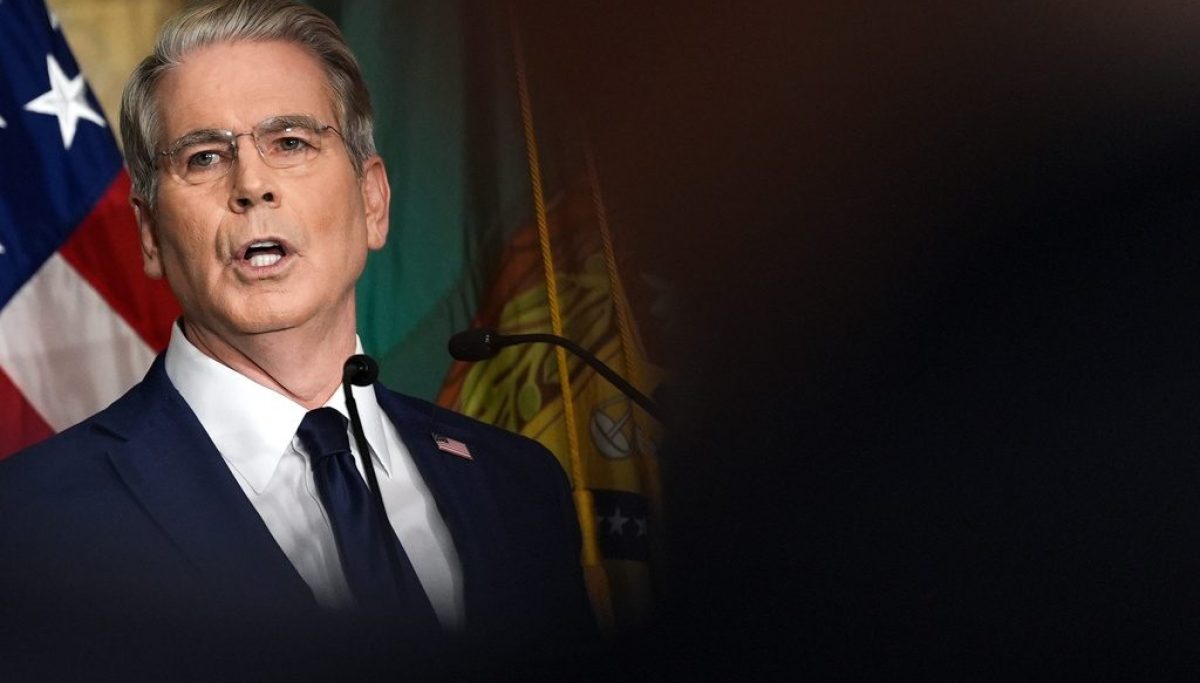
The yield on the benchmark 10-year Treasury note hit 5% for the first time in 19 years, adding to pressure on the federal government’s finances.The yield on the 10-year, which is the benchmark for a variety of interest rates, touched 5% on Monday. That is the highest yield on that security since the summer of 2007, near the start of the financial crisis and the Great Recession. The rise in interest rates comes just weeks after the national debt crossed $40 trillion for the first time in history. The rising debt and interest costs have renewed concerns about the fiscal outlook.Yields on other bonds, notably on longer-run bonds, have also risen recently. After debt hit the $40 trillion mark, yields on 30-year Treasury securities pushed to levels not seen in some two decades.Last month, the Treasury Department tried to intervene with buybacks in an effort to artificially lower yields on long-term securities, although the market shrugged off that effort. The Treasury then announced this week that it would triple buybacks to $6 billion in longer-term debt.Former Rep. Carolyn Bourdeaux, a Georgia Democrat who is now the executive director of the Concord Coalition, which focuses on balancing the budget, told the Washington Examiner that there are both macro and micro factors pushing the benchmark Treasury to 5%.“I do think the growing concern about the $40 trillion in debt — that’s something of a mile marker, a psychological mile marker for people — is an issue,” she said.Rising yields on Treasury securities influence borrowing costs across the economy.“Mortgages, car loans, credit card debt, small business loans — these interest rates affect everything,” Bourdeaux said.On top of concerns about the government’s growing debt and deficits, there is also upward pressure on yields from the Iran war, which began in February and has not been resolved. That uncertainty is further fueling anxiety in the bond markets as oil prices rise.Higher oil prices from the Iran war have sent domestic gasoline prices higher and have been a major contributor to the recent spike in inflation afflicting consumers in recent months.“I think people are becoming more skeptical that Iran is going to wrap up anytime soon. It might last for the rest of this administration,” Ryan Young, a senior economist at the Competitive Enterprise Institute, told the Washington Examiner, drawing contrasts to the Iraq War, which dragged on for years longer than some anticipated.At the start of the year, some economists were thinking that the Federal Reserve, under a new chairman, would cut its interest rate target, as sought by President Donald Trump. But with interest rates rising across the board, it is now more likely that the central bank will hike its rate target this year.The $40 trillion debt milestone has increased investor attention on the government’s fiscal problems.“If investors are looking at buying a 10-year bond or a 30-year bond, they’re thinking, ‘Am I going to get my money back in 10 years or 30 years?’” Young said. “That’s not as risk-free as it used to be, which is why the government is having to offer higher and higher premiums to entice people to take on that now riskier debt.”Treasury Secretary Scott Bessent has said that some sort of “fiscal consolidation” plan is in the works, although the details of that have not yet been released. And Bessent has recently said that he thinks the United States can grow its way out of its debt hole, something economists are widely skeptical about.“Our goal here today is to reiterate that our message of growth,” Bessent told reporters ahead of the Group of 20 meeting of finance ministers. “The world is awash in debt post-[global financial crisis], post-COVID, and the only way for us to get out of this is to grow our way out of this.”“I’m confident that a lot of the leaders are very receptive to this,” he added ahead of the gathering of finance ministers.Brett Loper, the executive vice president for policy at the Peter G. Peterson Foundation, a nonprofit organization focused on reducing federal deficits, told the Washington Examiner that, to grow the U.S. out of its debt over the next decade, the economy would have to experience 4.3% growth every single year.That would essentially equate to the U.S. doubling its economic output.A major ramification of higher yields on Treasury securities is the increased cost that the government will incur in servicing its debt. Bourdeaux said that for every tenth of a percentage point that gets added to the yield, some $380 billion in net interest over 10 years is added.“So it has an enormous impact,” she added.Furthermore, Trump said at the Republican midterm convention last week that there are plans to send out a $5,000 “dividend” check to every adult citizen if the GOP maintains control of Congress. Experts warned that such a move would be inflationary and only make the country’s debt and deficit concerns much worse.Still, it is worth noting that the yields on Treasury securities are not high by the standards of much of U.S. history. Although the U.S. is emerging from a period of about 15 years with low interest rates, the norm is for rates to be higher.GRIM $40 TRILLION DEBT MILESTONE RAISES QUESTIONS ABOUT FISCAL COMMISSIONFor instance, during almost the entirety of the 1990s, yields on the 10-year Treasury were typically above 5%. Also, during the 1980s, interest rates were regularly above 10%.Yields on the 10-year bond steadily fell after the financial crisis, before reaching record lows in 2020 in the fallout of the COVID-19 pandemic.
Yield on benchmark 10-year Treasury hits 5% for first time since 2007, raising debt fears
Full Article
Original Source
Read the full article at Washingtonexaminer →KhanList aggregates and links to publicly available news content. We do not host full articles from third-party sources. Always verify important information with original sources.