
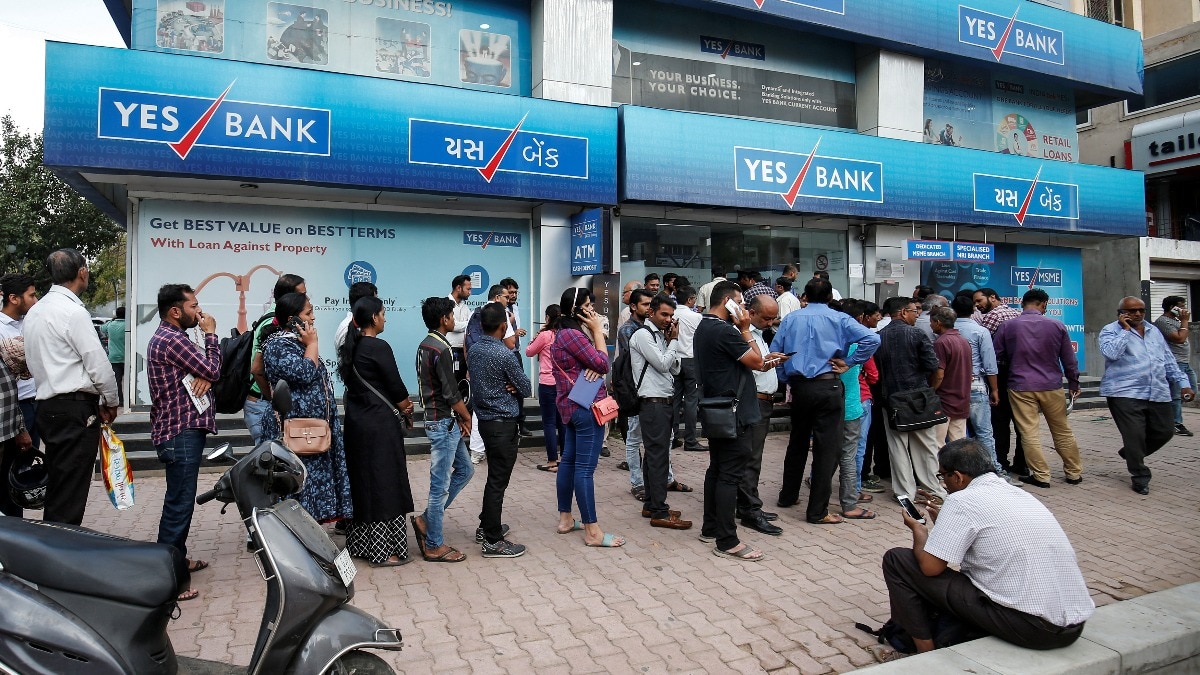
Yes Bank shares fell on Friday, extending losses after the Supreme Court upheld a ruling against the lender's decision to write off Rs 8,415 crore worth of Additional Tier-1 (AT-1) bonds during its 2020 rescue. The verdict has raised concerns about the bank's earnings and capital position, although S&P Global Ratings does not expect it to affect the lender's credit ratings.Yes Bank shares were trading at Rs 17.71, down 2.42%, around 11 am on Friday. The stock had plunged 14.43% to close at Rs 18.15 on Thursday after the Supreme Court delivered its verdict.The ruling is a setback for the bank because the Rs 8,415-crore bond write-off had helped strengthen its capital during the 2020 reconstruction. Reversing that decision creates a financial burden for Yes Bank, even as the reinstatement of the bonds could partly offset the hit to common equity.WHAT DID THE SUPREME COURT RULE?On October 15, the Supreme Court dismissed appeals filed by Yes Bank, the Reserve Bank of India (RBI) and the Union government against a Bombay High Court judgment that had set aside the bank's decision to write off the bonds. The dispute dates back to March 2020, when Yes Bank was facing a severe financial crisis and was placed under a moratorium. The RBI subsequently put in place a reconstruction scheme, with State Bank of India and other lenders participating in the rescue.As part of the process, Yes Bank wrote down two tranches of AT-1 bonds issued in 2016 and 2017, worth a combined Rs 8,415 crore, to zero on March 14, 2020. Investors who held these bonds lost their investments. The legal question was whether the bank's administrator had the authority to write off the bonds after the final reconstruction scheme had come into force. The Supreme Court upheld the Bombay High Court's January 20, 2023 judgment, which had set aside the write-off.The court found that the final reconstruction scheme did not authorise the administrator to take this step. The clause permitting the write-down had been omitted from the final scheme, meaning the administrator could not exercise a power that the approved plan did not provide.The verdict does not amount to a finding that every sale of these bonds was mis-sold. The court's central decision concerned the legality of the write-off and the administrator's authority. Allegations that the bonds had been mis-sold to retail investors were a separate, though closely related, part of the dispute.WHEN DID THE AT-1 BOND MIS-SELLING CASE FIRST EMERGE?The allegations became public in March 2020, as Yes Bank's rescue plan and the write-off of the bonds came into focus.Reports of alleged mis-selling of Yes Bank's AT-1 bonds surfaced in March 2020, following the lender's rescue and the write-off of the bonds.Retail investors alleged that bank relationship managers had encouraged them to invest in these high-risk instruments by presenting them as products similar to fixed deposits, without adequately explaining the risks involved. Some investors, including retirees, said they had moved their savings from fixed deposits into the bonds and lost their investments after the Rs 8,415-crore write-off.The allegations brought scrutiny to how the bonds were sold to retail investors and whether they had been adequately informed about the risks.Investors alleged that relationship managers had pitched the bonds as safer alternatives to fixed deposits, sometimes highlighting their higher interest rates without adequately explaining the risks. Some investors said they had been persuaded to break fixed deposits to buy the instruments.AT-1 bonds are a form of bank capital designed to absorb losses when a lender comes under severe stress. They are typically perpetual instruments, meaning they do not have a fixed maturity date, and they can carry provisions allowing their principal to be written down under specified circumstances. They are therefore substantially riskier than bank fixed deposits.In April 2021, Sebi imposed a Rs 25-crore penalty on Yes Bank over alleged mis-selling of AT-1 bonds in the secondary market. The bank said it would appeal the order. The allegations and the separate legal challenge to the 2020 write-off subsequently moved through regulatory and judicial proceedings.WHAT DOES S&P SAY ABOUT THE IMPACT ON YES BANK?S&P Global Ratings said the Supreme Court ruling would weigh on Yes Bank's earnings but was not expected to affect its ratings. The agency believes the bank's credit profile can withstand the ruling and expects it to remain adequately capitalised.S&P expects the impact of reinstating the bonds to be largely offset by the corresponding restoration of the bond liabilities. It projects Yes Bank's risk-adjusted capital ratio at 8% to 8.5% through March 2028, compared with 9% in March 2026.The bank's common equity tier-1 (CET1) ratio stood at 13.87% at the end of March 2026. S&P said this could absorb an estimated 250-basis-point hit while remaining comfortably above the regulatory minimum requirement of 5.5%.In other words, the ruling is expected to hurt earnings and put pressure on capital ratios, but S&P does not believe the impact is large enough to undermine the bank's overall creditworthiness. The rating assessment, however, does not mean the ruling is financially neutral for Yes Bank or that its share price cannot remain volatile.WILL THE RULING AFFECT YES BANK SHAREHOLDERS?For shareholders, the immediate concern is the financial impact of reversing the bond write-off. The ruling could affect reported earnings and capital ratios, while uncertainty over the accounting treatment and the bank's next steps may keep the stock under pressure.The reinstatement of the bonds could also mean that the bank has to recognise liabilities that it had previously eliminated. While S&P expects this to be largely offset in the common-equity calculation by the reinstatement of the bonds, investors will need to watch the bank's disclosures to understand the final accounting impact.The ruling does not automatically mean that Yes Bank is facing another financial crisis. S&P's assessment suggests that its capital position remains adequate, but the case creates an additional financial burden and may complicate the bank's efforts to improve profitability.For existing shareholders, the key factors to track are the bank's accounting treatment of the bonds, any appeal or further legal action, changes in capital adequacy and the impact on future earnings. A sharp fall in the share price reflects investor uncertainty, but it does not by itself establish the long-term direction of the stock.Yes Bank has said it is examining the Supreme Court judgment. The market will look for clarity on how the lender plans to implement the ruling and what it means for its financial statements and capital position.Investors should also distinguish between the bank's credit rating and its equity valuation. S&P's view that the ruling is unlikely to affect ratings is a signal that the bank's ability to meet its obligations remains intact; it is not a guarantee that the share price will recover.The next major signals will be the bank's formal disclosures, any further legal developments and evidence of how the ruling affects earnings and capital ratios over coming quarters.(Disclaimer: The views, opinions, recommendations, and suggestions expressed by experts/brokerages in this article are their own and do not reflect the views of the India Today Group. It is advisable to consult a qualified broker or financial advisor before making any actual investment or trading choices.)- Ends
Yes Bank shares slide 3% after verdict on AT-1 bonds: Will it impact investors?
Full Article
Original Source
Read the full article at Indiatoday →KhanList aggregates and links to publicly available news content. We do not host full articles from third-party sources. Always verify important information with original sources.