
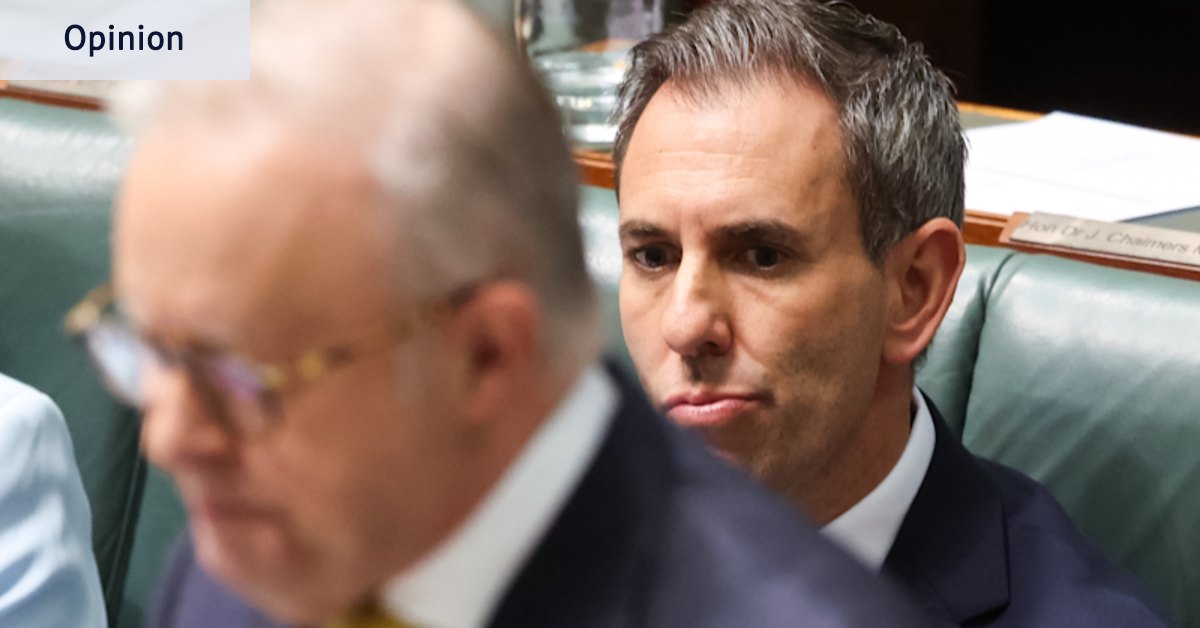
OpinionChief political commentatorOctober 15, 2026 — 3:30pmOctober 15, 2026 — 3:30pmTreasurer Jim Chalmers has been on the rack this week after the ATO decided to stop allowing businesses to pay their tax on their credit cards as it didn’t want to absorb the cost of the credit card surcharges. It sounds like a boring but sensible budget decision by the tax office because taxpayers would be on the hook to cover the additional costs.But politically it was an absolutely shocker.PM-treasurer relationships are always the subject of fascination for political watchers.Alex EllinghausenThe decision suggested the government doesn’t understand the pressures smaller businesses are already facing, including high fuel prices, high inflation and prospective changes to the tax treatment of trusts, of which many businesses make use.The government’s rapid backdown last Friday, overruling the tax office and delaying the rule change until next financial year (at least), should have been the end of it.But then the prime minister put his foot in it, unable to resist taking credit (as prime ministers are wont to do) for the political fix during a speech at the Australian Chamber of Commerce and Industry’s (ACCI) gala dinner on Tuesday night.“Andrew did text me last Thursday morning, and by Friday morning we had an announcement,” Albanese told guests, referring to the ACCI chief executive Andrew McKellar. Such things were possible, the prime minister added, when you’ve taken time to develop relationships with (in this case) business groups.That would be the very same McKellar who told this column as recently as August that the government didn’t “value enterprise and commercial risk-taking … the preferred model being put forward is [to] take the safe path, get a public sector job, join a union, consume, be silent, die”. But I digress.The prime minister low-key threw his treasurer under the bus in his rush to claim credit.The fact that Albanese said, during question time on Wednesday, he had discussed the surcharge backdown with the treasurer earlier last week, and that the Expenditure Review Committee had unanimously backed it, suggests, at a minimum, that Albanese knew he had over-egged things.Albanese’s mistake prompted questions about the relationship between him and Chalmers. PM-treasurer relationships are always the subject of fascination for political watchers and, as John Howard observed this week, a bit of “constructive tension” between the two most important ministers in any government was necessary.In the course of researching a forthcoming book with my colleague Shane Wright, the relationship between the pair has been a particular focus.The two men are from opposing factions, Left and Right, and from different states. Though they share a March 2 birthday they are a generation apart in age, and Chalmers’ ambition and impatience to implement economic change often butts up against Albanese’s patience and caution.Negative gearing and capital gains tax changes are a case in point: Albanese dumped them when he became opposition leader but Chalmers continued to advocate for the reforms internally. After several false starts, Albanese was finally locked in and 100 per cent behind the measures in the most recent budget.The prime minister is therefore not about to sack his treasurer, despite calls from Opposition Leader Angus Taylor and other overblown commentary in the past few months. But the powerful pair (and the government) are enduring a torrid time of late.Labor is in a tough spot right now. Its primary vote in the Resolve Political Monitor has been in the 20s since May 16, after the most recent budget was handed down, One Nation’s surge in the polls has (so far) proved to be more than just a flash in the pan, and Taylor’s performance rating is well ahead of Albanese and catching up to Pauline Hanson.It also has a huge cohort of inexperienced MPs: 49 of the government’s 124 senators and members are serving either in their first or second term in parliament (28 are in their first), meaning they have never experienced the slog of opposition or, even, sustained periods of bad polling and tough commentary on the direction and strategy of the government.The fact that Albanese had to remind his caucus this week that the next election was not due until May 2028, and that he planned for Labor to be “kicking with the wind in the fourth quarter” – a phrase he first used during the difficult days of opposition – underscores just how nervous some MPs have become about the government’s relationship with business, and their own seats.After winning a stunning 94 seats in the lower house at the last election, it’s all but certain that Labor will lose some seats next election. But those MPs wetting the bed about their political futures should stop and take a breath.Firstly, the government could lose 18 seats at the next poll and still govern in majority. And secondly, while Albanese is not popular, he is still comfortably the country’s preferred PM, in much the same way that Howard was unpopular but reliably won elections.The opposition has spent a lot of time arguing that the changes to trusts, negative gearing and capital gains tax are horrendous. But if it chooses to reverse them, the opposition will punch a structural hole in the budget while also promising income tax cuts, no new taxes and a better budget bottom line. That’s magic-pudding economics.In the annals of unpopular budgets and prime ministers throwing their treasurer under the bus, Chalmers’ budget and Albanese’s efforts this week are barely a blip.Joe Hockey’s 2014 budget was the gold standard for unpopular budgets, with the government unable to pass the majority of cuts to education, healthcare and more that it had promised not to make.A year and a half later, Tony Abbott made a failed bid to give Scott Morrison Joe Hockey’s job as treasurer, in a bid to save his own leadership. Now that is throwing your treasurer under the bus.The brouhaha over the past five months suggests people have forgotten what real economic reform looks like, and how much work is involved. Chalmers’ first four budgets were criticised for a lack of ambitious reform (a charge the treasurer rejects out of hand), and his fifth budget is now being criticised simultaneously for being too ambitious and for not constituting “real” reform (which is often code for “not what I wanted the government to do”).By pursuing a trio of high-risk-high-reward reforms to capital gains, negative gearing and the tax treatment of trusts, Chalmers is deliberately choosing to disadvantage some people and advantage others.Politicians and economists can and will debate the pros and cons of the government’s tax changes for years to come. They are the biggest and most ambitious measures since the introduction of the GST. In that context, the fuss over the ATO tax fix is a minor matter. Anxious Labor MPs need to hold their nerve.Get a weekly wrap of views that will challenge, champion and inform your own. Sign up for our Opinion newsletter.From our partners
Yes, Albanese threw Chalmers under the bus, but it was a very small bus
Full Article
Original Source
Read the full article at Smh →KhanList aggregates and links to publicly available news content. We do not host full articles from third-party sources. Always verify important information with original sources.