
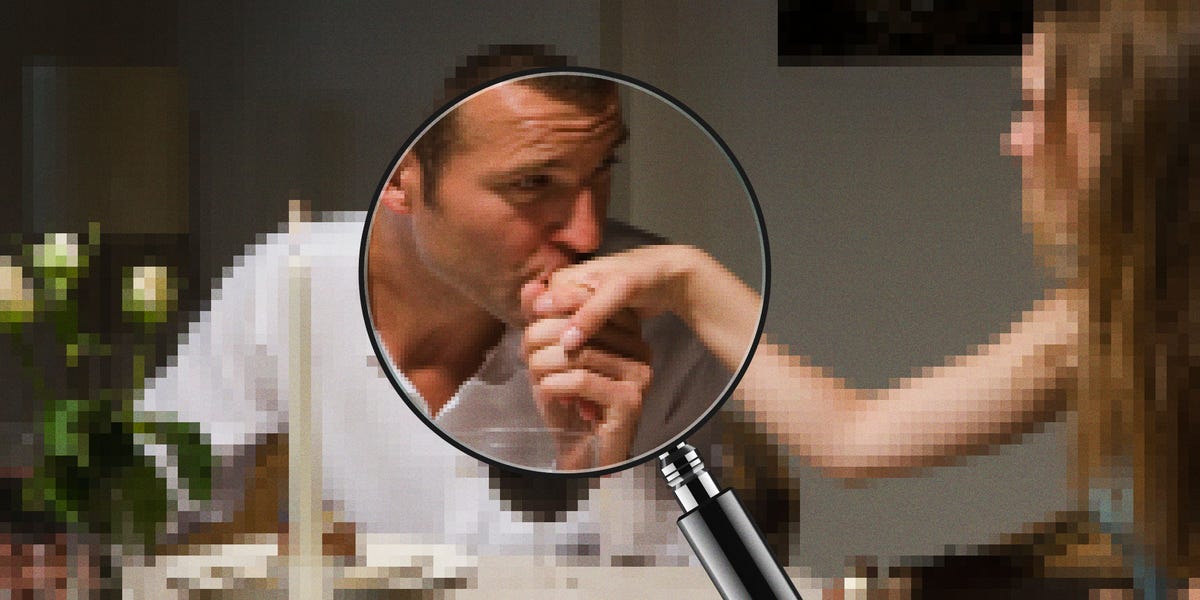
Years before he became “Dirty John,” an infamous stalker who preyed on a young woman while carrying a butcher knife hidden in a Del Taco bag, I met John Meehan over dinner at the Chateau Marmont. He was dating my friend.It was 2010, and my friend Kate had recently met a handsome, charming anesthesiologist named John Meehan on a dating website. She was smitten. He was successful, attentive, and apparently desperate to commit. He'd even asked for a key to her house. Kate was head over heels; I was spooked. Something about John didn't add up.Over dinner, John talked endlessly about his medical career, including the technical details of surgeries with gas ratios and how much money he made. Yet when I asked which medical school he'd attended, he became strangely evasive. When the bill arrived, John meticulously calculated his share down to the penny, despite having spent the evening boasting about his seven-figure income. Maybe he was just frugal. But there was a growing collection of little things that didn't make sense.Kate thought I was being cynical. At the time, I was an investigative journalist and former sex columnist living in L.A. who had recently enrolled in private investigator school. So, sure, maybe that wasn’t too misplaced. But I trust my instincts and genuinely thought she was in danger—when John left the restaurant, I borrowed my then-husband's Mercedes and followed him. John had told Kate he lived with his sister in Pasadena. He drove somewhere else entirely.Over the following days, I began digging. I discovered that John wasn't the doctor he claimed to be—he was a nurse anesthetist with a long criminal history, had lost his professional license, and had been accused of stalking women.I’ve seen many situations where people get into dangerous situations—from confronting love rivals to going back for one last suitcase—all for love.I had mixed feelings about telling Kate the truth. I knew that I had to break the bad news, but I was super nervous when I showed up to our happy hour date carrying a printout of John’s mug shot. Fortunately, she believed me and broke things off. And although I suspected at the time that he was a con artist with a serious capacity for violence, I was left feeling helpless.Years later, I listened in horror as the Dirty John podcast chronicled what happened when John Meehan entered his wife Debra Newell’s life. Their story mirrored his and Kate’s, except that when she tried to break up with him, things took a much darker turn. He eventually attacked her adult daughter, Terra Newell, who bravely fought back and killed him in self-defense. Hearing that, I was relieved that Kate had escaped. But I was also haunted by the knowledge that recognizing a dangerous man hadn't stopped him from finding another victim.From sitting outside no-tell motels on matrimonial surveillance to piecing together a crime victim’s last day on earth, I’ve seen many situations where people get into dangerous situations—from confronting love rivals to going back for one last suitcase—all for love.Here’s what detective work has taught me about dating:Love is the ultimate confirmation biasBefore I became a private investigator, I was a sex and dating columnist for The Independent in London. I spent years documenting my romantic adventures, writing about everything from casual sex to heartbreak. I've always been fascinated by the similarities between dating and detective work.In both instances, you’re sitting across from a relative stranger. You’re asking questions, and you’re trying to figure out whether they are telling the truth—all the while hoping that, in the dating realm, any skeletons you unearth are metaphorical, and not decomposing in someone’s crawlspace.But there's one enormous difference. When I'm investigating someone professionally, I'm looking for inconsistencies. When I'm falling for someone, I'm looking for reasons to believe them. And that's where things get dangerous.It’s been scientifically proven that love causes a dopamine reaction in the brain similar to eating pounds of chocolate or snorting cocaine. Think about it: Would you make any other major life decision—like who to live with, introduce to your children or combine finances with—while high? That’s why I love the idea of a “sexual sober friend,” aka someone who will tell you straight up if you are being totally irrational. Of course, you have to actually be willing to take said friend’s advice–see below!Pay attention to what people do, not just what they sayOne of the most useful lessons I learned in PI school was to not to “give people the benefit of the doubt.” Instead, we say, “Trust, but verify.”When you're investigating a crime, you build a timeline. You figure out what happened, when it happened, and whether the evidence supports the accounts you've been given. I think romantic relationships benefit from a much less obsessive version of the same principle.A charming explanation is not the same thing as a credible one.Someone tells you they're looking for a serious relationship. Do their actions support that statement? Do they make plans? Follow through? Introduce you to people in their lives? Respect your boundaries? Or do they deliver a spectacular speech about wanting to find their soulmate and then disappear for eleven days because, apparently, their phone fell into the sea? A charming explanation is not the same thing as a credible one.I once worked on a surveillance case involving a wife whose husband worked a boring day job as a dentist...but she was never allowed to come to his office, and he would disappear for hours in the evening. When he told her that he wanted a divorce and was leaving, she wanted to know where he was going, so she hired me and my partner.After 18 hours of surveillance, I was able to confirm what six years of couples’ therapy had failed to deliver: confirmation that not only was he cheating on her with his receptionist, which I captured on camera while hiding in a deserted parking lot, but that he was leading a double life as a wannabee-Soprano small-time strip club drug dealer.The next day, as I played the video evidence of his double life, writing prescriptions for several dancers, smoking pot, and shopping the aisles of Trader Joe’s for munchies, she told me that she had suspected for years that something was off, but she never felt ready to ask him the questions that would shatter her world. That’s happened to me a lot when I was doing matrimonial surveillance: People will tell me about finding incriminating photographs, suspicious messages, or underwear that clearly doesn't belong to them—and then ask me whether I think something is wrong.Often, they're not really asking me to uncover the truth. They're asking me to give them permission to believe what they've already seen. Which brings me to my next principle:Trust your instincts—but don't confuse suspicion with evidenceI believe in intuition, but I don’t believe that it’s supernatural magic. Sometimes it's simply our brains recognizing patterns before we've consciously identified them.At that first dinner with John Meehan, I couldn't immediately explain why I felt uncomfortable. But as the evening continued, I used my investigative training to spot the inconsistencies: his evasiveness, his elaborate claims, the mismatch between the person he presented and the details of his life. The important part wasn't that I had a bad feeling, it was that I paid attention to the feeling and then looked for facts.Being good at reading people doesn't make you immune to themEven after years of studying human behavior, I still sometimes find myself making the same mistakes I warn other people about.While working as a journalist on a murder investigation in Arkansas, I became attracted to someone I was interviewing, someone who had been good friends with a possible person of interest. I knew perfectly well that personal chemistry could interfere with my judgment but found myself getting involved anyway.Investigative work can teach you to be skeptical, but skepticism isn't a force field. You can know that someone is wrong for you and still want them. And you can be exceptionally good at uncovering other people's secrets while remaining spectacularly talented at hiding things from yourself.Don’t become a detective in your own relationshipA lot of people expect me to turn into Nancy Drew with every man I meet. There’s some truth to that; like most women, I do a Google deep dive before meeting someone for the first time.But after spending years investigating cheating spouses, con artists, and eventually a cold-case murder, I've become convinced that there's a fine line between healthy curiosity and turning your love life into a full-time surveillance operation.I don't think women should spend their evenings running background checks on every man who buys them a cocktail. Nor should they secretly follow their partners or interpret every unanswered text as evidence of a double life.I never invade any significant others’ privacy and never would. If I don’t trust them, the relationship isn’t worth it to me. Because tracking people, online or otherwise, is exhausting. And I already have enough of that in my day job!For years, I thought being a good investigator meant finding answers to every question. Now I think one of the most important skills—both in detective work and in dating—is knowing when you have enough information to make a decision. And when it's time to stop investigating and get on with your life.This image is of a professional model and used for illustrative purposes only. Catherine Townsend is an investigative journalist, licensed private investigator, and host of the true-crime podcast Hell and Gone. Her new book, HOW TO SURVIVE A MURDER INVESTIGATION: A True Story of Death and Danger in the Ozarks, is out now.
Years of Being a Private Investigator Taught Me So Much About Dating Men
Full Article
Original Source
Read the full article at Cosmopolitan →KhanList aggregates and links to publicly available news content. We do not host full articles from third-party sources. Always verify important information with original sources.