
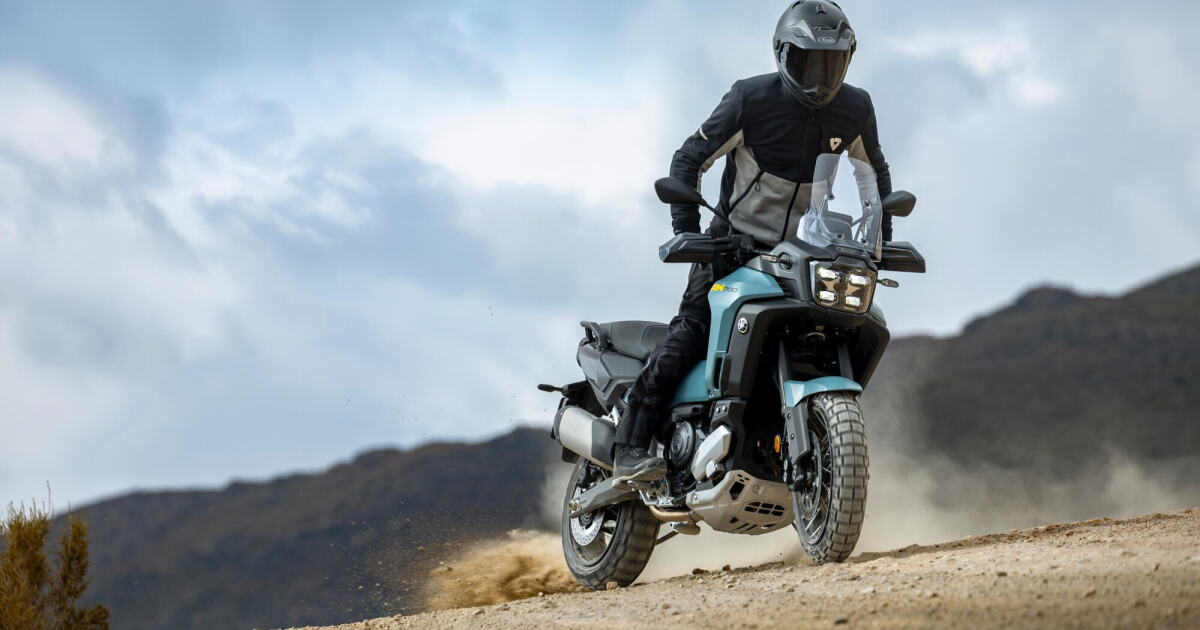
As someone who’s breathing motorcycle and automotive news day in, day out, I’m often asked about my favorite motorcycles and cars. And since I'm particularly keen on adventure motorcycles, I often find myself repeating one motorcycle in my answers: the Yamaha Ténéré 700.The reason is pretty simple. There is hardly any other motorcycle out there that’s as simple, as complete, and as genuinely capable of taking you just about anywhere. It doesn't need a dozen electronic riding aids or a complicated suspension setup to make its point. Give it a decent set of tires, a tank of fuel, and a willing rider, and it's ready to disappear down some forgotten mountain road.But what if I told you that Yamaha thinks you could get much of that adventure without an adventure motorcycle at all? What if, instead of straddling a tall, intimidating dual-sport, you could do it on a scooter?That might sound like sacrilege to the ADV faithful, but Yamaha appears to be entertaining exactly that idea with its new RW700 and RW350 scoots. These aren't your run-of-the-mill urban commuters with some adventure bodywork slapped on. Best of both worlds with on-road/off-road abilityYamaha They're built around the rather interesting proposition that a scooter can be more than a city runabout, potentially offering a more approachable, practical and surprisingly capable way of getting off the beaten track. And while I'm not quite ready to trade my imaginary Ténéré 700 for a scooter, Yamaha has certainly got my attention.Reason number one. At the heart of the RW700 is Yamaha's familiar 689cc CP2 parallel-twin, the same engine that powers the MT-07, YZF-R7, and Ténéré 700. It retains the characteristic 270-degree crank layout, but gets a slightly different state of tune for scooter duty.Yamaha quotes 68.4 hp at 8,250 rpm, alongside 48 lb.ft of torque delivered between 6,500 and 6,750 rpm. A chain drive sends power to the rear wheel.The equipment list is pretty interesting, too. Cruise control and a speed limiter are included as standard, while the Y-AMT transmission offers a choice between fully automatic operation and manual gear selection. The six-speed system does away with both the traditional clutch lever and foot-operated gear shifter. Instead, you can change gears through switches on the handlebars or simply let the electronics handle the job. Yamaha has also revised the clutch damping and shifting hardware, while tweaking the transmission software to better suit riding conditions on loose terrain. It is powered by the 689cc CP2 parallel-twin, the same motor as on the Ténéré 700Yamaha Reason number two. An equally adept chassis. The RW700 uses a double-cradle steel frame, paired with a 41-mm inverted fork offering 6.2 in (157 mm) of travel. At the rear, a link-type setup with a single shock absorber provides another 6.1 in (156 mm) of travel. Both ends are designed to offer enough compliance for terrain that might be a little less forgiving than your usual city streets.Wheels come in the form of a 17-inch front and 15-inch rear wire-spoke combination, wrapped in tubeless Pirelli Scorpion Rally STR tires. Yup, the same kind of rubber you’d typically find on hardcore adventure and dual-sport bikes. Braking duties are handled by twin 298-mm discs at the front, operated by hydraulic calipers, and a single 267-mm disc at the rear.My only gripe is how heavy the thing really is for a scooter. Yamaha claims a wet weight of 487.2 lb (221 kg) for the standard RW700. It also gets a 31.9-in (810-mm) seat height, 6.7 in (170 mm) of ground clearance, and a 3.7-gallon (14-liter) fuel tank.One of the more interesting touches is the choice between conventional scooter-style floorboards and proper, chunky footpegs. Other convenience features include self-cancelling turn signals and Yamaha's Smart Key system. The cockpit gets a 5-inch TFT instrument display, with Bluetooth connectivity for pairing your smartphone. It also supports Yamaha's Garmin StreetCross navigation app, which can be used free of charge. Tell me that doesn't look like an adventure motorcycleYamaha Reason number three. Electronics. A six-axis IMU feeds data to a suite of rider aids, including cornering ABS, lean-sensitive traction control, slide control, brake control, and engine-braking management.You get five selectable modes: Street, Sport, and Eco for tarmac, alongside Explore and Explore+ for venturing onto looser surfaces. The lattermost two also allow the rear ABS to be switched off, giving you more freedom to manage the back end on gravel.Yamaha has even tailored the automated transmission's software for off-road use, allowing it to account for wheelspin and sliding when deciding how and when to shift gears. Step up to the RW700 Explore, and the equipment list gets even more generous. It adds adjustable front suspension, heated grips, a heated seat, illuminated handlebar switchgear, and a center stand as standard.If the RW700 sounds like a little too much for your liking, Yamaha has a smaller alternative in the form of the RW350. It uses a less powerful 330cc single-cylinder engine, but doesn't appear to sacrifice much in the way of everyday equipment. The RW700 features Y-AMT that lets you choose between a fully automatic operation or a manual Yamaha You still get nifty features like under-seat storage with enough room for full-face helmets, cruise control, a 5-inch TFT display, Yamaha's Smart Key system, and self-canceling turn signals. The choice between conventional floorboards and proper footpegs is available here, too, so you can decide how you want to position yourself depending on the kind of riding you’re doing.The biggest mechanical distinction, naturally, is the transmission. Unlike the RW700, which uses Yamaha's six-speed Y-AMT setup, the RW350 sticks with a conventional V-belt automatic transmission. That should make it a more familiar proposition for anyone coming from a traditional scooter, without the added complexity of manually selecting gears.And that's perhaps where the RW350 makes the most sense. Not everyone needs a 689cc twin-cylinder engine or a nearly 500-pound adventure scooter to get away from the city. A smaller single-cylinder package could offer a more manageable, less intimidating entry point into the whole adventure-scooter idea.It might not have the same mechanical theatrics as its bigger sibling, but if Yamaha can get the balance between comfort, practicality, and genuine rough-road ability right, the RW350 could arguably be the more appealing everyday adventure companion. At 487.2 lb (221 kg), it is a bit heavy for a scooter, I have to admitYamaha Yamaha hasn't revealed pricing for either scooter just yet. For now, both models have only been announced for the European market, with no word on whether they'll eventually make their way to other regions.What really excites me is how fine the lines of adventure riding have become now. The likes of Honda's X-ADV were some of the early offerings in the adventure-scooter category. But when a company like Yamaha that has years of adventure motorcycling experience steps into the segment, you know how big the potential market really could be.That's largely because perhaps the next big adventure machine doesn't need a tall seat, a massive front wheel, or even a clutch lever. It might just need a CVT, a comfortable seat, and a willingness to take the long way home. Yamaha’s RW adventure scoots have all of that.Source: Yamaha
Yamaha urges you to ditch the ADV bike and take an ADV scooter instead
Full Article
Original Source
Read the full article at Newatlas →KhanList aggregates and links to publicly available news content. We do not host full articles from third-party sources. Always verify important information with original sources.