
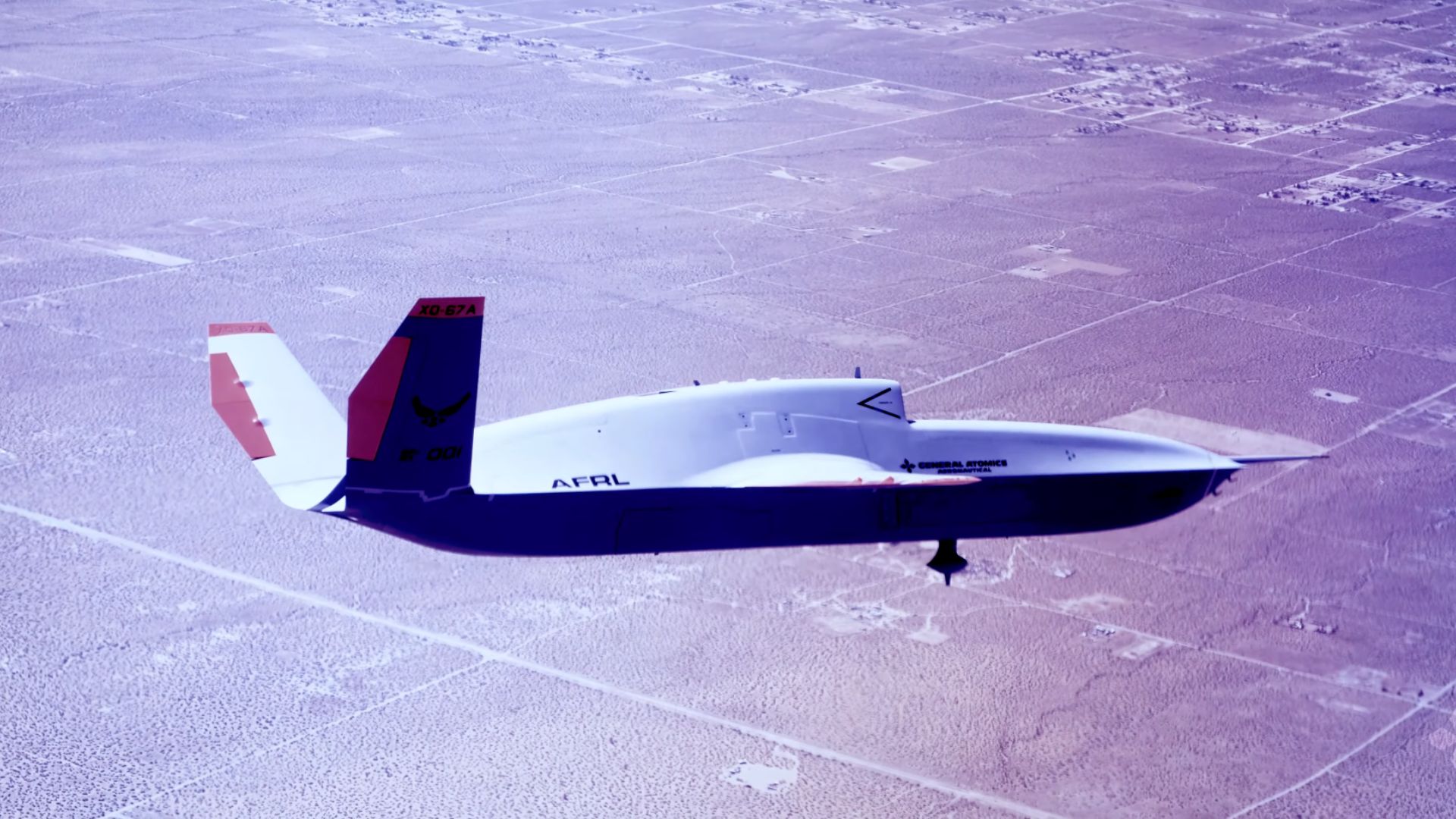
The US Air Force’s XQ-67A uncrewed aircraft has demonstrated integrated mission systems and beyond-line-of-sight data links during a test flight. The demonstration aimed to improve how uncrewed aircraft support crewed fighters by extending their reach, enhancing situational awareness, and reducing risks to pilots. The project brings together the Air Force Research Laboratory (AFRL) and Air Combat Command (ACC) to accelerate the development and delivery of uncrewed combat capabilities. “By pairing AFRL’s rapid prototyping with ACC’s operational test units, the Air Force is shortening the timeline between concept and warfighter capability,” said Col. Matthew Caspers, Deputy Technology Executive Officer for Air at the Department of the Air Force (DAF), in a statement. XQ-67A tests autonomy The US Air Force has flown its XQ-67A Autonomous Collaborative Platform (ACP) at the Nevada Test and Training Range, demonstrating the integration of advanced mission systems and beyond-line-of-sight communication technology. The test focused on technologies designed to help uncrewed aircraft operate across distributed theaters and support crewed fighter formations in demanding combat environments. During the flight, the XQ-67A demonstrated the integration of several mission-critical systems, including advanced sensors, mission computers, and power and thermal management hardware. These components are designed to work together in demanding operational environments, providing the aircraft with the onboard technology needed to support autonomous missions. Sensors collect information about the aircraft’s surroundings, while mission computers process data and support mission-related functions. Integrating these systems into a common platform is important for developing uncrewed aircraft that can gather, process, and communicate information during operations. The flight also tested power and thermal management hardware, which helps manage the electrical and heat loads generated by onboard equipment. These functions are particularly important when multiple advanced systems operate together, as they must remain within their operating limits to support reliable performance. Rather than evaluating individual components in isolation, the demonstration focused on integrating these technologies within the XQ-67A. The test provided an opportunity to assess how the systems work together as part of an autonomous aircraft architecture. Another key element of the demonstration was the integration of beyond-line-of-sight (BLOS) data links. These communication systems enable information to be transmitted beyond the direct line of sight between communicating platforms, supporting operations over greater distances. The test combined the data links with live, virtual, and constructive (LVC) simulations. This approach brings together real-world activities, simulated environments, and computer-generated elements to evaluate how systems and operational units can function together. According to the AFRL, the demonstration showed how uncrewed platforms could be managed across distributed theaters using resilient, layered command and control. Such capabilities are intended to help military forces coordinate operations across geographically separated areas while maintaining access to combat-relevant information. The flight also evaluated autonomous architectures aligned with the Autonomy and Agile Mission Suite Government Reference Architectures. These government reference architectures provide a common technical framework for developing and integrating autonomous systems and mission software. The Air Force said the XQ-67A’s systems were able to process and relay combat-relevant data in real-world scenarios. This capability is central to efforts to develop uncrewed aircraft that can exchange information and operate as part of a broader force rather than functioning as isolated platforms. The XQ-67A is being developed as part of the Air Force’s broader effort to advance Autonomous Collaborative Platforms. These uncrewed aircraft are intended to complement crewed combat aircraft by extending their operational reach, improving situational awareness, and increasing the number of available aircraft.By deploying uncrewed platforms alongside crewed fighters, military commanders could gain additional operational capacity without requiring a pilot in every aircraft. The approach is also intended to reduce the exposure of human aircrews to dangerous missions. The demonstration supports the US Department of the Air Force’s efforts to develop systems that can deliver greater operational reach and more resilient command and control in complex combat environments.Get the latest in engineering, tech, space & science - delivered daily to your inbox.Jijo is an automotive and business journalist based in India. Armed with a BA in History (Honors) from St. Stephen's College, Delhi University, and a PG diploma in Journalism from the Indian Institute of Mass Communication, Delhi, he has worked for news agencies, national newspapers, and automotive magazines. In his spare time, he likes to go off-roading, engage in political discourse, travel, and teach languages.
XQ-67A drone test advances US Air Force plans for uncrewed combat aircraft
Full Article
Original Source
Read the full article at Interestingengineering →KhanList aggregates and links to publicly available news content. We do not host full articles from third-party sources. Always verify important information with original sources.