
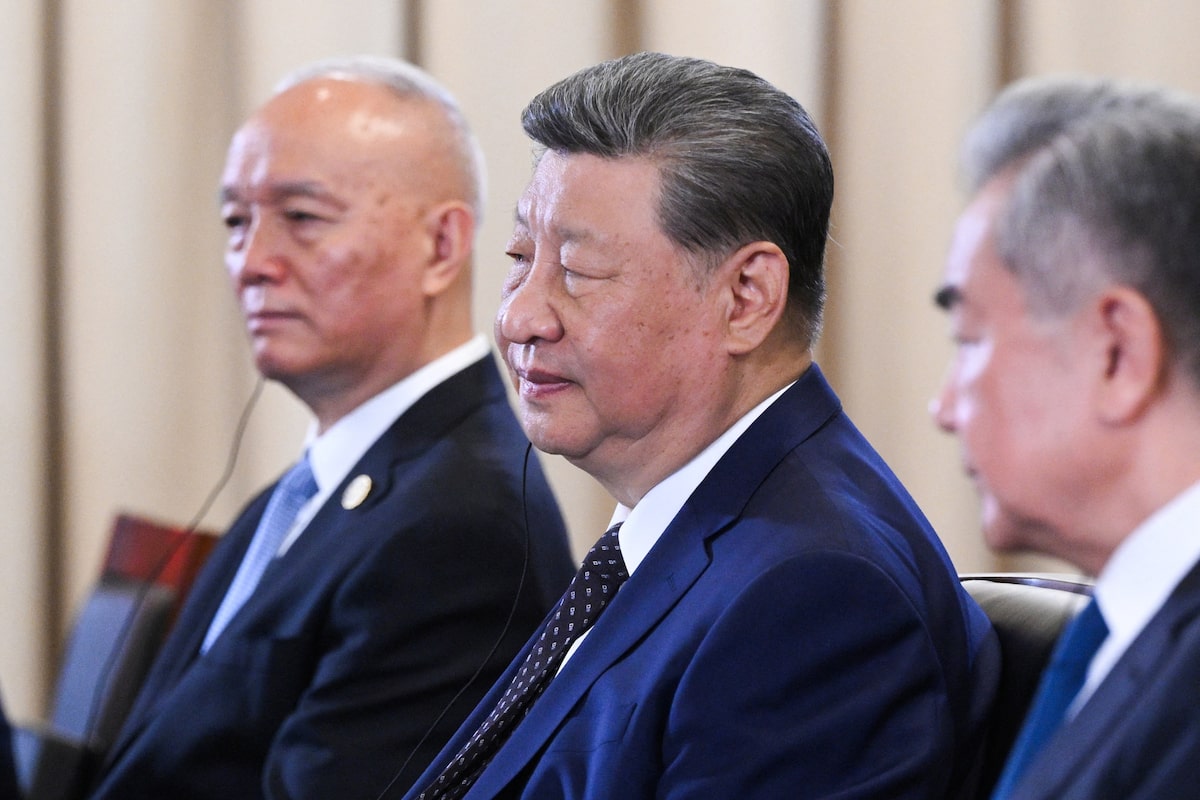
Open this photo in gallery:Russian President Vladimir Putin and China's President Xi Jinping are seen prior to talks on the sidelines of the Shanghai Cooperation Organisation, in Bishkek, Kyrgyzstan, on Monday.Kristina Solovyova/The Canadian PressIn 1997, Chinese leader Jiang Zemin and Russian President Boris Yeltsin issued a “Joint Declaration on a Multipolar World and the Establishment of a New International Order.” The primary vehicle for this was to be the Shanghai Cooperation Organisation, founded in 2001 by China, Russia and four Central Asian powers. While the SCO has added members and extended its remit steadily over the past two decades, it has remained a minor international forum, the doings of which are dutifully reported by various state-controlled media outlets but largely ignored by much of the world.Twenty-five years on, a lot has changed: As SCO leaders gathered this week in the Kyrgyz capital of Bishkek, amid the wars in Ukraine and Iran and the massive economic disruption wrought by U.S. President Donald Trump, the organization looks a lot more like a model of a new world order than ever before — and one led by China. Under current President Xi Jinping, China has advanced the SCO – along with the BRICS grouping and several Beijing-led initiatives – as a challenger to what it sees as a U.S.-dominated international system, and on Tuesday, Mr. Xi urged members to take up the mantle of “historical responsibility and proactively guide the course of history.”Mr. Xi called on members to advocate for “equitable economic globalization,” in part driven by China’s massive Belt and Road trade and investment initiative, and “improve fair and orderly governance.” The SCO, he said, should “strictly prevent external forces from interfering in the internal affairs of other countries, endangering political security or undermining regional stability.” It was a major flex of Chinese geopolitical influence and ambition ahead of a trip later this month by Mr. Xi to Washington, after Mr. Trump’s own visit to Beijing in May, where he was apparently overawed by China’s leader and secured little beyond extending a trade war truce that Mr. Xi dearly wants to keep in place. Trump and Xi exchange praise at meeting but talk past each other on Iran, TaiwanAmong the leaders joining Mr. Xi in Bishkek were Indian Prime Minister Narendra Modi, Iranian President Masoud Pezeshkian and Russian President Vladimir Putin, with whom Mr. Xi met Monday, greeting him warmly in front of the cameras before the two leaders began a private bilateral summit. The two men have a close and longstanding friendship, and Mr. Xi said relations between China and Russia “will become ever stronger, their progress ever steadier, and their future ever brighter” under his and Mr. Putin’s leadership. The timing of their meeting, while determined by the annual SCO summit, has echoes of earlier this year, when Mr. Putin arrived in Beijing hot on the heels of Mr. Trump and left far happier. Open this photo in gallery:Members of the delegations, led by Russian President Vladimir Putin and Chinese President Xi Jinping, attend a meeting on the sidelines of the Shanghai Cooperation Organisation summit.Kristina Solovyova/ReutersWu Xinbo, director of the Center for American Studies at Shanghai’s Fudan University, said that “in China’s foreign policy, China‑Russia relations carry greater importance and standing than China‑U.S. relations.” Moscow and Beijing are comprehensive strategic partners, whereas the U.S. remains a key rival, no matter the current trade truce expected to be extended by Mr. Xi and Mr. Trump in coming weeks.Craig Singleton, senior fellow at the non-partisan Foundation for Defense of Democracies, said Mr. Xi “sees no contradiction between seeking a steadier relationship with Trump and deepening ties with Putin.” “Beijing can use tactical stability with Washington to reduce economic risk while continuing to strengthen relationships that constrain U.S. power,” he added. “The Xi-Putin meeting is a reminder that summit diplomacy with Trump is about managing competition, not changing China’s strategic alignment.”It’s unclear whether Mr. Pezeshkian, who met with Mr. Modi, Mr. Putin and Pakistani Prime Minister Shehbaz Sharif in Bishkek, held a formal bilateral meeting with Mr. Xi, but Iran’s presence at the SCO summit was consequential nonetheless, Mr. Singleton said. “China remains Iran’s most important economic lifeline even as Washington escalates military and financial pressure on Tehran. Xi can support calls for diplomacy while preserving Beijing’s economic relationship with Iran,” he said. “That gives China room to present itself as a stabilizing power while retaining considerable leverage over an adversary of the United States.”A formal meeting with Mr. Pezeshkian “would underscore Beijing’s willingness to visibly engage Tehran just weeks before Xi travels to Washington,” he added, while avoiding one would suggest China was wary of potentially angering Mr. Trump, who has at times attempted to foist blame for continuing disruptions from the Iran war onto Beijing. From Bishkek, Mr. Xi flies to Cairo for a state visit, his first in 10 years to Egypt, which has borne the brunt of disruptions from both the war in Iran and Israel’s ongoing military action in Gaza. Both conflicts have shown the limits of China’s influence in the Middle East, which had appeared to be growing in the wake of several failed U.S. wars. In an essay published in Egyptian media Tuesday, Mr. Xi said “profound changes unseen in a century are unfolding at a faster pace, amid a volatile international landscape.” “We need to join hands to lead the way in China-Arab and China-Africa cooperation,” he added. Julian Gewirtz, a former senior director for China at the White House National Security Council, said Mr. Xi’s packed diplomatic schedule this month – as well as Bishkek and Cairo, he is expected to travel to India for a BRICS summit before heading to Washington – was indicative of “Beijing’s growing sense of strategic opportunity.” Mr. Xi wants to “show that China has friends and options around the world at precisely the moment Washington is alienating many of its allies,” Mr. Gewirtz wrote on his Substack. “Beijing can deepen its influence across Eurasia and the Global South, build institutions around its own priorities – and then arrive in Washington to be feted by the American president. Put another way, China can build an international ecosystem less centred on Washington while managing – and extracting benefits from – Washington itself.”
Xi flexes China’s global influence as he meets with Putin ahead of Trump summit
Full Article
Original Source
Read the full article at Theglobeandmail →KhanList aggregates and links to publicly available news content. We do not host full articles from third-party sources. Always verify important information with original sources.