
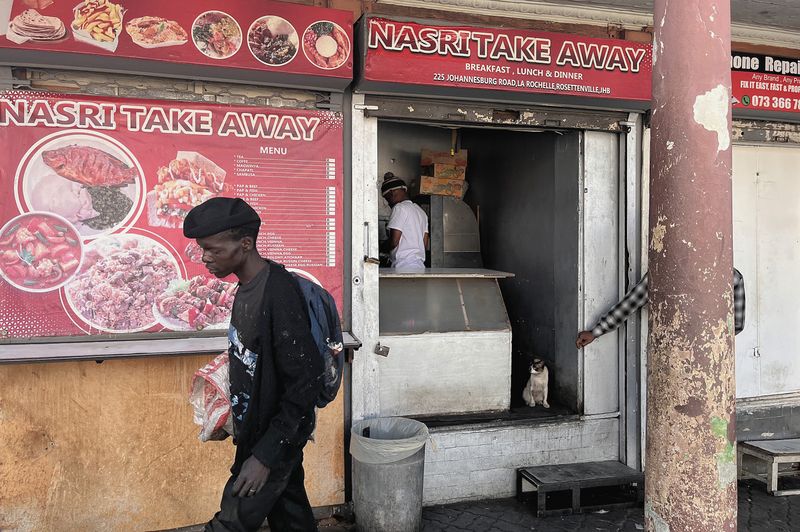
In Rosettenville, Gauteng, foreign shopkeepers and hairdressers said that police make routine stops at their businesses, threatening to arrest and deport those who do not pay sometimes substantial bribes. In Knysna, Western Cape, foreign workers in low-paying jobs say their transport runs to and from work are beset by police officers who demand payment – also under threat of arrest and deportation. Both groups said that the extent to which they are targeted by police has increased substantially in 2026. Since at least 2015, civil society organisations such as Corruption Watch and Lawyers for Human Rights have routinely raised the alarm over police and Home Affairs officials abusing their power over migrants to solicit bribes large and small. Lawyers for Human Rights has published similar reports in recent years, which highlighted the role of police and Home Affairs officials abusing their powers over immigrants to extort bribes. All 41 people it interviewed for a 2023 LHR report attested to the “pervasive solicitation of bribes… as a condition for their release”.“Foreign nationals have become a lucrative business for all law enforcement,” added Sharon Ekambaram, the head of LHR’s Refugee and Migrant Rights programme, during a recent interview. A cycle of catch-and-release in RosettenvilleLast month, officers at Booysens police station allegedly netted more than R10,000 in bribes from eight immigrant hairdressers after arresting and threatening them with deportation. Viewfinder visited the area a few days after the eight were released and interviewed three of them, including the barbershop’s 38-year-old Congolese owner. They all asked not to be named for fear of further reprisal from the police.They said that police officers, some of whom initially posed as plainclothes customers, raided their barbershop on the afternoon of 20 October.The officers started demanding passports and unspecified “documents”. One of the barbers interviewed, a Burundian, said he produced his formal Recognition of Refugee Status document. But, it had expired. He explained to the police that the Department of Home Affairs had responded to his renewal application.He was arrested along with seven colleagues – two men and five women – and driven to Booysens police station.Staff inside a hair salon in the Rosettenville main street area on 26 October 2026, a week after police arrested three women and five men and demanded bribes up to R10,000. (Photo: Ayanda Charlie / HNF) At the station, the group were not brought through the front for normal processing, they said. Instead, they were taken into an office in the back of the building and addressed collectively.“They said, ‘talk to us. If you don’t wanna talk to us, were are gonna take you to jail,’” said one of the barbers who was interviewed. Understanding this to be a solicitation for a bribe, the barber says he asked the police how much they wanted. He was told that the cost would be R2,000 per head. A negotiation ensued, in which a price was settled upon: the barbers were to pay R1,000 each, and the hairdressers were told to pay R1,500 each. The police believed this latter group made more money than their colleagues, the barber explained. The money was called for from friends and colleagues. Several hours and about R10,000 in cash later, all eight were released and driven back to the salon, they said.The next day, one of the Burundian barbers spotted one of these same police officers parked outside the shop. He proceeded to ask for “lunch money”.Anti-immigrant protesters march in Durban on 30 June 2026. The workers interviewed said anti-immigrant mobilisation this had made their circumstances worse. (Photo: Felix Dlangamandla) Viewfinder interviewed five other immigrant business owners near the salon. All said that the cycle of raids, arrests, extortion and release had become commonplace in the area. It is a new phenomenon, they said, which they understood to be connected to broader anti-immigrant mobilisation. Officers from the Booysens and Moffatview police stations were the worst offenders, they added.While the amounts solicited were sometimes R1,000 or more, some of those interviewed described extreme pettiness on the part of the police.One owner of a food stall described police visiting his stall and filling plates of food before walking off without paying. At other times, police were described as asking for “lunch money” and accepting as little as R100 to let targeted immigrants off the hook.Foreign workers in Knysna describe predatory patternIn Knysna, a group of foreign workers described the emergence of another routine pattern of police extortion. They said officers lay in wait for them on their routes to and from work. The police approach and demand money, under threat of arrest, they said. The people interviewed asked to be referred to by pseudonyms, fearing further reprisal from the police. Marguerite, a Zimbabwean receptionist at a local hotel, said that she now routinely carries petty cash to pay bribes.“I can’t walk for maybe 20 minutes without someone asking me for my documents,” she said.“Even if you have everything, all your documents, they still want money.”The demands reportedly happen on foot, at roadblocks and aboard taxis and buses carrying foreign nationals. Sometimes, Marguerite said, bus drivers negotiate directly with officers, telling passengers how much they must contribute to be allowed through. “The driver will just say we must give R100 to pass.”The waterfront in Knysna. (Photo: Suné Payne) A gardener, Errol, described officers arresting migrants who could not produce identification. Then, he said, the police drive their victims a short distance and demand money for their release.“They just move like 100 or 200 metres and say guys pay us R100 and then they release you,” he said.But, as in Rosettenville, the amounts can sometimes be much higher, said Precious, a domestic worker. Officers would start by asking for R1,500 and negotiate down to R1,000 or less depending on what they felt their victim could afford. “If I said yes I’m working then they will tell me: ‘Call your boss (and tell him) that we arrested you so we need the money.’”Precious went on to describe an incident in which officers took household belongings, including a television, refrigerator and bicycle, from a foreign national they had threatened with arrest.The workers interviewed said anti-immigrant mobilisation in 2026 had made their circumstances worse. Errol described officers exploiting the fear generated by anti-immigrant groups, sometimes presenting themselves as protecting migrants before demanding money. Marguerite said the atmosphere had become so frightening that she had sent her children back to Zimbabwe after her daughter was bullied at school for being foreign. “When you live in South Africa as a foreigner, you live in fear,” she said.Police queried Viewfinder emailed queries directly to the station commanders of the Moffatview, Booysens and Knysna police stations, asking them to respond to allegations that officers under their command had routinely extorted foreign nationals, demanding bribes under threat of arrest or deportation, and, in some cases, unlawfully detaining and transporting them in police vehicles.Only Colonel Nicholas Warnick, Knysna’s station commander, responded. He acknowledged the “serious allegations”, but requested that clear details of the officers allegedly involved in the extortion be furnished. “This office cannot respond to vague assumptions,” he said. Viewfinder is not in possession of details identifying the officers. DM XenoBarometer tracks the anti-immigrant movement and its impact. We aim to surface underreported stories, paying close attention to potential rights abuses, emerging patterns in anti-immigrant mobilisation and failures in the government’s response. It is produced by the Southern Africa Accountability Journalism Project (SA | AJP), an initiative of the Henry Nxumalo Foundation working with Viewfinder and with the financial assistance of the European Union. It can under no circumstances be regarded as reflecting the position of the EU.
XENOBAROMETER: Raid, arrest, extort, release — police shakedown of immigrants for bribes ‘now routine’
Full Article
Original Source
Read the full article at Dailymaverick →KhanList aggregates and links to publicly available news content. We do not host full articles from third-party sources. Always verify important information with original sources.