
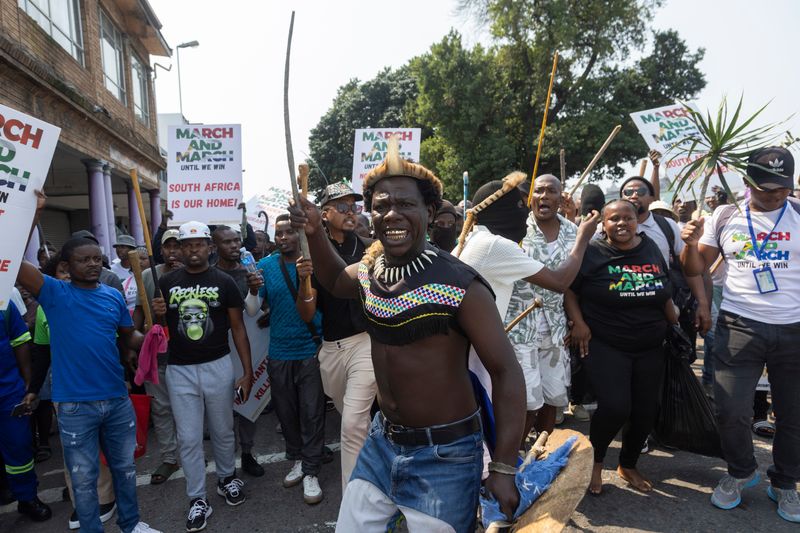
March and March has consistently said that it is concerned with illegal immigration. But, a Department of Home Affairs verification process in June found that all but three out of 457 displaced people at Durban’s Che Guevara Road were documented and legally resident in South Africa.The march on 3 September turned violent, and four immigrants were admitted to hospital. Possessions were piled in the road and marchers reportedly tried to set these alight. This marked an escalation in the character of public demonstrations by March and March, whose supporters present themselves as nonviolent, lawful and supportive of immigrants’ rights to reside legally in South Africa.Unofficially, however, the movement’s supporters in Durban flouted those principles for months, according to a new database containing the testimonies of 235 immigrants who say they were targeted by the movement.The database was compiled by a civil society coalition, the Siyafana Sonke Action Campaign, and relied on individualised interviews with displaced immigrants – mostly Congolese and Burundians. It describes how supporters of March and March took matters into their own hands in the run-up to the movement’s 30 June deadline for undocumented foreign nationals to leave the country. In incidents throughout much of the year, and culminating in mid-May, respondents described small groups armed with machetes, spears and knobkerries marching on the homes, businesses and places of employment of scores of immigrants in and around the city centre.An immigrant displaced to Che Guevara Road in Durban holds up papers. Almost all people displaced to the encampment were documented. (Photo: Joseph Bracken, GroundUp)March and March protesters pull down the tarps covering the belongings of foreign nationals in front of Home Affairs on Che Guevara Road in Durban where they have been living for months, 10 September 2026. (Photo: Rogan Ward) Durban mayor Cyril Xaba speaks to the media in front of Home Affairs on Che Guevara Road on 10 September 2026. (Photo: Rogan Ward) Many interviewees said they were assaulted, while respondents commonly described being ordered to leave. Immigrants’ landlords were told to put them out and employers were told to fire them. Immigrant businesses and homes were looted. Many immigrants reported that the police refused to assist or open cases, sometimes telling complainants to “go back” to their countries. In September, Siyafana Sonke shared a redacted version of the database with Viewfinder for analysis. This article summarises the main findings.Viewfinder also visited a shelter – at a private home in Glenmore, Durban – housing immigrants who have refused to leave the city but are unable to return home for fear of attack.Reports of violence and assaultNearly a third of the 235 testimonies contained descriptions of physical assault by supporters of March and March, sometimes with the use of weapons.A 54-year-old Burundian man, a Hutu who said he fled ethnic attacks in his home country, said he spent a week in King Edward Hospital after a group of about 20 people assaulted him on 14 July 2026.March and March protesters try to intimidate foreign nationals in front of Home Affairs on Che Guevara Road on 10 September 2026. (Photo: Rogan Ward) March and March leader Jacinta Ngobese-Zuma addresses foreign nationals in front of Home Affairs on Che Guevara Road on 10 September 2026. (Photo: Rogan Ward) March and March protesters try to intimidate foreign nationals in front of Home Affairs on Che Guevara Road. (Photo: Rogan Ward) A 58-year-old Congolese woman, who worked as a vegetable vendor on Smith Street in Durban, described how a group of March and March supporters attacked her, hitting her on the head. While fleeing, she said that a nail became lodged in her leg and she needed a tetanus injection. A 46-year-old Burundian woman, who worked as a shoe vendor at Durban’s Sunday Market, said that she and her son were attacked at their stall on 8 March 2026. She was also forced from her home by her neighbours, who threatened to attack her family. She described five other attacks on her and her family at the market between 2019 and 2024, and shared police case numbers for each.Loss of livelihoods and businessesAbout a fifth of the people interviewed said they had lost their livelihoods. The reasons mostly related to businesses being attacked, looted and destroyed; to employers turning people away; or, to trading sites being abandoned due to threats. A 51-year-old Congolese woman said she was chased from a market where she traded in 2024. Protesters allegedly stole the business permit and subsequently operated from the site themselves. She was put out of her home on 27 May, she said.Foreign nationals who have been living on the street in front of Home Affairs on Che Guevara Road for months watch March and March protesters on 10 September 2026. (Photo: Rogan Ward) March and March protesters lie on a mat in front of Home Affairs on Che Guevara Road in Durban on 10 September 2026. (Photo: Rogan Ward) A 29-year-old Burundian man said protesters destroyed his motorbike which he used to generate an income.A 27-year-old Burundian man said his barbershop was attacked a number of times between April and May 2026. He tried to restart his business several times, and was attacked each time. He described being assaulted with fists and sticks.Theft, looting and destruction of propertyIn some instances, people described being robbed and looted as they were chased from their homes or turned out from their places of business. A 38-year-old Congolese man from Umbilo said protesters arrived at his mechanic yard and demanded that he close shop. He said he was badly beaten and that the perpetrators took over his business and seized control of his equipment, which he estimated as being valued R42,000.A 40-year-old Congolese man described how a large group attacked his barbershop in Chesterville on 14 March. One attacker allegedly had a knife and another a gun. He was robbed at knifepoint, with attackers taking his equipment and inverters.Police allegedly refused to open docketsAbout a fifth of respondents reported that police refused to open cases when immigrants tried to report the types of incidents outlined above.Umbilo police station was most frequently accused of this, with seven people complaining that officers there refused to help them. Other stations accused of refusing to take cases included Mayville, Sydenham, Berea, Glenwood, Pinetown, Umkomaas, Durban Central, Point and Broad Street.Police protect foreign nationals who have been living on the street near Home Affairs on Che Guevara Road in Durban before March and March arrived on 10 September 2026. (Photo: Rogan Ward) March and March protesters on their way to Home Affairs on Che Guevara Road on 10 September 2026. (Photo: Rogan Ward) A 38-year-old Congolese nail technician who was attacked, chased from her stall and robbed said she tried to open a case at Umbilo police station. She says the officer refused to open a case and told her to “go back” to her country, and that “if you don’t leave, we will hit you more”.A 49-year-old Burundian woman said she tried to report an assault by March and March supporters on her son to police (her account does not identify which police station). Police told her, she said, that there are too many cases like this and that they do not have the capacity to give her a case number.March and March leader Jacinta Ngobese-Zuma leads a protest to Home Affairs on Che Guevara Road on 10 September 2026. (Photo: Rogan Ward) A 34-year-old Congolese woman from Mobeni said both her home and shop were looted bare, in April and July respectively. Her shop, she said, was looted in front of police officers who refused to intervene, despite her requests that they do. She tried to report both incidents to Umbilo police station, but in both instances she was turned away. Police say they’re unaware of xenophobic attacksViewfinder put a query to KwaZulu-Natal police spokesperson Colonel Robert Netshiunda. It asked for the South African Police Service’s response to allegations that it failed to protect migrants and refused to open cases in response to xenophobic attacks linked to March and March supporters.“Police in KwaZulu-Natal are not aware of any xenophobic attacks at any part of the province,” he said. “As for the alleged refusal to open cases by police, we will appreciate to be given specific details of each matter, what day, which police station and the names of police officers who refused to open cases (every police officer at the Community Service Centre wears uniform with a name tag). They should be held accountable if found to have refused to open cases.”March and March protesters in front of Home Affairs on Che Guevara Road in Durban on 10 September 2026. (Photo: Rogan Ward) March and March protesters on Che Guevara Road. (Photo: Rogan Ward) ‘You must leave, or they will kill you’Last month, Viewfinder visited one of the shelters – a residential home where at least 15 people were huddled together in a small living room. Burundian Germain Semihare (46) said he fled his home country in 2004 after his father was shot and killed during a dispute over the seizure of his property. Fearing the same fate, he left.Semihare told a story of resilience and resolve. He arrived in Durban not knowing a word of English. He spent his first nights at the central police station for shelter and found work as a car guard in South Beach. Germain Semihare was driven from his home in May, and has not seen his wife and children since. He asked to be photographed anonymously. (Photo: Daneel Knoetze, Viewfinder)Twenty-two years later, before the attacks, he had come to consider himself settled, stable and integrated. He had married a Xhosa woman, with whom he has two children. He had opened a hair salon which employs four people. He also worked full-time as an admin clerk at a laboratory, earning a decent income. He said he was spared when xenophobic violence flared up in South Africa in 2008 and again in 2015.In May, that all changed. He was attacked with sticks on the streets. His barbershop was looted. His employers asked him not to return. Then the vigilantes came for him at home. “They beat our door. They said that they are going to kill us if we don’t leave. Luckily my wife was talking to them in Zulu,” he recalls.“She then said to me, ‘you must leave, or they will kill you’.”He fled with just a tog bag. His wife later took the children to her parents in Mthatha. He has not seen them for four months. “She says that she is praying for me to be stable again, like before. She says that it is going to be okay. I have to wait, maybe they are going to stop. We can go to the community. And start to open a business again, like before,” he said. “We wish that, but we don’t know.”March and March supporters protest in front of Home Affairs on Che Guevara Road. (Photo: Rogan Ward) March and March protesters on Che Guevara Road. (Photo: Rogan Ward) March and March respondsTwo weeks ago, Viewfinder interviewed March and March spokesperson Sandile Dube over the phone.He was asked what the movement’s position was on why more than 400 immigrants ended up sleeping on the street on Che Guevara Road for months, in light of claims that March and March supporters had displaced them. He did not answer directly.“First and foremost, we are concerned about those people (the immigrants) and their own safety,” he said, explaining the movement’s rationale for marching on the encampment. “It is inhumane that you can have a human being living under those conditions, both foreigners or South Africans. That must be condemned. There are children involved there. They must be protected.”He was again asked to take a position on March and March supporters who had allegedly driven these people from their homes.“Any South African who stands up for his country, we support that action. But, it must be within the laws of this country. So what does that mean?” he said. He did not explain what that meant. He pivoted instead: “Any illegal immigrant that is found in our country – we still stand to say that those immigrants should leave the country with immediate effect.”When pressed, he acknowledged that he was aware that only three of the 457 people on Che Guevara Road were found to be undocumented. He was asked to reconcile his response with that fact.“They are documented. However, they don’t want to go back to their respective communities where they were. So, in the absence of going back to their communities, they must be deported to your respective countries.”Asked point-blank what he made of reports of widespread violence and intimidation by March and March supporters in Durban in the run-up to the 30 June deadline, he pointed to the fact that on 30 June there were scores of nonviolent marches in South Africa described by the government as “peaceful”.“Then you come to say it was violent. There is a contradiction there. There is a possibility that these foreign nationals are not telling the truth.”A query to eThekwini Municipality asked it to explain its failure to provide safe accommodation and protect the refugees from attacks. Spokesperson Senzelwe Mzila responded that immigration and refugee affairs fell under the mandate of the Department of Home Affairs, while policing, public order and criminal investigations were the responsibility of the SAPS.“We therefore respectfully refer you to SAPS and the Department of Home Affairs for comment on the matters raised in your correspondence,” he concluded. DMXenoBarometer tracks the anti-immigrant movement and its impact. We aim to surface underreported stories, paying close attention to potential rights abuses, emerging patterns in anti-immigrant mobilisation and failures in the government’s response. XenoBarometer is produced by the Southern Africa Accountability Journalism Project (SA | AJP), an initiative of the Henry Nxumalo Foundation working with Viewfinder and with the financial assistance of the European Union. It can under no circumstances be regarded as reflecting the position of the EU.
XENOBAROMETER: Database of victim testimony details months of violence by March and March in Durban
Full Article
Original Source
Read the full article at Dailymaverick →KhanList aggregates and links to publicly available news content. We do not host full articles from third-party sources. Always verify important information with original sources.