
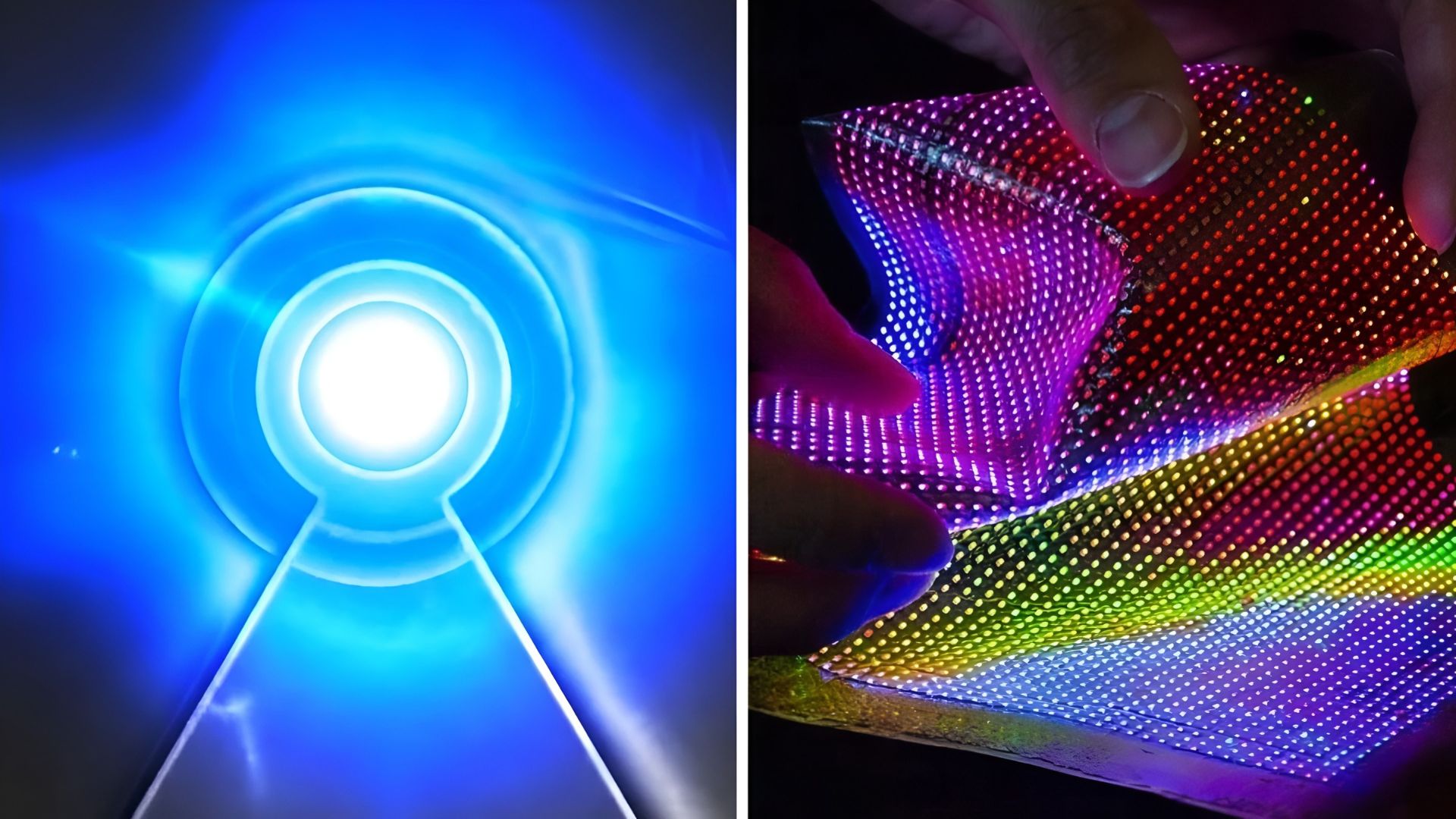
A microscopic LED could offer data centers a more energy-efficient way to move information between computing systems. Researchers from the University of Illinois Urbana-Champaign and the University of Notre Dame have developed a micro-LED with record optical switching performance. The device achieves an optical modulation bandwidth of 2.75 gigahertz while consuming just 25 milliwatts of power. The achievement could help reduce the energy demands of short-range optical communications. Data centers increasingly rely on light-based links to move information at high speeds. However, conventional optical transmitters typically use lasers, which consume considerable power and generate heat. The researchers believe their design could provide an efficient alternative for these connections. Their findings also establish a development roadmap for engineering smaller LEDs without sacrificing performance. Finding the ideal size The research team focused on gallium nitride quantum well LEDs, a widely used semiconductor design. They investigated how device dimensions affect switching speed and electrical power consumption. Their experiments covered micro-LED diameters ranging from 100 micrometers down to just 2 micrometers. Surprisingly, the smallest devices did not deliver the best overall performance. Researchers identified 5 micrometers as the optimal diameter for balancing bandwidth and power consumption. The optimized device achieved 2.75 GHz of optical modulation bandwidth. This measurement indicates how quickly an LED can switch its light output in response to electrical signals. Beyond that frequency, the optical signal can lose intensity and become less useful for reliable data transmission. Lead author Abdelghany Abouelnagga said the team challenged the assumption that smaller devices always perform better. Their findings provide a systematic approach to evaluating the relationship between device size, switching speed, and energy requirements. Achieving these results also required detailed semiconductor modeling. Researchers examined material imperfections and electrical characteristics that can introduce parasitic effects. These unwanted effects can limit switching performance and reduce efficiency. The team used those models to guide fabrication and optimize the final device. Its results represent a record for optical modulation bandwidth among quantum well LEDs. Challenging data center lasers Optical communication has become increasingly important as data centers handle growing volumes of information. Light-based connections can transmit data at high frequencies with relatively little signal loss. Copper interconnects face greater limitations as transmission speeds increase. Lasers currently dominate many high-speed optical connections. However, their power requirements create additional challenges for facilities already managing substantial electricity consumption. Heat generated by optical components also adds to cooling demands. Abouelnagga noted that approximately 90% of data center communications involve distances shorter than 10 meters. These connections could benefit from lower-power optical transmitters. The new micro-LED consumes just 25 milliwatts while responding to electrical signals at gigahertz frequencies. Its small footprint could also support dense arrangements of optical emitters. Researchers envision placing multiple micro-LEDs into two-dimensional arrays. Each emitter could carry an independent stream of information, potentially increasing communication capacity within compact hardware. The study appeared in IEEE Electron Device Letters. Researchers from Illinois and Notre Dame collaborated on the project through their respective engineering departments.Although the technology still requires further development, its performance offers a promising direction for short-range optical links. More efficient micro-LED transmitters could eventually help data centers increase communication speeds without relying exclusively on power-hungry lasers.Get the latest in engineering, tech, space & science - delivered daily to your inbox.Aamir is a seasoned tech journalist with experience at Exhibit Magazine, Republic World, and PR Newswire. With a deep love for all things tech and science, he has spent years decoding the latest innovations and exploring how they shape industries, lifestyles, and the future of humanity.
World record-setting micro-LED hits 2.75 GHz while consuming just 25 milliwatts
Full Article
Original Source
Read the full article at Interestingengineering →KhanList aggregates and links to publicly available news content. We do not host full articles from third-party sources. Always verify important information with original sources.