
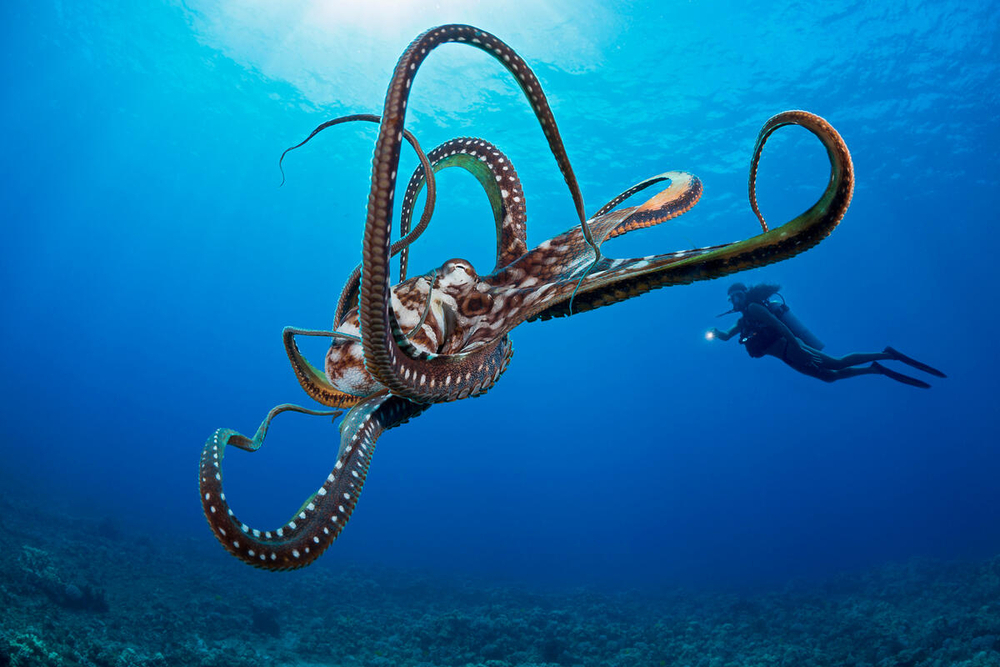
Happy World Octopus Day! Every Oct 8, the world celebrates one of the more unusual creatures of the sea. Octopuses are well-known for their eight legs and ability to squirt ink when frightened. They’ve also been known to use tools, a sign of intelligence, and can shape-shift to mimic the colors and texture of their surroundings, an effective way to disappear from both predators and prey. Mongabay has reported on several octopus discoveries this year, including: Ancient octopus were apex predators Modern colossal squid are believed to be the largest invertebrates in the sea, but Mongabay’s Shanna Hanbury recently reported on an even larger ancient octopus species whose fossils were described by Japanese researchers in April 2026. The Japanese team found a fossilized jawbone from the now-extinct Nanaimoteuthis haggarti. Based on its jaw size, researchers suggest the octopus may have reached 6.6 to 18.6 meters (22 to 61 feet) in length. On the higher end, that’s around two-thirds the size of an adult blue whale, the largest animal to ever exist. “It suggests that it may have been among the largest invertebrates ever known,” study co-author Yasuhiro Iba, a paleontologist at Hokkaido University in Japan, told Mongabay by email. They were likely gigantic predators that roamed the late Cretaceous seas between 100 million to 72 million years ago. A rare look at baby octopuses From long dead octopus to newly born, Hanbury also reported on baby Argentine octopuses and a rare photo of them. Patagonian octopus eggs in Puerto Lobos Protected Natural Area in Argentina. Image courtesy of Martin Brogger. These eggs belong to a small Patagonian octopus (Octopus tehuelchus). It’s one of the more common octopus species in the region, but researchers still haven’t been able to determine its global conservation status, although reported catches in Patagonia have declined over the past 50 years. The black dots inside each egg are the developing eyes of the embryos, indicating that they’re progressing toward hatching. The female octopus of this species often lays her eggs in the shell of an oyster, then guards them fiercely. She even stops eating during this period. A new species discovered New octopus species are described often, including a blue octopus about the size of a golf ball recently discovered in the Galapagos. On a deep-sea expedition in 2015, scientists used a remotely operated vehicle to find a golf-ball sized, short-armed blue octopus. In a recent study, they confirmed that it’s new to science, reported Mongabay’s David Brown. However, questions remain about how the new species, Microeledone galapagensis, makes use of its stubby arms. “If you gather prey by moving your arms through the sediment (as we think they do), wouldn’t it be better to have longer arms with more suckers than short little arms?” queried lead author Janet Voight. Banner image: Big blue octopus (Octopus cyanea) with a diver in background. Image courtesy of David Fleetham/WWF via naturepl.com. Credits Topics
World Octopus Day: new discoveries about the world’s smartest invertebrates
Full Article
Original Source
Read the full article at News →KhanList aggregates and links to publicly available news content. We do not host full articles from third-party sources. Always verify important information with original sources.