
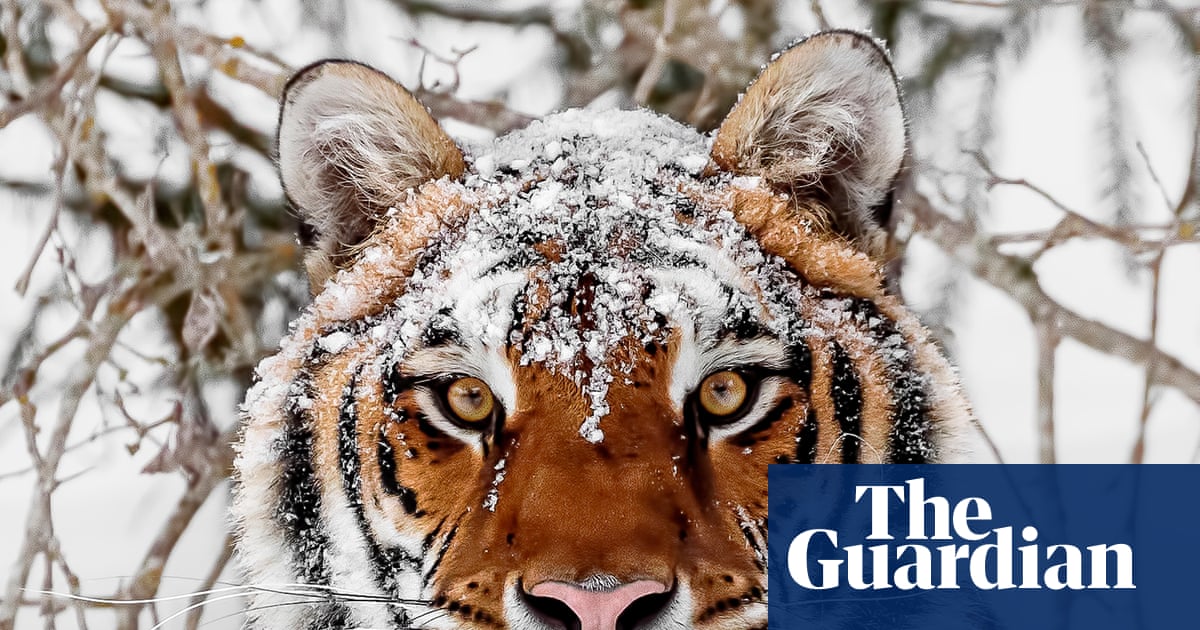
Conservation comebacks for wild tigers, tuna and green sea turtles prove that global nature loss can be reversed, scientists have said. But a report warns food production must be the next “positive tipping point” if the world is to avert biodiversity collapse.The World Wildlife Fund (WWF) analysed nearly 36,000 animal populations and more than 5,000 species, producing the largest ever database of vertebrate wildlife. Scientists found populations had declined by an average of 73% since 1970, showing that “nature continues to be degraded at an alarming scale”, with “no sign of losses slowing”.Nature loss is no longer just an environmental challenge but a direct threat to the global economy, the report says, noting that about half of global GDP – roughly $58tn (£44tn) in 2023 – depends on nature and its ecosystem services. The authors write that species collapse now poses an “existential threat to economic stability, geopolitical security and human wellbeing”.Animal populations were found to be falling most sharply in tropical, biodiversity-rich regions, while trends in northern temperate parts of the world appeared much gentler.In Latin America and the Caribbean, land and freshwater wildlife populations fell by an average of 95% between 1970 and 2022, while the equivalent declines were 80% in Africa and 23% in Europe and Central Asia.Graph of living planet index, globally and in different regions.Freshwater wildlife suffered the sharpest losses across the world’s ecosystems, with monitored populations in rivers and lakes down by an average of 85%, compared with 69% for land species and 59% for marine species.Tanya Steele, the chief executive of WWF UK, said: “Nature loss is not just a crisis for wildlife. It’s already sending us the bill through growing risks to our food security, water supplies, economy and resilience to climate shocks.“We stand at a fork in the road: either we continue paying the rising price of nature loss, or we invest in nature’s recovery and a future where people and wildlife can thrive together.”But despite the pattern of global biodiversity decline, wild tigers, green sea turtles and bluefin tuna are recovering, the report said, showing that “it is still possible to reverse the global loss of nature when action is taken”.In 2010, about 3,200 wild tigers remained globally and the species was sliding toward extinction. After sustained and targeted conservation interventions, the population has grown to roughly 5,700, an increase of more than 70%.Becci Day, WWF UK’s tiger lead, said the remarkable comeback of wild tigers demonstrated the “science of hope” and proved that when climate and ecological action was taken, change was possible.The report said Atlantic and Pacific bluefin tuna populations, which were collapsing after decades of overfishing, had now recovered to the point where neither was now considered threatened.A green sea turtle off the coast of Demre, Turkey. Photograph: Anadolu/Getty ImagesLast year, the green sea turtle became the first marine turtle ever downlisted from endangered to “least concern” on the IUCN red list, reflecting 50 years of coordinated conservation work across about 80 countries.Dr Mike Barrett, the chief scientific adviser for WWF UK and a co-author of the report, said: “These are examples that show that nature can recover even when pushed right to the brink, and they provide us with inspiration. It’s also very clear that conservation alone cannot tackle the scale of threats facing nature.”He said nature would have no chance of recovery if “negative tipping points” – self-reinforcing, irreversible ecological changes that accelerate climate crisis – were passed. “The systems which drive nature’s loss have to be transformed. And that’s energy, food and finance,” he said.“Our report shows that we’ve already passed the tipping point in the energy sector with the take-up of renewable energy. That transition is now unstoppable. It’s not happening fast enough, but it is unstoppable.”Humanity must likewise adapt the way it produces food, he said. “Agriculture is the single largest cause of habitat loss and degradation and therefore the loss of biodiversity. It’s also a major source of greenhouse gas emissions and so helps drive climate change, so you have that feedback.”Dr Steve Smith, a research fellow at Global Systems Institute and a co-author of the report, said: “The biggest prize for nature recovery would be a sustainable and healthy food system, but it’s currently the farthest away from positively tipping. For example, agricultural expansion drives almost 90% of deforestation worldwide.”Positive tipping points are thresholds beyond which a sustainable technology or practice becomes increasingly cheap, widespread or politically popular, allowing progress to become self-propelling.
World must change way it produces food to avoid biodiversity collapse, says WWF
Full Article
Original Source
Read the full article at Theguardian →KhanList aggregates and links to publicly available news content. We do not host full articles from third-party sources. Always verify important information with original sources.