
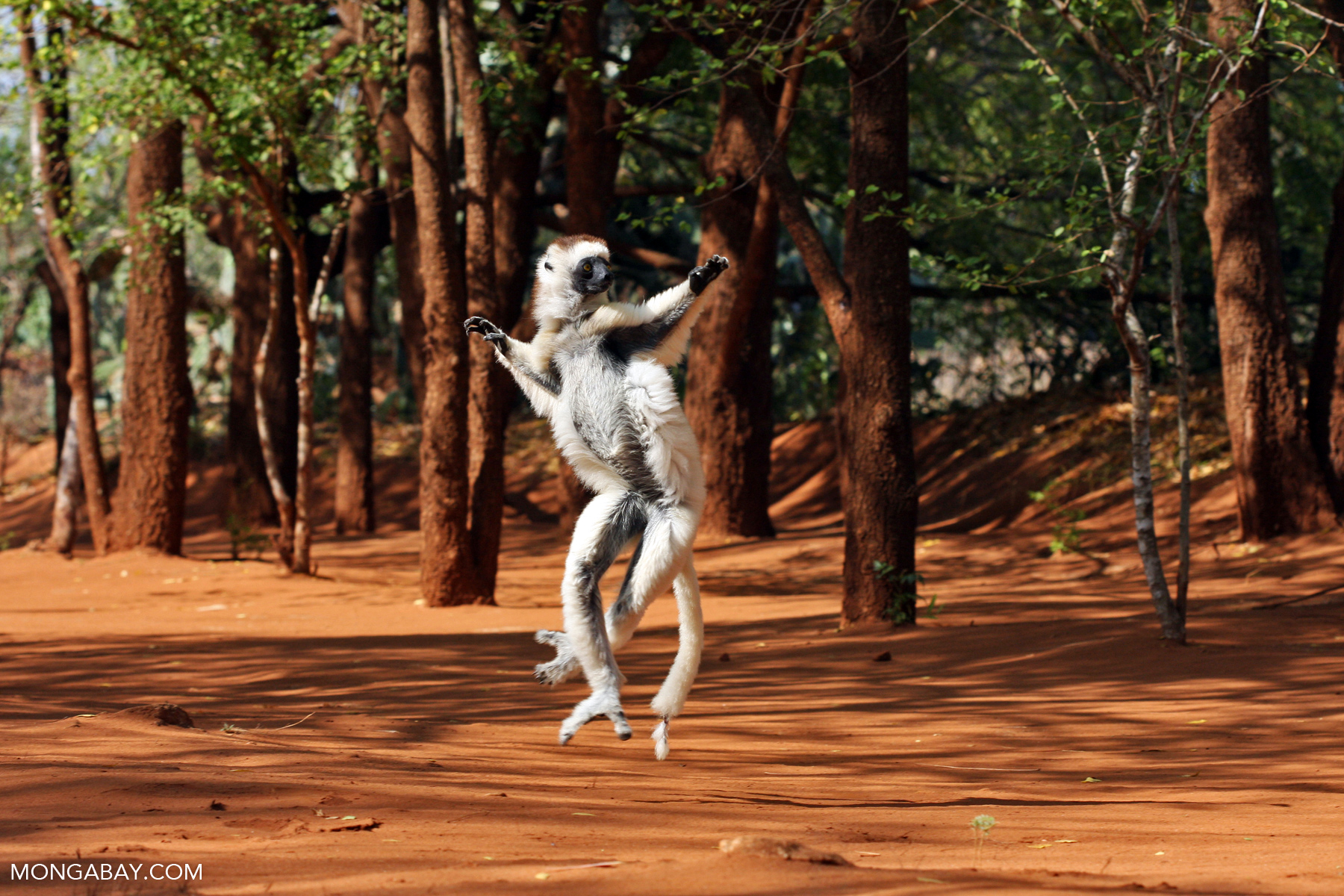
More than 100 known species of lemurs live in Madagascar. These primates with large eyes, a pointed snout, and long bushy tails are found only in the island country, where they usually live in large groups on trees. Lemurs are one of the world’s most threatened groups of primates, under pressure from the loss of their habitat and hunting. On World Lemur Day, celebrated on the last Friday of October, we highlight some recent Mongabay stories about these remarkable animals. Restoring a connection between forests offers hope for lemurs In eastern Madagascar, Andasibe-Mantadia National Park and the Analamazoatra Special Reserve shelter around a dozen species of lemurs, alongside an extraordinary array of other animals and plants, many of which are found nowhere else on Earth. Once connected by continuous rainforest, the landscape between the two parks was fractured in the 1960s, when large stretches were cleared for agriculture and cattle pasture. What remained was a patchwork of forest fragments separated by degraded land, limiting wildlife movement and threatening biodiversity. Mongabay’s Marina Martinez reported in April about how a coalition of researchers, conservationists and local communities is rebuilding the forest corridor. Launched in 2023, the reforestation project aims to restore 150 hectares (370 acres) of native forest and reconnect these two critical habitats. Lemurs like invasive guava fruits, and that could be a problem for reforestation Restoring native forests is critical for lemurs. However, once damaged, forests in Madagascar are vulnerable to takeover by invasive guava trees, whose seeds the lemurs themselves help to spread. When the delicious strawberry guavas (Psidium cattleyanum), native to Brazil, are in fruit, lemurs will choose them over native fruit, Mongabay contributor Ryan Truscott reported in March. Conservationists say forest restoration projects for lemurs must account for how strawberry guavas can impact the forests. “[T]he guava lures Madagascar’s remaining frugivores to endanger the very forests on which they depend,” anthropologist Cortni Borgerson, an associate professor at Montclair State University in the U.S., told Mongabay by email. Verreaux’s sifakas could help bring Madagascar’s dry forests needed attention Madagascar’s dry tropical forests are declining rapidly. However, these forests often don’t get the same attention from conservation groups and funding bodies as their humid rainforest counterparts do. Contributor Mino Rakotovao reported in September 2025 that NGOs and government representatives pushed for the inclusion of a charismatic inhabitant of Madagascar’s dry forests, the Verreaux’s sifaka (Propithecus verreauxi), to the list of the World’s 25 Most Endangered Primates. This inclusion, they said, would hopefully help the lemur and its critical habitat get more attention needed for their protection. Meet the Mouse Lemurs! For younger readers, Mongabay Kids explores a group of tiny lemurs called mouse lemurs that live in all kinds of forests across Madagascar. Banner image: A Verreaux’s sifaka dancing. Image by Rhett A. Butler/Mongabay. Credits Topics
World Lemur Day: How can we save these primates’ forest homes?
Full Article
Original Source
Read the full article at News →KhanList aggregates and links to publicly available news content. We do not host full articles from third-party sources. Always verify important information with original sources.