
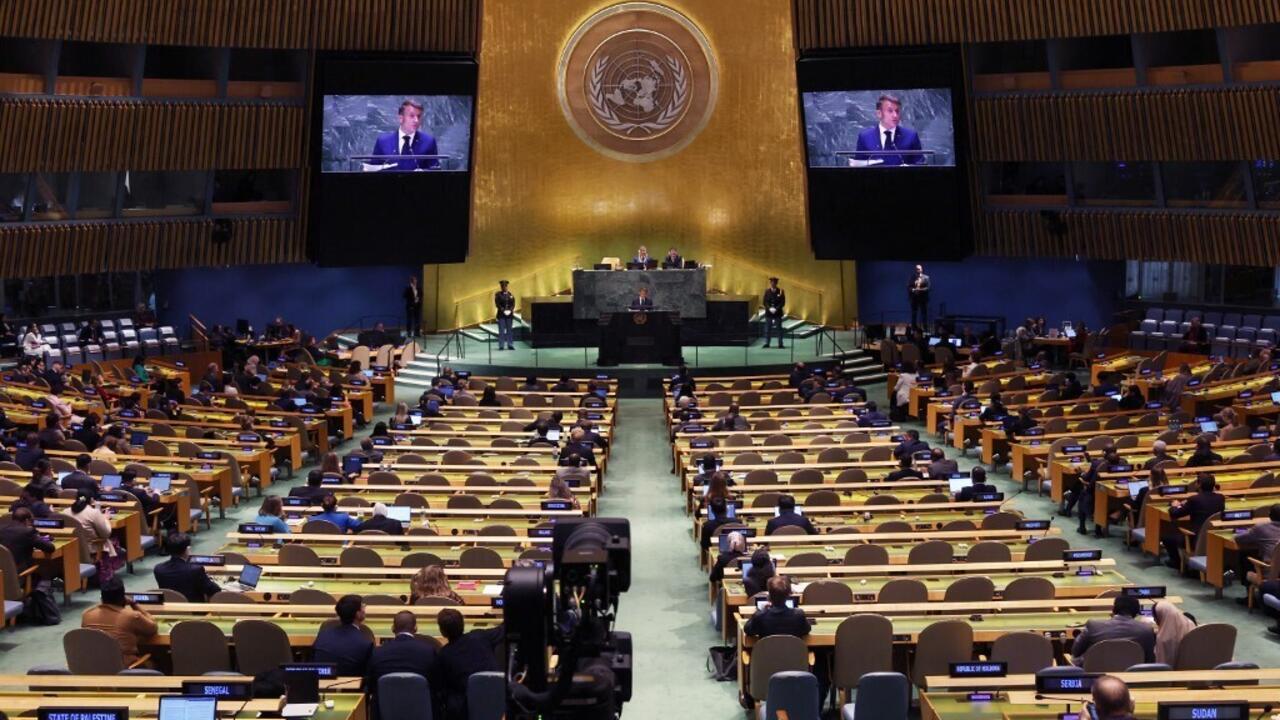
World leaders are gathering in New York on Tuesday for the start of the United Nations General Assembly's annual high-level debate, with wars, climate change, economic pressures and growing concern over artificial intelligence set to dominate a packed week of diplomacy. Some 130 heads of state and government are expected to address the assembly, as leaders confront conflicts in Iran, Gaza, Ukraine, Sudan, the Democratic Republic of Congo and Myanmar – and the persistent question of what the UN can realistically do to help end them. Climate shocks, widening inequality and disruption to global trade will also be high on the agenda, as blocked shipping routes and strained supply chains push up prices and weigh on growth. At the same time, the rapid development of artificial intelligence has emerged as a major concern, amid warnings over the lack of international safeguards for increasingly powerful technology. The gathering comes at a difficult moment for the United Nations itself. Now in its 81st year, the organisation is facing financial pressures, renewed calls for reform and questions over whether its institutions still reflect the balance of power in the 21st century. The UN's 193 member states have agreed to a broad reform package that includes efforts to update institutions such as the Security Council, where the US, Russia, China, Britain and France remain the five permanent members with veto powers. Turning those commitments into concrete changes, however, has proved far more difficult. To display this content from X (Twitter), you must enable advertisement tracking and audience measurement. Macron to meet Trump in New York ahead of UN General Assembly Pressure on the UN US President Donald Trump and French President Emmanuel Macron are among the leading figures due to speak on Tuesday, following UN Secretary-General Antonio Guterres's opening address on the state of the world. Ukrainian President Volodymyr Zelensky and Iranian President Masoud Pezeshkian are scheduled to speak on Wednesday. Pezeshkian is due to travel to New York, although Iranian state media reported on Monday that the United States had refused visas to members of his communications team. Israeli Prime Minister Benjamin Netanyahu is scheduled to address the assembly on Thursday. Palestinian President Mahmoud Abbas will speak by video the same day after the United States refused him a visa for a second consecutive year. ‘International law is our compass’ in global conflict, UN rights chief tells RFI Several other major leaders will also be absent. Chinese President Xi Jinping, Russian President Vladimir Putin and Indian Prime Minister Narendra Modi are not expected to attend. France's UN ambassador Jérôme Bonnafont said the gathering remained an important opportunity for countries to demonstrate their support for the organisation at a time of deep international divisions. "We believe in multilateralism," he said, adding that high-level week was an opportunity for countries to reaffirm that they preferred "cooperation and dialogue to confrontation". Finances and reform It has been a difficult year for the UN, whose influence has often appeared limited in efforts to halt major conflicts in the Middle East and Ukraine. Financial problems have also forced cuts to peacekeeping operations and humanitarian aid. The United States recently paid $725 million towards its UN dues, easing some of the immediate pressure and signalling that Washington intends to remain engaged with the organisation. Richard Gowan, director of the International Crisis Group's programme on global issues and institutions, said the UN was no longer in the "freefall" it faced a year ago, but remained trapped in a prolonged crisis. "The UN may not be in emergency care like it was last year," he said, "but it does seem to be trapped in a trauma centre for the foreseeable future." Attention is also turning towards who will replace Guterres when his second five-year term ends on 31 December. No clear successor has yet emerged, adding another layer of uncertainty over the future direction of the organisation. AI moves up the agenda Alongside war and diplomacy, artificial intelligence is becoming one of the week's most closely watched issues. The speed of recent advances has prompted growing concern over the lack of industry controls or global rules governing the most powerful AI systems. Days before the gathering, leaders of three major AI companies warned about the possibility of the technology moving beyond human control and called for a pause in development. Trump dismissed those concerns and urged continued advances to ensure the United States maintained its technological lead over China. The Security Council has added a high-level meeting on AI to its agenda for Wednesday afternoon, after a separate meeting on Ukraine attended by Zelensky earlier in the day. AI development cannot be left to market whim, UN experts warn Climate change will also feature prominently during the week, alongside discussions on rising sea levels, education and gender equality. For Guterres, it will be his final General Assembly high-level week as secretary-general. Previewing his address, he said power was shifting in "an era of deep uncertainty" and argued that international cooperation was becoming more important rather than less. Away from the assembly hall, hundreds of bilateral meetings will take place in UN offices, diplomatic missions, hotels and restaurants across New York. Esther Brimmer, a senior fellow in global governance at the Council on Foreign Relations and former US assistant secretary of state, said such face-to-face encounters could still lay the groundwork for agreements reached months later. She described the global situation in 2026 as "much more serious and complex than in decades past", but added that there was still reason for hope. "Over the past decades," she said, "we've learned a lot about international cooperation." (with newswires)
World leaders gather at UN as wars, AI and climate change dominate agenda
Full Article
Original Source
Read the full article at Rfi →KhanList aggregates and links to publicly available news content. We do not host full articles from third-party sources. Always verify important information with original sources.