
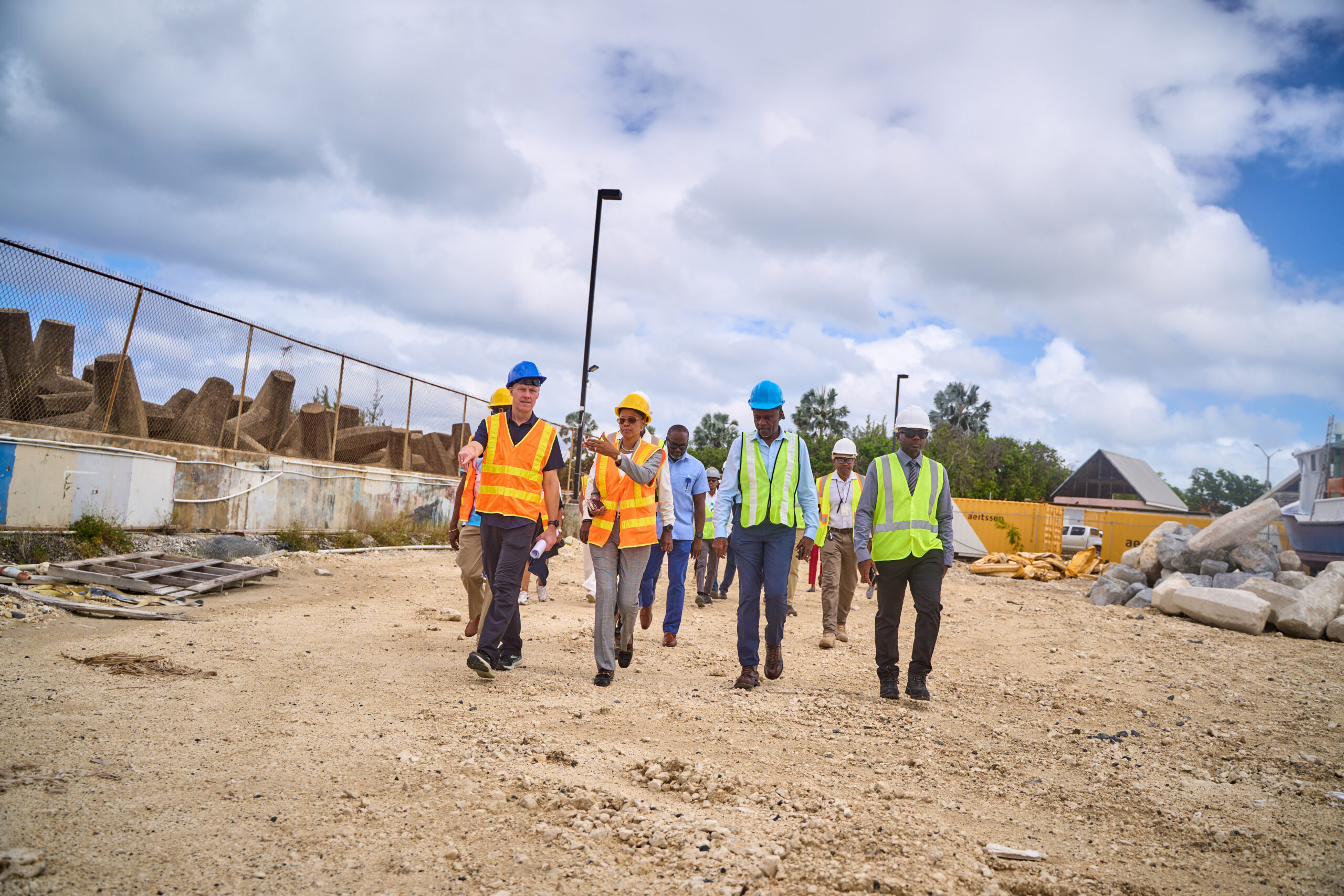
Deputy Prime Minister and Minister of Environment, National Beautification and Fisheries (centre) updates World Bank Division Director for the Caribbean Achim Fock (left) and other officials on the ongoing repair work to the breakwater. (Photo Credit: Shamar Blunt /Barbados TODAY) The World Bank on Tuesday expressed confidence in rebuilding the Bridgetown Fisheries Complex breakwater after Hurricane Beryl damage, while the government said a revised timetable for the remaining work should be ready for fisheries minister Santia Bradshaw by the end of the month. Government officials and World Bank representatives conducted a joint site inspection of ongoing repairs to the fisheries breakwater and sugar berth damaged by Hurricane Beryl in 2024. Deputy Prime Minister and Minister of Environment, National Beautification and Fisheries Santia Bradshaw (second left) with Ministry officials and the World Bank’s Division Director for the Caribbean Achim Fock (centre). (Photo Credit: Shamar Blunt /Barbados TODAY) The deputy prime minister hosted the World Bank technical delegation to assess progress on the Beryl Emergency Recovery Project, supported through a multi-year loan agreement. Bradshaw highlighted the importance of the financial and technical partnership in restoring operations for the fishing industry. Deputy Prime Minister and Minister of Environment, National Beautification and Fisheries Santia Bradshaw in a conversation with Permanent Secretary Steve Devonish. (Photo Credit: Shamar Blunt /Barbados TODAY) “I really want to welcome you guys, especially those who are here for the first time, to be able to actually see the really important work that is being done in partnership with the World Bank and the Government of Barbados,” Bradshaw said. “Again, we extend sincere thanks to you for all the work that you’ve been doing.” Emergency work began soon after the hurricane to stabilise the damaged breakwater, but the project had faced logistical delays during implementation, she said. You Might Be Interested In “This project… started after Hurricane Beryl, and therefore we went into an emergency response to be able to try to repair the breakwater to restore the facility here at Bridgetown, which was severely damaged as a result of the system that affected the fisherfolk here. “The work on the breakwater has started. There have been some delays in the process as a result of making sure that we had all of the procurement mechanisms in place, but we have now.” A project engineer is now overseeing the site to address early operational issues, Bradshaw said. “We’re trying to correct a number of the things that may have happened in the early stages in terms of being able to act urgently. This morning we get the opportunity to see the work that has been done on the breakwater and the work that is still to be done here at the Bridgetown port, and certainly to troubleshoot and raise any concerns while on site.” World Bank Division Director for the Caribbean Achim Fock praised the standard of the restoration work, saying the project was intended to strengthen the facility against future severe weather while supporting fishing livelihoods. “I’d like to thank the Deputy Prime Minister and the Government of Barbados for showing us what has been achieved so far under the Beryl Emergency Recovery Project. This is a project implemented by the government, and we at the World Bank provide some support in terms of financing and technical assistance.” After touring the marine facilities, Fock expressed confidence in the engineering work, particularly on the fisheries marina’s breakwater: “A lot of work has gone into this. I was impressed by how strongly the recovery was done in terms of sustaining any future hurricane, and I think that should give a lot of assurance to the fisherfolk. I also realised what a big impact the storm had on the livelihoods of these fisherfolk, and I’m glad that the project can also help with that, restoring livelihoods in terms of refinancing some of the boats.” Addressing discussions on site logistics, Fock said removing the earth remaining on the road leading to the breakwater could increase the port’s capacity. “So far it’s good. We had a discussion on whether some of the earth that’s still there on the road into the breakwater should be removed. I think that would increase the capacity of the port and therefore help the fisherfolk and the industry overall.” He said the World Bank’s role includes technical support in areas such as procurement, financial management, and environmental and social matters. “We now have a big mission by our team leaders and different experts. We come with technical experts, colleagues who advise on procurement, financial management, as well as the environmental and social aspects of the project. It’s really teamwork—our team together with the government team—to bring the best to the ground that we can.” Deputy Permanent Secretary of the Ministry of the Environment, National Beautification and Fisheries Steve Devonish said the project was moving from emergency work to the governance, certification and compliance requirements of the World Bank loan agreement. “When you deal with emergency work, you have to do this quickly and on the hoof,” Devonish said. “We reached a point where we tried to regularise a lot of the activities that happened then, not only from a project management perspective, but from a certification and payment perspective. When you’re in an emergency, everybody gives you leeway. When you come out of an emergency, people ask why you did things a certain way.” Compliance with the loan conditions was necessary to ensure spending could be reimbursed, he noted. “We are in a position where we’re under a loan from the World Bank and their technical officials are here. They have particular things they want to see and we want to be in a position to comply with all that is set out in the loan, so that when we apply for funding, it will not be a matter of it not being eligible for reimbursement or in conflict with the loan agreement and the loan conditions.” He also addressed a debate over a temporary construction access road, which technical teams decided to remove to protect the coastal environment and retain boat-storage space for fisherfolk. “The Fisheries Division pointed out, quite rightly, that leaving the temporary road would reduce space where they can store boats,” Devonish said. “The Coastal Zone Management Unit also noted it was a matter of durability—water could become stagnant and smelly. We went back to the consultants, reviewed design solutions, and decided to return to the original scheme. In doing so, we are cognisant that it stretches the timeframe, but for long-term planning, we are certain it is the right decision.” The project timetable was being updated after physical inspections of submerged structures, the senior official said. “Timelines are important, but until you get all the components, you cannot establish an accurate timeline. “When we remove the temporary roadway, we have to inspect the existing pilings to see what damage has been done. In terms of a revised schedule, between now and the end of this month, we will be in a position to advise the minister. This is only one component of a multi-year loan agreement with several other components, but in terms of the loan agreement, we are well within the envelope at the moment and staying on track.” (RR)
World Bank team praises ‘Beryl’ recovery works
Full Article
Original Source
Read the full article at Barbadostoday →KhanList aggregates and links to publicly available news content. We do not host full articles from third-party sources. Always verify important information with original sources.