
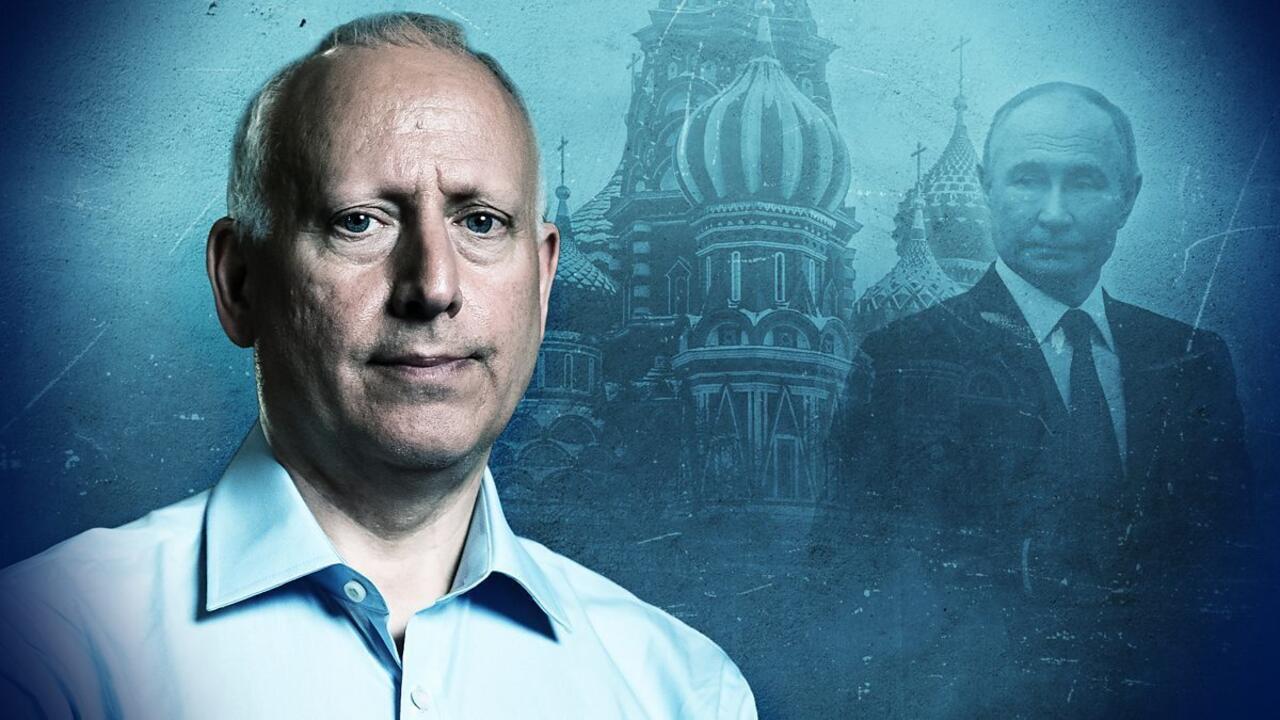
How does you report on the reality of a Russia at war from its capital? Based in Moscow for more than 30 years, the BBC's Russia correspondent Steve Rosenberg is one of the few Western journalists still working in the country. He spoke to RFI about his daily life as a reporter in Russia and why he has chosen to stay, despite the Kremlin's increasing hostility to foreign media. Rosenberg is well known in Russia. The fame he has gained asking Russia's political leaders, including President Vladimir Putin, direct and unflinching questions during televised press conferences means he is often approached in the street – encounters he says are overwhelmingly positive. "Very often, people come up to shake my hand or ask for a selfie... it says a lot about what's happening in the country," he said. "In my view, it shows that the massive wave of anti-Western propaganda disseminated by state media hasn't reached the entire population." On a recent visit to France to attend the Bayeux Calvados-Normandy Award for War Correspondents – which held a screening of the BBC documentary Our Man in Moscow, following a year in Rosenberg's life reporting from Russia – he sat down with RFI. RFI: How has it felt being out of Russia in Western Europe, in France? Steve Rosenberg: Every time I leave Russia, which isn't very often, and arrive in Europe or go back home to the UK, I initially find it strange to step out of this bubble I live and work in. But I think it's important to leave Russia every few months, take a step back, and look at what's happening there from a distance before going back. In a way, working in Russia today is a bit like being a deep-sea diver. You descend below the surface, into a very strange environment where the pressure is intense. After the full-scale Russian invasion of Ukraine, I felt as if a huge wave had engulfed the Russia I knew. And so, from time to time, it's important to surface – remove your regulator, if you like – and breathe before diving again. When I leave the country, I want to return because it fascinates me and I want to know what will happen. But it's important to release the pressure from time to time. France ‘dismayed’ over Russia’s ban on Reporters Without Borders RFI: You first arrived in Russia in 1991, initially to teach English, later becoming a BBC correspondent. Do you remember a moment when the Russia you knew truly changed? Was there a turning point, or was it something that unfolded gradually? SR: When you're in the midst of a tornado, it's difficult to see everything that's happening. It's only in retrospect that you realise, "ah, that was the precise moment when something changed". Looking back, I feel like I've known four different Russias. I saw the end of Soviet Russia – I spent a year studying in Moscow in 1990. So I experienced the last gasps of the Soviet Union. Then I witnessed its collapse in 1991. After that I experienced Russia in the 1990s, the first decade of independent Russia, a period full of chaos but also hope. People thought Russia and the West would become friends, that a new era of peace was dawning. But it was also a period of chaos, during which many Russians were impoverished by the wars in Chechnya. Then there was Putin's Russia, the first version. His rise to power in 2000 marked a different Russia. There were worrying signs from the start, but it seemed Putin wanted to improve relations with Europe and the West. The economy was growing. Oil prices were high. Then, gradually, the country became more authoritarian. Finally, I've experienced post-2022 Russia, which I often call Z-Russia. The Z is one of the symbols of what the Kremlin calls the "special military operation" in Ukraine. It's a very different Russia, much more authoritarian, with more repressive laws. A country at war with its neighbour and with ever-increasing internal repression. RFI: Were you surprised that Putin went so far as to invade Ukraine? SR: Yes, absolutely. I didn't think he would make that decision. It was a belligerent show of force by the Kremlin. That day I was on air all day, until late into the night. When I finished my last live broadcast, I sat down and, for the first time, I truly grasped the magnitude of what had just happened. I understood that life would never be the same again. Not only for Russia, but also for Europe, for the West. And I'm certain Putin didn't think it would be a war. I'm certain he must have been convinced that in a matter of days, or weeks at most, the Ukrainian government would collapse in Kyiv, a pro-Moscow regime would be installed and the whole thing would remain a military operation. But the authorities clearly miscalculated. On a street in Moscow, a screen shows an image of Russian President Vladimir Putin behind an electronic board promoting contract military service in the Russian army, 19 December 2024. © Shamil Zhumatov / Reuters Russia accuses France of ‘silencing dissent’ over journalist expulsion RFI: Let's talk about how you do your job in Moscow for the BBC. You have to renew your visas and accreditations every three months, how does that affect the way you work? SR: Previously, we received one-year visas and accreditations, multiple-entry visas... But since the invasion of Ukraine, journalists from so-called "unfriendly countries" only receive three-month visas. And the UK is on that list. So we have to renew our visas and accreditations every three months. At first, as the expiration date approaches, you inevitably wonder if they will renew it or not. I imagine that's exactly how the authorities want us to feel. But I've come to understand that there's no point in worrying. I can't do anything if one day they decide not to renew my visa, I won't be able to influence their decision. So there's no point in worrying or keeping a suitcase packed. RFI: Since 2022, you also have to think differently about the people you meet, where you meet them and how you interact with them. Tell us about that. SR: We obviously have to think very carefully about who we talk to and who we put on air or show. After February 2022, a whole series of repressive laws were passed in Russia to silence dissenting voices and punish those critical of the authorities and the war. So we have an obligation to ensure the safety of the people we put on air. When I conduct [interviews with ordinary people in the streets] I don't directly ask people: "are you for the war or are you against the war?", because that could get them into trouble. But there are many other questions that allow us to gauge public opinion and understand what's happening. There are also places we can no longer go that we used to. For example, for the past two or three years, the BBC hasn't been granted permission to go to the Belgorod, Kursk, and Bryansk regions bordering Ukraine – where bombings and drone attacks obviously generate a lot of stories. Now you need special permission to go to these regions, which isn't being granted. We keep applying, but for now we can't go. I read the Russian press and regularly publish a review of it, because the newspapers say a lot about what's happening in the country. Even in a highly controlled media environment, they reflect the developments taking place in Moscow. And the authorities can't accuse me of spreading propaganda if I report what's in the newspapers. Headlines in Russia media on 22 February 2022, as Putin announced the full-scale invasion of Ukraine. © AP - Alexander Zemlianichenko Jr 'The major risk remains a human-directed attack', cyber threat expert warns RFI RFI: Is it difficult now trying to convince people to talk to you? SR: We used to have a very long list of contributors, experts and commentators we could contact to talk about all sorts of topics: culture, music, politics, economics. And then after 2022 – actually, this had started before the full-scale invasion – some people began refusing our interview requests. That long list became extremely short. Some people are afraid to speak to the BBC. They don't want to risk being accused of associating with a major Western media outlet. Others have left the country. What surprises me is that ordinary people always agree to talk to us in the street. Wherever we go, in cities, small towns or villages, we stop passersby. I always introduce myself, specifying that I work for the BBC. Of course, not everyone agrees to talk, but if you stop people on Oxford Street in London, not everyone will answer your questions either. Many people agree to talk to us, and that's encouraging. RFI: Freedom of the press is virtually non-existent in Russia today. When you ask Putin a question during his annual December press conference, is the question sometimes more important than the answer? SR: First of all, there's no guarantee I'll get the floor. But when I do have the opportunity, I know it's a huge responsibility. I have to think about the question I'm going to ask, and what the Russians watching live across the country will hear. It's not easy because you rarely get a follow-up question – once the question is asked, they take the microphone away. But even a single question to Putin and a single answer can shed light on his way of thinking. One time [after I had asked a question], the next day the security guard in our building said: "Steve, the question you asked our president yesterday is a question we're all asking ourselves." It teaches you something about what people are thinking. I would love to be able to conduct a real interview with Putin. So far, my attempts have failed. I've interviewed [Belarusian President Aleksandr] Lukashenko twice, in lengthy sessions. He's a very different character from Putin. He answers everything and seems to enjoy a kind of duel during the interview. Russia's President Vladimir Putin holds his annual end-of-year press conference in Moscow on 19 December 2025. © AFP - ALEXANDER KAZAKOV/POOL What links matryoshka dolls, Belarusian nuns, French churches and Russian troops? RFI: Why do you think it's important to be there on the ground? SR: Being there in person has real value. If you're not there, if there are no more foreign correspondents, everything becomes black or white. All Russians seem black, and the whole country too. But when you're there, we can see the nuances. I'll give you an example. I was returning to Moscow after a reporting trip and we stopped at a petrol station about 200 kilometres from the city. I wanted to buy some biscuits. As I was approaching to pay, another customer recognised me. He came up to me and asked if I was a reporter. I replied yes. He told me: "I saw your reports somewhere, maybe on YouTube." And he said he wanted to pay for my biscuits. I told him he didn't have to, that it was very kind but not necessary. He insisted, and he paid. Then he came to shake my hand with a big smile before leaving. It's these small interactions that teach us a lot about what's going on. It's not just about knowing what the president says and thinks, but also what ordinary Russians say and think. RFI: You've been reporting from Russia for more than 25 years now. In Our Man in Moscow, you say you want to stay to tell the end of this story. Is it important for you to see it through to the end? SR: Yes, I tell myself that all the time, but is it realistic? When will this story end? In a way, Russia resembles a vast Tolstoy novel – it's War and Peace. Unfortunately, more war than peace in this moment. We turn the pages wondering how the novel will end, but it seems to go on forever. It just keeps going. One Russia replaces another, then another. This interview has been adapted from the original version by RFI's French service and edited for length and clarity.
'Working in Russia is like being a deep-sea diver', BBC's man in Moscow tells RFI
Full Article
Original Source
Read the full article at Rfi →KhanList aggregates and links to publicly available news content. We do not host full articles from third-party sources. Always verify important information with original sources.