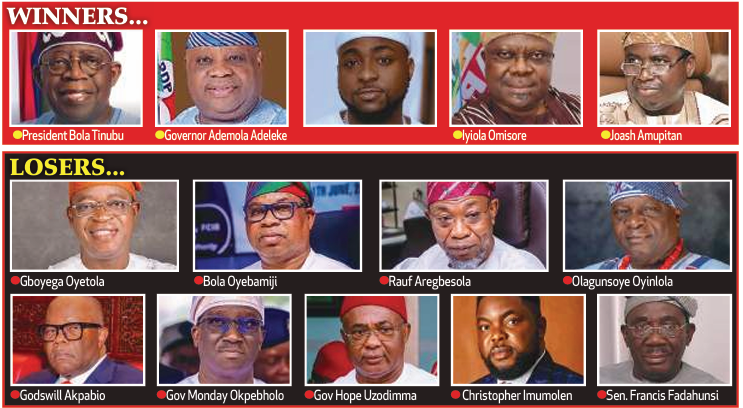
For a state that has acquired a reputation for producing some of Nigeria’s most fiercely contested elections in recent years, the outcome of last Saturday’s Osun governorship election was as emphatic as it was politically revealing. Governor Ademola Adeleke of the Accord Party secured 511,067 votes to defeat the All Progressives Congress (APC) candidate, Bola Oyebamiji, who polled 444,815 votes, giving the incumbent a winning margin of 66,252 votes. Besides, Adeleke won 19 of the state’s 30 local government areas, while Oyebamiji got 11. But beyond the figures, the election produced a fascinating cast of winners and losers. Some won at the ballot box. Others won by surviving a political test. Some lost an election, while others lost something potentially more consequential: influence, relevance, credibility or the aura of political invincibility. For Adeleke, his allies and others who seemed to have played their roles nobly, the dancing continues, but for the losers, especially those who played ignominious roles, it’s probably time to retrace their steps. Winners Bola Tinubu: Unexpected Winner President Bola Tinubu may appear an unlikely name on a list of winners after his party lost a governorship election in a state where the APC deployed considerable political machinery. Yet Tinubu has a strong claim to a place on the winners’ side, not because his party won, but because the election gave him an opportunity to demonstrate that the federal government could allow an opposition incumbent to defeat a ruling party candidate in a governorship election. It was Tinubu who stepped in when the Economic and Financial Crimes Commission (EFCC) shockingly froze the bank accounts of the Osun State government just a few days to the polls. Although a controversial move, the intent was clear: institutions of state must steer clear of politics or any likeness of it. On several occasions, Tinubu publicly called for a peaceful, transparent poll, and after Adeleke’s victory, the President called to congratulate him and described the outcome as reflecting the will of the people. He also commended the electoral umpire and the security agencies for the conduct of the election. That mattered in a country where the credibility of elections is often judged not merely by what happens at polling units but by whether the party in power is willing to accept an unfavourable outcome. Whatever the undertones or the reasons being adduced by political analysts why Tinubu allowed a free and fair process, he may have actually gained something politically valuable from Osun. For a President facing a crucial 2027 election to allow his party to lose the Osun poll gracefully, it signals that there might be hope for a credible ballot next year after all. Ademola Adeleke: Danced His Way to Victory There is no argument about the biggest winner. Adeleke has transformed what began as an unlikely political rise into one of the most remarkable personal electoral stories in contemporary Osun politics. In 2022, he defeated then-incumbent Gboyega Oyetola in a closely fought contest. Four years later, he has done it again, this time against a different APC candidate and with a substantially larger winning margin. His 511,067 votes were not merely enough to secure another four years. They demonstrated the depth of the coalition he had built around his incumbency, his personal appeal and the political structures that eventually moved with him from the Peoples Democratic Party (PDP) to Accord. Besides, the symbolism was also impossible to miss. The politician once derided by opponents and sections of the public for his dancing and flamboyant public persona has now become a two-term governor. The dancing, in the end, has become part of his political brand. Davido: Made Osun Poll Everyone’s Business If Adeleke was the candidate who danced his way to victory, David Adeleke, better known as Davido, ensured that millions of people far beyond Osun were watching. Davido’s involvement went beyond the conventional celebrity endorsement. He repeatedly campaigned for his uncle, used his enormous social media following to push the Adeleke narrative and brought his considerable local and international profile to bear on an election that would ordinarily have remained a state-level political contest. On election day, he was again active online, openly and unabashedly mentioning names he thought were in the state to subvert the will of the people. The singer could not determine how voters marked their ballot papers. But politics is not only about votes. It is also about narrative, visibility and mobilisation. Davido made Osun a global conversation in a way few Nigerian state elections have experienced. He even wrote to President Donald Trump! His role also demonstrated how Nigeria’s political communication is changing. Traditional party structures remain important, but a globally recognised entertainer with hundreds of millions of followers can now inject an entirely different dimension into a local political contest. Whether his influence translated directly into votes is impossible to quantify. However, his influence on the visibility of the election, remains beyond dispute. Joash Amupitan: A Credible Umpire? For Prof. Joash Amupitan, the Osun governorship election offered perhaps the clearest opportunity yet to demonstrate that INEC can conduct an election in which the umpire is judged by the quality of the process rather than the controversy surrounding the outcome. The election was keenly contested, politically charged and watched closely because of the stakes for both the ruling APC at the federal level and Accord Party at the state level. Yet, at the end of the exercise, the most important verdict was not simply who won or lost, but whether voters were allowed to freely express their choice and whether that choice was transparently reflected in the final result. Amupitan emerged as one of the winners because INEC, under his leadership, largely succeeded in staying out of the political contest. There were no major allegations of the commission openly tilting the process towards one candidate. The collation and declaration of the result did not also produce the kind of widespread controversy that has characterised several previous elections. For an electoral umpire, that is a significant achievement. The INEC chairman’s real success, therefore, was in ensuring that the rules were applied consistently and that the ballot, rather than political influence, determined the winner. The Osun election therefore gave Amupitan an opportunity to reinforce public confidence in INEC at a time when trust in electoral institutions remains fragile. By allowing the candidates to fight their political battle without the commission becoming the story, he strengthened the perception of INEC as an umpire rather than a participant. Perhaps, ultimately that should be Amupitan’s biggest win from the Osun election. In all, Adeleke may have danced his way back to Okefia House, but the INEC chairman can claim a quieter victory: presiding over an election in which the credibility of the umpire was not called to question. Senator Omisore: Mixed Signals But Still a Win For Senator Iyiola Omisore, the Osun election may have produced one of its more intriguing political paradoxes. Although he openly endorsed the APC candidate, Oyebamiji, but the results from his political backyard suggested that his supporters may have received a different message from the one he publicly delivered. At Omisore’s own polling unit in Ife Ward 1, Accord’s Adeleke polled 131 votes against Oyebamiji’s 85. That voting pattern has fuelled speculation that Omisore, despite publicly standing with the APC candidate, may have discreetly encouraged elements of his political structure to support Adeleke. The results provide enough political intrigue to make the theory difficult to ignore. After all, during their mass detection before the poll, Omisore’s supporters cited his ill-treatment by the party as a key reason they were exiting the APC. Omisore therefore emerges as an unlikely winner in the election. He managed to maintain his public allegiance to the APC while apparently retaining enough influence within his political base to leave open the possibility that his supporters voted differently at the ballot. If that was indeed the strategy, it was a politically deft balancing act. In an election defined by shifting alliances and unexpected voting patterns, Omisore may have discovered that his greatest political currency was not necessarily the candidate he endorsed, but the followers who listened to him when nobody was watching. The Opposition: Hope Restored? Although the broader opposition may not have contested the election as a single political entity, Adeleke’s victory nevertheless represented a psychological boost. The lesson is straightforward: the APC can be defeated. That may sound obvious, but in the emerging 2027 political environment, it is an important message. Opposition politicians have spent months discussing alliances, coalitions and the possibility of presenting a united challenge to Tinubu and the APC. Some opposition figures have already backed the idea of a single candidate against the ruling party. Osun has now provided something that political calculations and Abuja meetings cannot provide: an actual electoral example. A ruling party with federal power, access to national political figures and a formidable political structure can still lose an election. That is perhaps the biggest political message of Osun to opposition politicians. Accord: Victory for Fringe Party Then there is Accord itself. The party has achieved what would ordinarily have seemed almost impossible: it has retained the governorship of a major Nigerian state with a candidate who was once a member of another major political party. Adeleke’s movement to Accord transformed the party from a minor participant into the platform controlling the Osun Government House. The irony is that Accord’s victory came amid a bitter internal leadership dispute, making the outcome even more remarkable. The party now has the responsibility of proving that its Osun victory was not merely the product of Adeleke’s personality and political structure. It’s unclear if Adeleke will announce his exit tomorrow. But for now, Accord has every reason to celebrate. Losers Gboyega Oyetola: Another Painful Chapter For Gboyega Oyetola, the result is another reminder of how dramatically the political landscape in Osun has shifted. He lost the 2022 election to Adeleke after serving as governor. Four years later, the man who defeated him returned for another term. Oyetola has remained one of the APC’s most recognisable figures in the state and was associated with the party’s struggle to reclaim Osun from the incumbent. But Adeleke’s second victory makes that task considerably more difficult. The former governor now has to confront an uncomfortable political reality: his principal rival has not only survived the first election but has now consolidated his hold on the state. Bola Oyebamiji: Biggest Loser To be sure, Oyebamiji did not suffer an electoral humiliation in the conventional sense. After all, he polled 444,815 votes, won 11 local government areas and secured what reports described as the highest vote total ever recorded by an APC governorship candidate in Osun. But elections are ultimately about winning. And Oyebamiji had behind him the machinery of the APC, the support of several heavyweight politicians and the enormous advantage of challenging an incumbent on behalf of the ruling party. He still lost by 66,252 votes. That makes his defeat the most consequential individual loss of the election. His loss also raises questions about whether the APC correctly assessed the strength of Adeleke’s grassroots structure and whether the party’s internal divisions undermined the formidable machinery it assembled behind its candidate. Rauf Aregbesola: Diminishing Influence? Few names once carried as much weight in Osun politics as Ogbeni Rauf Aregbesola, who backed the ADC candidate, Najeem Salaam during the election. As governor between 2010 and 2018, he built a formidable political machine and became one of the most influential political figures in the state. But the 2026 election offered another indication that the old Aregbesola political architecture no longer commands the influence it once did, especially after his exit from the Tinubu umbrella. His former political allies are now scattered across different camps, and the candidate associated with the APC establishment could not overcome Adeleke’s coalition. By the way, he was reported to have lost his polling unit. Oyinlola: The Old Order Takes Another Hit Former Governor Olagunsoye Oyinlola suffered another symbolic political setback in the election after openly backing the APC and its governorship candidate, Oyebamiji. At his polling unit at Court Hall I, Okuku, the result went against the former governor. Accord secured 125 votes, while the APC managed 85, a result that underscored the growing disconnect between the old political establishment and voters in its traditional strongholds. The result may be only a polling-unit statistic, but its political symbolism is difficult to ignore. When a party fails to win the polling unit of one of its most prominent supporters, questions inevitably arise about the reach and relevance of that political influence. For Oyinlola, the outcome was another reminder that political stature and past achievements do not automatically translate into votes, particularly in an election where voters appeared willing to cross traditional political lines. Okpebholo/Uzodimma/Akpabio: Federal Might Vs Local Reality In all, the Osun election also exposed the limits of national political power. The APC did not enter the contest as an under-resourced opposition party. It deployed heavyweight politicians like the Governor of Edo, Monday Okpebholo, Hope Uzodimma of Imo State and and substantial political machinery. Yet Adeleke prevailed. Indeed, during the final mega-rally and campaign events for the APC, top national heavyweights stormed Osogbo, led by Senate President Godswill Akpabio (representing Tinubu). APC National Chairman Prof. Nentawe Yilwatda, and over 10 APC governors were also present. In fact, the altercation between Okpebholo and Uzodimma on the one hand and Adeleke and his group on the other was one of the highlights of the campaign season. APC’s failure despite the massive campaign should concern anyone who believes that national political influence can automatically be converted into local votes. Osun demonstrated that voters retain the capacity to separate state politics from national political calculations. For the APC, that is perhaps one of the most important lessons from the election. Imumolen and Factional Accord The defeat of the factional Accord leadership associated with Christopher Imumolen was another highlight of the just-concluded Osun election. The internal dispute within Accord produced competing claims about the authentic leadership of the party and different political positions ahead of the election. Imumolen disclosed that the party has stepped down its support for Adeleke and stated its support for the candidate of the APC’s Oyebamiji. Interestingly, while making his speech, Imumolen replaced the yellow cap, which is synonymous with the Accord party in the state, with that of the APC, illustrating his full support for the latter. In the end, the Adeleke-led Accord structure prevailed electorally. With Adeleke’s win, the ballot has now provided its own verdict on which political structure has the greater legitimacy on the ground. Senator Fadahunsi: A Candidate for ICC Probe For Senator Francis Fadahunsi, the election was also a costly political episode. Speaking in Yoruba language in a video that went viral, Fadahunsi said: “How many people have you seen the APC kill? We are here to tell you that until the day of the election, if we see any Accord member in Ilesa, we will kill them.” He cross a line that shouldn’t be crossed by every measure and the fact he is still walking free says a lot about our security system. His controversial pre-election remarks about “killing” sparked outrage, with the statement widely interpreted as a call for violence against the party. Although his camp later attempted to clarify that he meant defeating Accord at the polls rather than physically harming anyone, the remarks were serious enough to draw police attention, with the senator summoned for questioning. The comments could now haunt Fadahunsi beyond the ballot box. Given the gravity of alleged incitement to violence during an election, his remarks could potentially attract scrutiny from international accountability mechanisms, including the International Criminal Court (ICC), particularly if they are found to have constituted incitement to violence. The irony was devastating for the senator: Accord was not “killed”. It survived the political onslaught and, against the odds, emerged victorious at the polls. For a politician who had become one of the more vocal opponents of Adeleke’s return, the outcome was therefore doubly bruising: not only did his preferred political outcome fail, his controversial rhetoric may now remain part of the post-election reckoning. And therein lies the larger story of Osun 2026. The election was won by Adeleke, but its consequences extend far beyond the governor. It exposed the limits of federal might, tested the staying power of old political godfathers, elevated celebrity politics, gave INEC a modest institutional victory and provided opposition politicians with something they desperately needed: evidence that the APC can be beaten. But Adeleke, once dismissed by many as a politician who danced more than he governed, now has four more years to prove that his political performance can match the electoral performance.
Winners and Losers as Adeleke Dances Back to Okefia House
Full Article
Original Source
Read the full article at Thisdaylive →KhanList aggregates and links to publicly available news content. We do not host full articles from third-party sources. Always verify important information with original sources.