
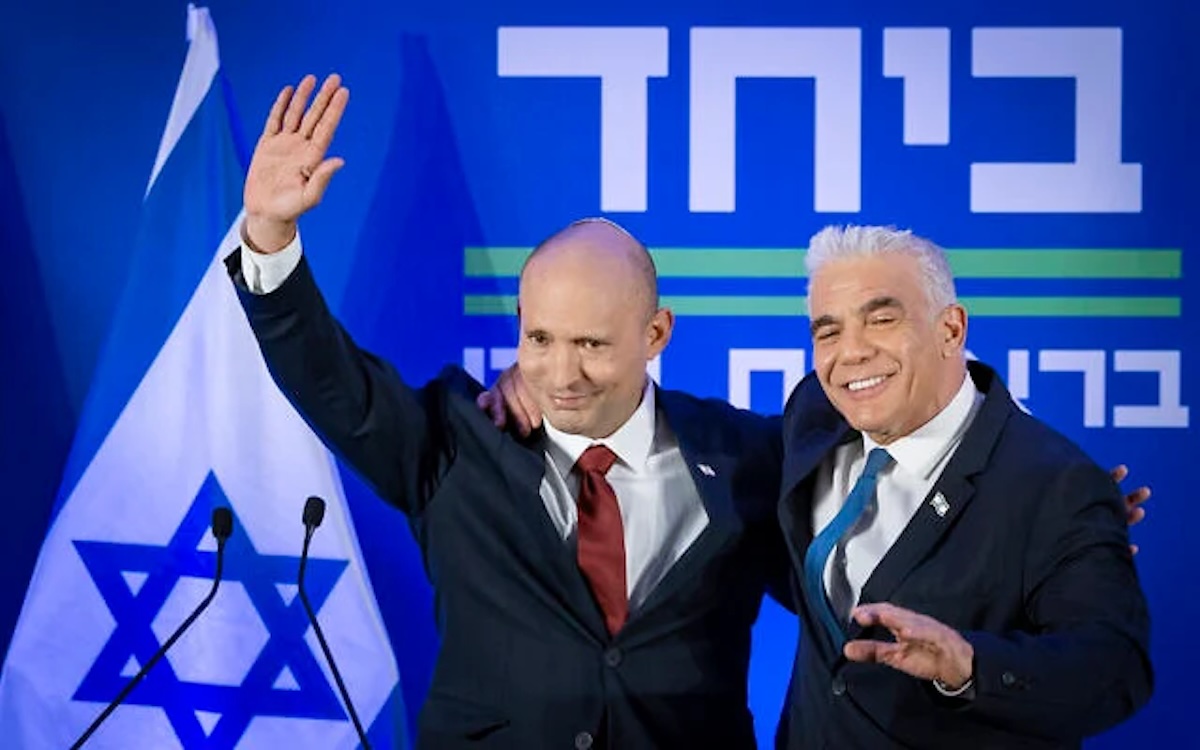
Israel’s opposition parties appeared to have secured enough Knesset seats in Tuesday’s elections to oust Prime Minister Benjamin Netanyahu from power and end a four-year reign marked by genocidal war in Gaza and escalating terror and dispossession against Palestinians in the West Bank. But will they? With about 86% of ballots counted as of Wednesday morning, Netanyahu’s far-right religious bloc is projected to have lost about 11 seats, putting them at 53, eight shy of an outright majority. The Jewish opposition bloc, led by Yashar party leader Gadi Eisenkot, is projected to win 48 seats, putting it in a position to take control. But it would likely have to cooperate with the parties representing Israel’s Arab minority, which together won a record 19 seats on Tuesday thanks to unprecedented turnout among Arab voters who braved racist incitement from the Netanyahu camp and widespread suppression tactics at the ballot box. Graphic by The Petek Ameer Fakhoury, an analyst at Israel’s Van Leer Jerusalem Institute think tank, described the mobilization of Palestinian citizens in the elections as a “truly historic development.” “They went to the polls in extraordinary numbers to confront a political leadership responsible for what they regard as the gravest crimes against their people: devastation in Gaza, ethnic cleansing in the West Bank, and years of persecution and intimidation at home,” he told Middle East Eye. “History has placed Palestinian citizens of Israel in an extraordinary position. Having mobilized first and foremost to protect their own people, they may now also help rescue Jewish Israelis from their country’s destructive trajectory,” he said. ‘Bibi or Tibi’ With a limited window for the parties to negotiate a new government before another election is triggered, the Arab parties now hold leverage to press their demands. Mansour Abbas, the leader of the smaller of the two Arab factions, Ra’am, signaled his willingness to compromise on Tuesday evening as the results emerged, saying his priority was to “bring down Benjamin Netanyahu” along with Finance Minister Bezalel Smotrich and National Security Minister Itamar Ben-Gvir “in this election.” Ra’am has featured in further-right governments before, previously helping to cobble together the majority that briefly allowed former Prime Minister Naftali Bennett – also part of the Eisenkot coalition – to form one in 2021. But with the current parliamentary math, Abbas’s seven seats alone would not be enough to form a majority. The larger Arab coalition, the left-wing Joint List, has also offered to back Eisenkot’s government. Its parliamentary leader, Ahmad Tibi, has been vocal about his demands for concessions, including commitments to fight crime in Arab communities, end the demolition of homes that were built without authorization (often due to permit discrimination), halt racist incitement against Arab citizens and offer a potential “political horizon” for Palestinian self-determination. He said the choice was between “either Bibi or Tibi.” Eisenkot has likewise described “Netanyahu’s retirement from political life” as a central goal. But in an effort to court Jewish Netanyahu voters hostile to Arabs and hold together his own bloc, he ruled out working with Arab parties unless they recognize Israel as a Jewish state, accept conscription of Palestinian citizens of Israel into the Israeli military and denounce Hamas as a terrorist organization. Amjad Shbita, the general secretary of Hadash, the socialist party that is the biggest faction in the Joint List, has expressed hostility to the idea that Eisenkot would get to dictate terms. “Laying down conditions won’t work with the Joint List,” Shbita said. “We will negotiate as equals because we need each other.” Tibi said the opposition could form a coalition “if it wants to, if it is brave enough to.” Making things more complex is pressure from within Eisenkot’s bloc. Bennett and former Defense Minister Avigdor Liberman have rejected forming a government dependent on Arab parties’ support or abstention.Liberman has urged members of Netanyahu’s Likud party to defect and join the opposition to form a “true” right-wing government. One potential opening would be to peel away Likud hawks opposed to Netanyahu’s concessions to ultra-Orthodox parties, most notably draft exemptions for yeshiva students. On the other side of the opposition, Yair Golan, the leader of the left-wing Democrats party, has urged Eisenkot to cooperate with the Arab parties and form a coalition that would decisively push Netanyahu out of power. נתניהו הפסיד. אני יודע לספור עד 120. 65 זה יותר מ-55. ככה עובדת הדמוקרטיה הישראלית. נקודה.תמונת המציאות חייבת ללמד אותנו לקח אחד מהדהד: אין לנו עתיד כאן אם לא נפסיק לפחד. ואם לא נפסיק עם הגזענות. אסור לנו לקבל יותר את החלוקה הגזענית של נתניהו בין קולות יהודיים לקולות ערביים.…— Yair Golan – יאיר גולן (@YairGolan1) October 28, 2026 “Netanyahu lost. I know how to count to 120. Sixty-five is more than 55. That’s how Israeli democracy works. Period,” Golan wrote Wednesday on social media. “The reality must teach us one resounding lesson: We have no future here if we don’t stop being afraid. And if we don’t stop with the racism. We must no longer accept Netanyahu’s racist division between Jewish votes and Arab votes.” “Anyone who tries to erase the voices of Arab citizens is surrendering to Netanyahu and giving up on Israel,” he said. Another possibility on the table is a “national unity government” that would involve a power-sharing agreement between the Netanyahu and Eisenkot factions, likely boxing out the Arabs entirely. Eitan Tzelgov, an expert on Israeli populism and democratic backsliding at the UK’s University of East Anglia, presented the choice for Eisenkot’s bloc as a binary one: “govern with the Arab parties, or with Netanyahu.” “Israel is a tribal society, with cohesive right-wing tribes and a shrinking liberal tribe that will need to make a decision,” he said in an email to Common Dreams. “Over the years, Netanyahu and the far right have built an ideological firewall around the Arab parties by presenting any Jewish-Arab collaboration as support for terrorism.” “The leaders of the change bloc, representing Israel’s liberal camp, now must decide if they are willing to break it,” he continued. “That is the only way to bring about a U-turn from the current government’s policies in Gaza and the West Bank.” He was not optimistic about their stomach for it: “A more likely outcome at the moment,” he said, “is a split within the change bloc and collaboration of some of its components with Netanyahu, a result [US President Donald Trump] reportedly supports.” Joint List Chair Yousef Jabareen put the stakes in plain terms: “Anyone who wants to offer a substantive and genuine alternative to Netanyahu’s blood-soaked government will have to talk to us,” he said. “It’s either the continuation of racism, the continuation of exclusion, and the continuation of supremacy, or a genuine Jewish-Arab partnership.” –Common Dreams
Will Israeli opposition parties join forces to eject Netanyahu?
Full Article
Original Source
Read the full article at Asiatimes →KhanList aggregates and links to publicly available news content. We do not host full articles from third-party sources. Always verify important information with original sources.