
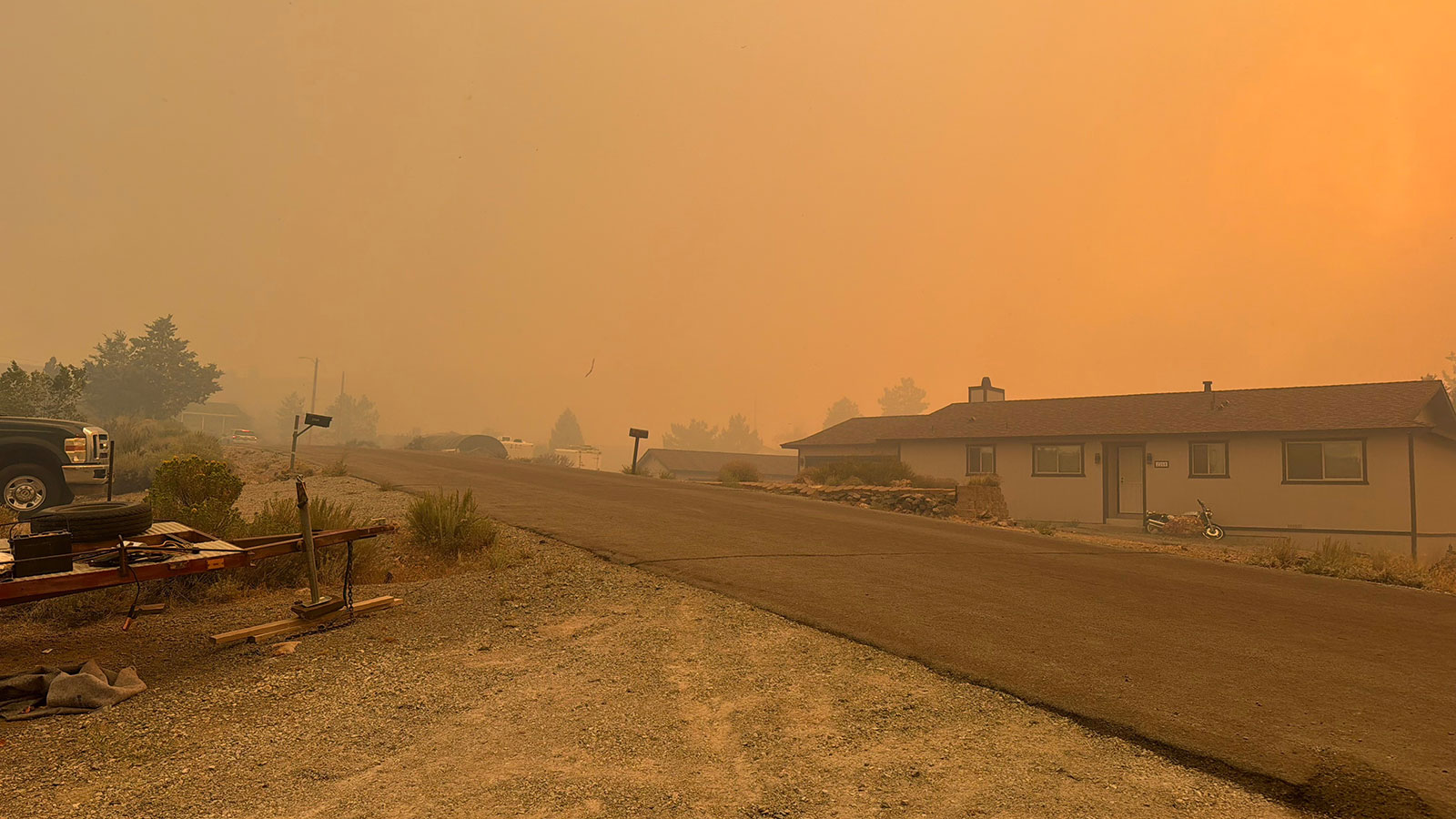
Smoke fills the air from the Hawk Fire Aug. 22, 2026, in northwet Reno, Nevada. (Image credit: Shane Merritt via AP) Headlines about wildfires and bad air seem to be ubiquitous this summer, along with their climate-change kin: heat waves, heat domes, and drought. But important wildfire stories don’t always garner big headlines in big media venues, perhaps seeming too small in scale, too localized, too subtle, too complicated. Right now, though, in what we might call peak wildfire journalism season, a good number of such stories can be found. As prologue, this piece offers a valuable context for reading about fires and understanding what does and does not count as news: “Wildfires: why media coverage doesn’t always make the climate connection.” Doug Specht, The Conversation. Deep dives The next five pieces are longer essays or commentaries that range widely through information and ideas, often but not always written from a personal point of view. “The right word is wrongness.” Rebecca Solnit, Meditations in an Emergency. A meditation on the summer’s “discordant, damaged sky,” partly in the context of the Buddhist word “duhkha” and its possible meanings. “High heat, high drama.” Bill McKibben, The Crucial Years, Substack newsletter. Focused on Europe but with wide peripheral vision, this piece includes a particularly impressive collection of revealing quotations. “What happens when the world is on fire.” John Vaillant, Time Magazine. An overview of the fires this summer by the author of the terrific book “Fire Weather: On the Front Lines of a Burning World.” “This is climate breakdown, and its expressions are manifold,” Vaillant writes. “As long as we burn fossil fuels without limits, wildfires will do the same in our forests, cities, and towns. But we are not passive bystanders, and these genuine ‘trials by fire’ are nature’s stern invitation to mature as a society, to confront with intelligence and courage the daunting energies we’ve unleashed with our own.” “The Trump administration upended how we fight wildfires. Then came the West’s worst fire season in years.” Western Compact and The Colorado Sun. This is a thorough look at “full suppression” vs “let it burn” fire management choices under current drought and heat conditions. As one subhead in the story has it, there is “no simple answer.” “Bigger, hotter fires are slowly erasing America’s great forests.” Eric Niiler, The New York Times. Subhead: “Towering woodlands in the West are being permanently replaced by tracts of spiky shrubs. Conditions ‘just aren’t normal any more,’ one researcher said.” A thoroughly researched reconsideration of the idea that wildfire is good because it regenerates forests. What is lost in a fire After deaths, the most obvious losses from wildfires are material — homes, possessions, whole towns — but other important losses are not. These personal accounts reveal some of the other casualties. “A graduation, a birthday—and an evacuation.” Kelsie Kilawna, The Narwhal. A member of the Okanagan Indian Band in British Columbia tells her story in a context many of us would not normally consider: “But, even as I watched the fire consume everything in its path, I realized this is exactly what my people prepared me for. This is why they taught me about grief.” “Running from a fire should not be this routine.” Joshua Partlow, The Atlantic. In the context of the fires in Spokane, Washington, where he interviews a handful of evacuees, Partlow writes, “As more people have moved into forested exurbs and wildfires’ footprints have grown, such evacuations have become a distressingly familiar summer ordeal: a dayslong limbo in relatives’ spare rooms or emergency shelters, pets in hotel lobbies, possessions lugged around in plastic bags.” Indeed, for many, especially in the West, preparing to flee a wildfire has become a normal summer routine: Search the internet for “fire evacuation checklist” or “wildfire go bag” to see how abundant such advice is — including such fire-specific tips as to wear cotton or wool clothing, as petroleum-based ingredients in other fabrics melt and burn skin. Other newly routine actions include checking websites (and apps) like the EPA’s AirNow Fire and Smoke Map, which covers both fires and smoke plumes; Watch Duty, for timely fire information; and Purple Air, for current and localized air quality index numbers. “Shrouded in wildfire smoke, my first summer as a mother is not what I imagined.” Amara Possian, The Narwhal. Trapped indoors by Toronto’s terrible air quality with her 12-week-old baby, Possian is swept by anxiety and by a fundamental uncertainty: “Baby Z, I don’t know yet how I am supposed to show you the beauty of the world, and everything there is left to save, everything there is to fight for, without burdening you with the grief of everything we have already lost, and all the things I experienced that you never will.” “‘We can’t make it better again’: what Europe’s wildfires tell us about the climate crisis.” Ajit Niranjan, The Guardian, from the weekly “Down to Earth” newsletter. The prominent German climatologist Stefan Rahmstorf’s experience of cutting short his surfing vacation because of this summer’s fires near Bordeaux, France, frames the personal within a scientific context. Read more: Urban firestorm devastates Spokane as dense smoke envelops the Northwest A viral summer photo As sometimes happens, one of this summer’s photos went viral. An image of people on a beach looking towards an ominous firescape is both striking and thought-provoking, as these two pieces illustrate. (Both stories contain the image; the second has a more complete version.) “How an AFP beach snap became emblem of Europe’s wildfire summer.” Radio France Internationale (RFI). This is the story of how a vacationing photographer from the Agence France-Presse (AFP) took the photo with his smartphone. “It looks like an AI image. But the photos of beachgoers watching a wildfire are real.” Kaarel Mayrand, The Energy Mix Weekender, on Substack. Commentary on the suggestiveness of the photo, including thoughts about misinformation and diversions. In English and French. The health effects of smoke While it is easy these days to find information about how dangerous wildfire smoke is for human bodies, these pieces offer something a little different from the standard. “What you need to know about wildfire smoke.” Fatima Syed and Shannon Waters, The Narwhal. Useful for its focus on Canada. “Smoke gets in your eyes . . . and your lungs, your bloodstream, your brain, just about everywhere.” Andrew Dessler, The Climate Brink newsletter on Substack. Information and graphics from a climate scientist about the increase and spread of wildfire smoke, which turns out to be quite costly as well as dangerous: “You read that right: The cost of climate-worsened wildfire smoke alone is larger than what earlier studies said every other estimated cost of climate change would be, combined.” Dessler also addresses “the ‘but acreage burned/number of fires has gone down’ argument.” “What the newest research on wildfire smoke tells us.” Maggie Astor, The New York Times. “Scientists have found that people are being exposed to more toxins than previously known, and beyond damaging lungs, wildfire smoke may affect hearts, brains and other organs.” “When wildfire smoke hits home.” Matt Willis, in Katelyn Jetelilna’s Substack newsletter, Your Local Epidemiologist. A health professional — whose son has just joined a wildfire fighting crew — weighs in on how to keep indoor air less dangerous when the outside air is smoky. Read more: Improving indoor air quality might save your life Regional fire stories Just as stories about individual people encountering wildfires can illuminate the experiences of many other people, articles that focus on local features behind regional fires also illustrate the ways such features come together at larger scales. “America’s rural lands are burning.” Nancy Walecki, The Atlantic. “Many of the biggest fires this year started because of back-to-back lightning strikes and have grown because of extreme heat, drought, and dry fuel left behind after an unusually warm winter. They’ve destroyed grazing land and crops, killed livestock, and incinerated fruit that was just shy of harvest.” “Colorado warns of severe fire risk in southwestern states. It may be difficult to share resources.” Colorado College Journalism Institute, Inside Climate News. “Drought raises the stakes of New Hampshire’s relationship to fire.” Molly Rains, New Hampshire Bulletin. “Drought turns southeastern US into ‘tinderbox’ as wildfires rage.” Kiley Price, Inside Climate News. “Heat, drought, wildfires: Climate change supercharges disasters in Europe.” Kiley Price, Inside Climate News. Republish our articles for free, online or in print, under a Creative Commons license. SueEllen Campbell created and for over a decade curated the website "100 Views of Climate Change," a multidisciplinary collection of pieces accessible to interested non-specialists. She is especially interested... More by SueEllen Campbell
Wildfires, beyond the headlines
Full Article
Original Source
Read the full article at Yaleclimateconnections →KhanList aggregates and links to publicly available news content. We do not host full articles from third-party sources. Always verify important information with original sources.