
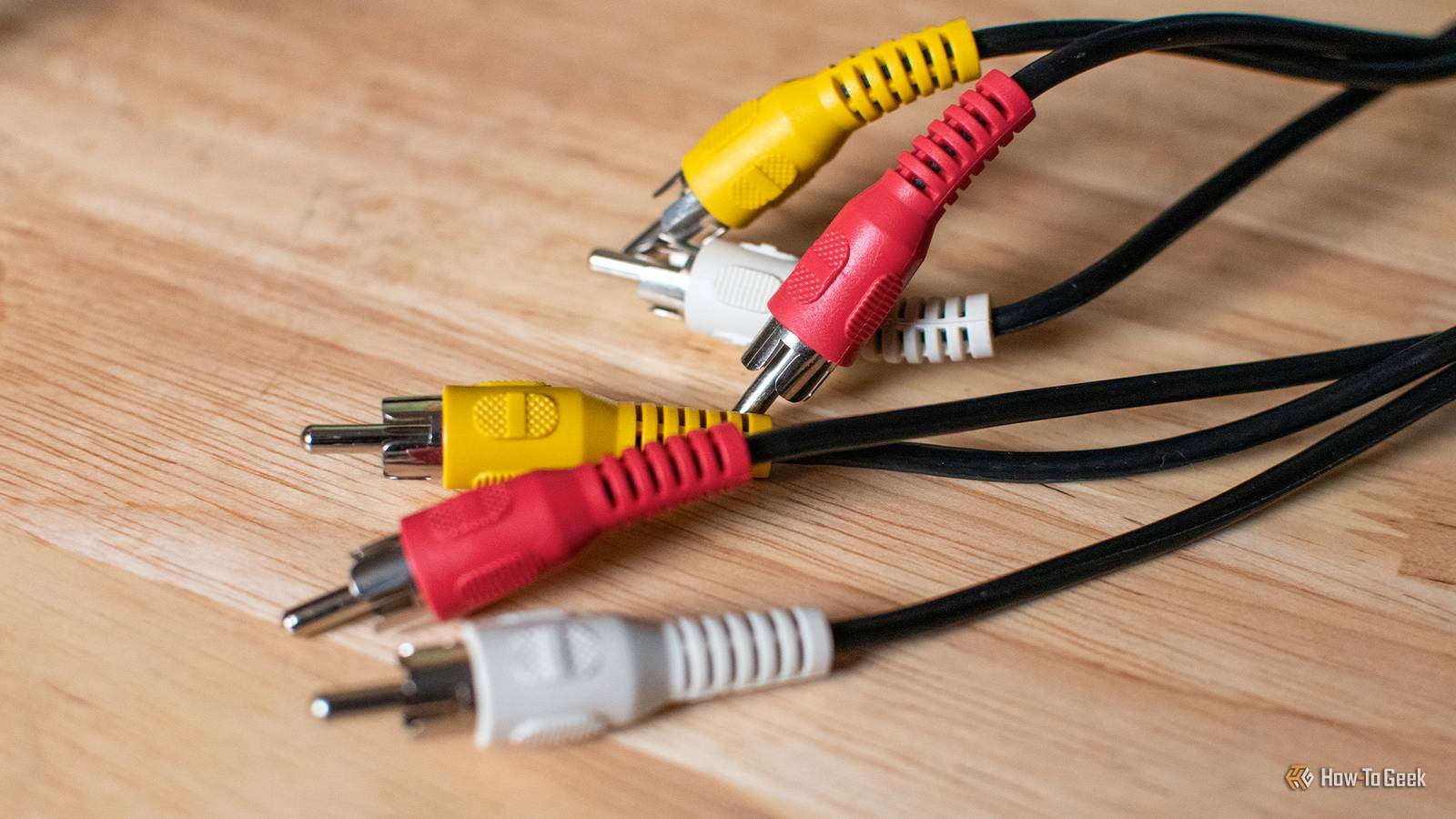
Published Oct 19, 2026, 2:00 PM EDT Andrew Heinzman is a seasoned tech writer with over half a decade of experience. He specializes in delivering insightful tech news and detailed product reviews, particularly focusing on audio and video technology, as well as computers and smartphones. His journey in tech writing includes a two-year stint as the News Editor at Review Geek, the former sister site of How-To Geek. Throughout his career, Andrew has consistently provided readers with valuable insights and up-to-date information on the latest developments in the tech world, earning recognition for his clarity, depth, and relevance. In his free time, Andrew likes to explore music and read books, just as he did when earning his bachelor's degree in English literature. It's odd to think that a trio of colorful cables can bring back such strong memories. But the red, yellow, and white colors of the composite video standard managed to dominate home entertainment for decades, particularly among movie buffs and gamers. Today, HDMI is the king of TV connectivity. It pushes high-quality video and audio through a single cable, which feels magical but also impersonal. Composite video had much more personality and didn't rely on decades of digital advancement in order to perform its job. But how did the humble red, yellow, and white cables actually work? A solution to the color television challenge Adapting what came before Television broadcasters faced a serious dilemma in the 1940s and '50s: color television was clearly right around the corner, but over-the-air broadcasts didn't have the bandwidth to add RGB color information to existing signals without losing black-and-white compatibility. The FCC, which insisted that television was a public trust similar to radio, refused to let black-and-white sets go obsolete, so it worked with the broadcast industry to develop the NTSC color standard, which preserved black-and-white compatibility by combining color, luminance, and synchronization information into a single video signal. Composite video baseband signal (CVBS), better known by the name "composite video," served as a backbone for NTSC at television stations. It integrated with the equipment that they were already using to process black-and-white footage within their studios, though some peripheral equipment had to be upgraded in order to make the switch, which is why there were black-and-white holdouts for a few decades after NTSC's introduction. That said, the composite video standard was mostly absent from homes until the mid-to-late 1980s. Home video equipment, such as VCRs, laserdisc players, and game consoles created a demand for composite video among consumers who were tired of wrapping wires around their TV's antenna screws or playing musical chairs with their TV's coaxial port. It's also worth noting that NTSC was not a globally adopted standard. Most regions outside of the U.S. chose the PAL standard, while France, plus some parts of Eastern Europe and the Middle East, utilized SECAM. NTSC's 60Hz power frequency provides a better base frame rate than the latter standards, but its color reproduction is far more inconsistent, hence the nickname "Never the Same Color." Wait, I always called it an "RCA cable," was I wrong? Kind of, but not really Composite video cables usually come with one of three different connectors. There's the classic RCA connector, which is what you'll be most familiar with; it has a sheath and pin design that slots into the color-coded ports of DVD players, TVs, VCRs, and other electronics. The three cables are all interchangeable in practice, but the yellow cable occasionally uses a mini-coax design to improve signal integrity, so it's designated as the video lane while the red and white lanes serve as left and right audio channels. Interestingly, the RCA connector predates composite video by about two decades. It started out as a monophonic connector for radios, phonographs, and amplifiers, but slowly grew into the de facto connector type for several multimedia solutions. Home theater and pro audio designations like LFE (subwoofer cables) and S/PDIF still use the RCA connector today and are mutually compatible with composite video cables, so it's not uncommon for people to simply refer to all of these separate media cables as "RCA cables." (While these standards are compatible, you should use dedicated S/PDIF and LFE cables when possible, as they're usually designed to provide better signal integrity than composite video cables.) The other common composite connector, called "3.5mm mini-jack," is typical of smaller electronics like camcorders, portable DVD players, and older smartphones (plus some Raspberry Pi models, curiously). As the name implies, 3.5mm mini-jack utilizes a 3.5mm "headphone jack" to pull audio and video from a source device. But this standard usually terminates in RCA connectors to make TV connectivity easier. There's no difference in video or audio quality when comparing RCA and 3.5mm mini-jack, but the former tends to be more robust and durable. Broadcast gear tends to utilize a slightly obscure BNC connector for composite video. BNC can achieve better, more stable video than RCA because it features enhanced shielding, a stable 75-ohm impedance (RCA impedance can be wishy-washy), plus a bayonet locking mechanism similar to that of a standard coaxial TV cable. That said, you'll rarely find BNC in consumer gear. Other composite connectors have come and gone over the years, including examples like the SO-239 UHF jack. But RCA, 3.5mm mini-jack, and BNC are the most well known and widely used. Composite video came with massive limitations Better options existed, they just weren't as cheap or available From its inception, composite video intentionally compromised quality in favor of convenience and cost. Mixing color and luminance information in a single channel creates a ton of unwanted artifacts because there's no way for TVs to separate all of this garbled information back into its original quality. You end up with dot crawl between colors that sharply contrast each other, rainbow banding on checkered or pinstripe patterns, incredibly inconsistent color reproduction, soft edges, wandering images, and other problems that range from minor annoyances to serious offenses. Plus, composite video is unbalanced. It's vulnerable to RF interference, regardless of how well shielded an individual set of cables might be. There's also the video resolution problem: composite is stuck at 480i in NTSC territories. Higher-quality video television standards existed alongside composite video, but they weren't as widely used by consumers (or implemented by manufacturers) due to cost and unfamiliarity. S-Video, which gained popularity in the late '80s, breaks color and luminance data into two separate lanes through the use of a 4-pin mini-DIN connector. The component video standard gained traction a few years later, but we'll get to that in a minute. It's worth pointing out that composite video quality can vary wildly depending on how a device outputs its video signal. Video game consoles of the 2000s, like the Wii and PS2, were surprisingly well optimized for composite video output to CRT televisions. Later TVs also utilized built-in comb filtering to separate color and luminance channels, which reduced unwanted artifacts and provided a sharper picture over composite. Component video is a different beast Is it "composite with more cables," or something else completely? While S-Video splits color and luminance information into two separate channels, the component video standard takes things a step further by utilizing a pair of color-difference channels alongside a dedicated luminance channel. Not only does this mitigate some of the color accuracy and artifacting issues that plague composite video, but it provides support for 1080i and 720p video resolutions, which look far more appealing on a flatscreen TV than 480i. Component video cables use the same RCA connectors as composite video, and they even retain the same red and white audio lanes for stereo sound. But the picture information is spread across three mini-coax RCA cables (for a total of five lanes). This could've been accomplished with a 5-pin connector of some kind, but the five-cable approach was likely chosen to reduce signal bleed, reduce costs, and maintain some physical compatibility with other equipment. You can reuse the cables for anything that needs an RCA connector, or use the luminance channel from a componenet output to get a black-and-white video on a composite-only TV, for instance. Unfortunately, component cables managed to confuse a lot of people back in the day. The five-cable approach is just a bit overwhelming, especially when you're staring at the back of a DVD player or TV that includes composite alongside component. A lot of people simply went the composite route even when their equipment fully supported component because they were befuddled by the wad of RCA connectors. It doesn't help that a lot of component adapters, especially the aftermarket ones for game consoles, included a yellow composite lane for older TVs. Six cables in one harness is pretty extreme! After nearly a century of use, composite video is fading away It's fair to say that composite video has no real future outside of retro tech. The RCA connector may continue to be used by subwoofers, digital mixers, and turntables for some time, but modern TVs rarely provide composite connections. And although composite video hardware is incredibly cheap to manufacture, the video quality offered by this old standard isn't good enough or reliable enough for today's consumers.
Why we spent decades using the "worst" TV cable ever made
Full Article
Original Source
Read the full article at Howtogeek →KhanList aggregates and links to publicly available news content. We do not host full articles from third-party sources. Always verify important information with original sources.