
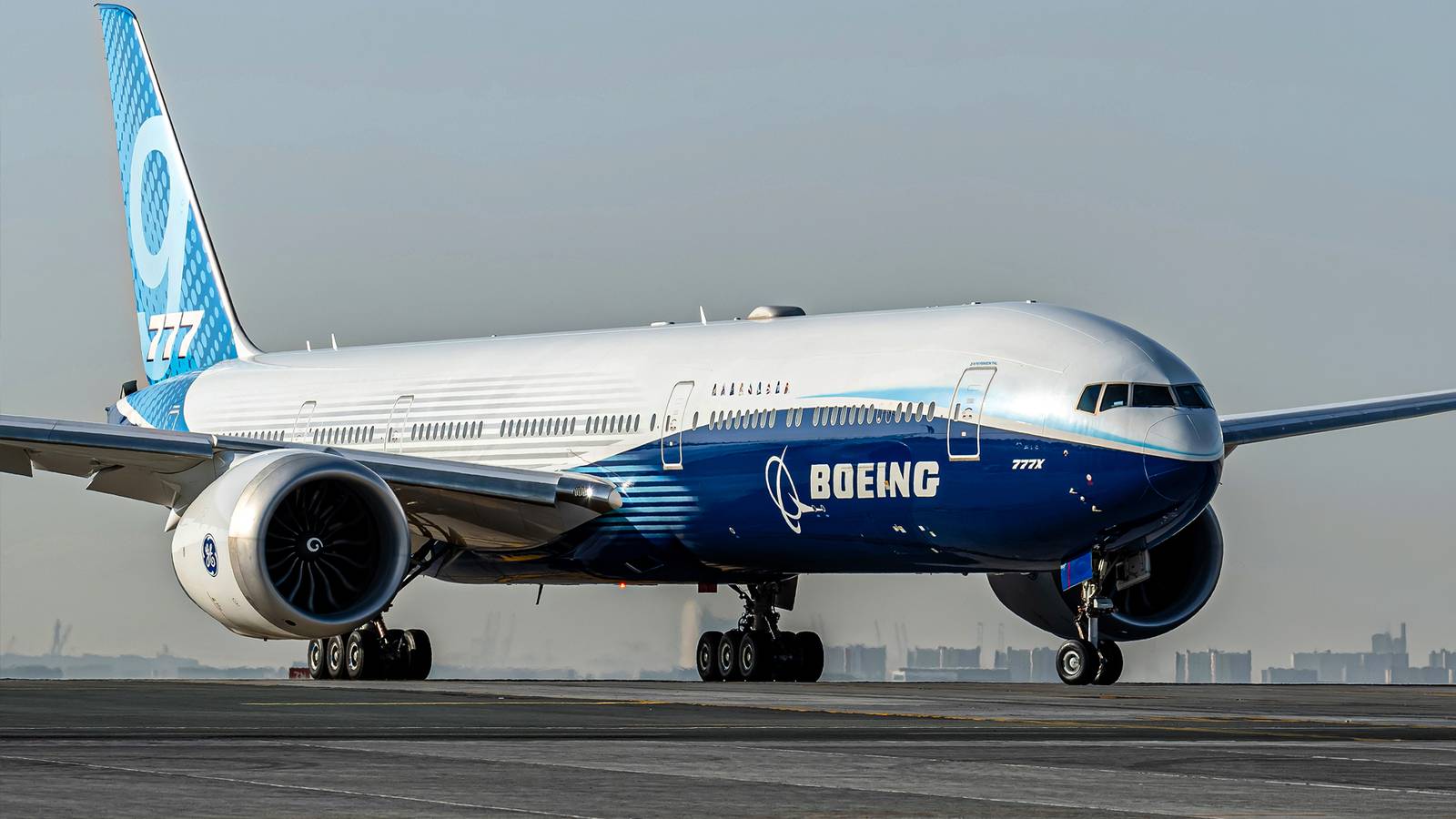
Published Nov 19, 2026, 8:00 PM EST Brandon's passion for aviation started at a young age. He became involved in the flight simulator and VATSIM communities, which sparked his interest in aviation and eventually led him to earn his private pilot license. Outside of work, he continues to build flight hours, explore new airports, and stay involved in the aviation community. GE Aerospace describes the GE9X as the largest and most powerful commercial aircraft engine ever built, and the specifications support the claim. A 134-inch front fan, a composite fan case, ceramic matrix composites in the hot section, and a 60:1 overall pressure ratio make it the most advanced large turbofan in production, and Guinness World Records certifies it as the most powerful commercial jet engine by test performance. None of that puts competitive pressure on anyone, because the engine has no rival to fight. GE holds the 777X exclusively, as it has held every 777 variant since the 777-200LR. Where the engine matters commercially is on an aircraft it has never powered. Rolls-Royce has supplied the only engine ever offered on the Airbus A350, a position no competitor has challenged in two decades, and Airbus is now studying a stretched version of that aircraft aimed at the roughly 400-seat market the 777-9 currently has to itself. A stretch of that size needs more thrust than the Trent XWB-97 produces, and the GE9X sits in exactly that class. Airbus has looked at the idea. By most accounts, GE has not shown much appetite for it. The Largest Engine Ever Built, By The Numbers That Hold Up Credit: GE Aerospace The headline dimension is the front fan, which measures 134 inches across and carries 16 fourth-generation carbon fiber composite blades inside a composite fan case. GE’s product material claims that this makes the fan larger than a Boeing 737 fuselage. Key.Aero frames the comparison more precisely, describing the engine’s overall diameter, rather than the fan alone, as greater than the fuselage diameter of the 737 family. Either way, the GE9X is the largest installation ever hung under a commercial wing. Thrust needs the same care. Guinness World Records lists the GE9X at a maximum thrust of 134,300 pounds, achieved during an engineering test at GE’s outdoor facility in Peebles, Ohio, on November 10, 2017, breaking the 127,900 pounds the GE90-115B recorded in 2002. Guinness also lists the engine’s rated thrust as 110,000 pounds and notes that the record reflects testing conditions rather than commercial operation. For service on the 777-9, the engine is certified to 105,000 pounds. The record figure therefore describes what the architecture can produce at its limits, not what a flight crew will ever command. Efficiency is where the design earns its reputation. GE puts the GE9X at approximately a 10:1 bypass ratio and a 60:1 overall pressure ratio, with specific fuel consumption up to 10% better than the GE90-115B. Ceramic matrix composites appear in the combustor liner and the high-pressure turbine shrouds, parts that tolerate higher temperatures with less cooling air than the metal components they replace. GE says the engine received FAA certification in September 2020, after 27,000 cycles and 17,000 hours of testing. Why Rolls-Royce Has Owned The A350 Since 2006 Credit: guilhem gaubert | Shutterstock Every A350 ever built flies behind the same engine. Rolls-Royce supplies the Trent XWB as the family’s sole powerplant across a thrust range. Simple Flying puts it at 84,000 to 97,000 pounds, and no alternative has ever been offered to a customer. For a widebody that has sold in A350 numbers, that is unusual, and it exists because of a decision GE made rather than a competition Rolls-Royce won. Aero-News Network reported in 2008 that GE executives had told Airbus the company would not build an engine to compete with the GE90 it supplies for the 777, leaving Airbus with a Trent variant as its only option for the A350. Airbus sales chief John Leahy had already closed the other door, saying, “We have no intention of putting their GEnx engine on the A350 at all.” GE’s view was that the GEnx suited the smaller A350 variants but could not economically scale to the thrust the A350-1000 required. Commercially, the refusal was straightforward. GE is the exclusive engine supplier for the 777-200LR, the 777-300ER and the 777 freighter, and the A350-1000 was designed to take sales from precisely those aircraft. Developing a 97,000-pound engine for Airbus would have handed airlines a GE-powered alternative to a GE-powered Boeing, buying a share of one program at the cost of a monopoly on another. Rolls-Royce, which had lost the 777 engine competition to the GE90, took the work instead and has held the position ever since. The Stretch That Would Reopen The Engine Question Credit: Nattanon Tavonthammarit | Shutterstock Airbus has been circling a larger A350 for most of 2026. Commercial aircraft CEO Lars Wagner told the media in Toulouse that a decision on stretching both the A350 and the A220 would come before 2030, adding that there is “clearly” demand from the industry for longer versions of each. Aerospace Global News reported that Wagner tied both projects to viable business cases and board approval, while acknowledging that customers are waiting for each aircraft. Thrust is the obstacle that makes the engine question unavoidable. AIN reported that a stretch would need more thrust than the A350-1000’s Trent XWB-97 can provide, and that the alternatives are limited. By AIN’s reckoning, one option would be the GE9X that powers the 777-9, an engine already certified in the class a 400-seat Airbus would require. Rolls-Royce has signaled nothing publicly about an XWB above 97,000 pounds, leaving the stretch dependent either on an unannounced derivative or on a supplier Airbus has never used on the program. Wagner’s own answer was carefully incomplete. Pressed by reporters on whether Rolls-Royce would automatically keep its exclusive position on a prospective A350-2000, he declined to confirm it, and he declined to specify whether Airbus is engaged with GE Aerospace on supplying engines for the aircraft. He did say Airbus is happy with Rolls-Royce and that the exclusive partnership “works well” for the A350 family. Those two positions aren't contradictory, but together they fall short of the commitment Rolls-Royce has enjoyed since the program began. GE Has Little Interest In Powering An Airbus Credit: GE Aerospace The obstacle to the GE9X on an A350 is not Rolls-Royce. Reuters reported in October that industry sources say Airbus has toyed with using a GE Aerospace engine for the roughly 400-seat A350-2000, but that the engine maker has so far shown limited interest in joining. Airbus, in other words, has considered the option and GE has not pursued it. Nothing about the underlying arithmetic has changed since 2008. GE holds the 777X exclusively, and a 400-seat A350 would compete directly against the 777-9 rather than against the aging 777-300ER. Supplying an engine for that aircraft would mean competing with a program GE already owns outright, at a moment when the 777X backlog represents years of engine deliveries and decades of aftermarket revenue. AIN noted the politics of an Airbus-GE widebody partnership as a complication in its own right, separate from the engineering. Practical constraints sit on top of the commercial ones. The GE9X has no application outside the 777X, which means every development dollar spent adapting it for an Airbus wing would serve a single prospective customer on an aircraft that has not been launched. GE is also still closing out problems with the engine it has. AIN listed a variable guide-vane issue and, more recently, a mid-seal durability issue among the technical challenges the engine has encountered during 777-9 flight testing. An engine maker working through durability findings on its newest product is not an obvious candidate to open a second airframe program. What The 777X Backlog Is Worth & What Still Gates It Credit: Aerospace Trek | Shutterstock Volume is the real measure of the GE9X’s position. At the Dubai Airshow on November 17, 2025, Emirates ordered 65 additional 777-9s worth $38 billion at list prices, taking its total Boeing orderbook to 315 widebodies; 270 777Xs, 10 777 freighters and 35 787s. The same announcement raised the airline’s GE9X commitment to 540 engines, including 130 added that day, making Emirates the largest GE9X customer by a wide margin. Deliveries from that orderbook run through 2038. Emirates also bought optionality that could extend the engine’s run. The carrier signed up for options to convert its latest 777-9 order into the 777-10 or the 777-8, which Emirates described as backing for Boeing’s feasibility study on the larger 777-10. Any 777-10 would use the same engine, since no alternative exists for the airframe. Certification is what stands between the backlog and revenue. GE identified a durability problem with the GE9X mid-seal after a crack was found during a January 2026 shop visit on a 777X flight-test engine, a component chief financial officer Rahul Ghai described as “one of the parts that connects the front and the back of the engine.” Air Data News reported that the FAA will not certify the 777-9 until it approves the redesigned seal, citing an agency official speaking to FlightGlobal; GE is seeking that approval by the end of 2026, and Boeing is still targeting first delivery in 2027. Boeing CEO Kelly Ortberg said in September that “We may see some of the testing spill into next year,” because GE had needed more testing than expected to validate the fix. Reuters has put the program six years behind schedule, with more than $15 billion in charges.
Why The World's Largest Commercial Jet Engine Is A Threat To Other Powerplants
Full Article
Original Source
Read the full article at Simpleflying →KhanList aggregates and links to publicly available news content. We do not host full articles from third-party sources. Always verify important information with original sources.