
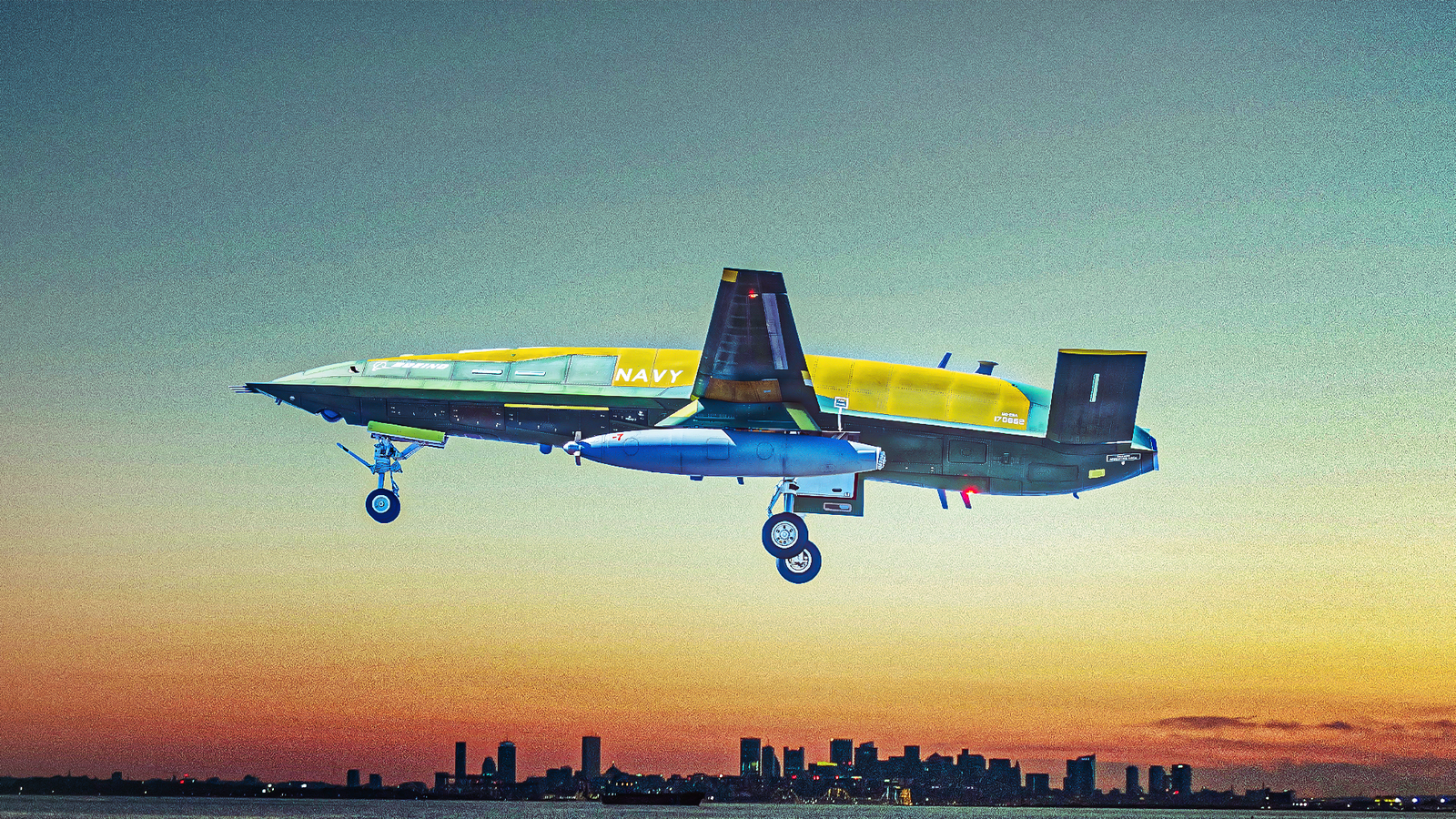
Published Oct 29, 2026, 3:01 PM EDT Luke Diaz is a freelance military writer with experience with active duty experience in the US Navy as well as defense and industrial engineering. He is a former Naval Flight Officer who performed tactical air control on the carrier-based E-2 Hawkeye. The US Navy's Naval Air Systems Command just finalized a contract with Boeing for an $80 million drone program to produce what will be the first carrier-capable unmanned aerial vehicle to enter operational service. The MQ-25A Stingray is an integral part of the Air Wing Of The Future, which will serve alongside the upcoming sixth-generation F/A-XX and fifth-generation Lockheed Martin F-35C Joint Strike Fighter. The revolutionary 'tailhook' drone will provide aerial tanking and surveillance to enhance the Carrier Air Wing. The Stingray addresses a glaring geographic vulnerability in the modern carrier strike group. For years, the Navy has had to use its Boeing F/A-18E/F Super Hornet fighters as 'buddy tankers' to refuel other jets in midair. This stopgap measure diverts roughly 20-30% of the fleet's strike fighters away from strike and air-defense roles. Operating the uncrewed MQ-25A effectively doubles the combat radius of the Navy's carrier wing. The Stingray is helping engineers and operators pioneer Manned-Unmanned Teaming (MUM-T) frameworks. In its tanking role, the Stingray extends the reach of crewed F/A-18s and F-35Cs beyond 700 nautical miles. Its secondary role in Intelligence, Surveillance, and Reconnaissance (ISR) also acts as a massive force multiplier for the carrier strike group. Lessons learned from deploying an uncrewed ISR platform at sea will provide a blueprint for the future of naval warfare. The $80 Million Headline: A Spending Limit Is Not A Blank Check Credit: US Navy The Navy's recent $80 million indefinite-delivery/indefinite-quantity contract awarded to Boeing serves a distinct, vital purpose in making this transition a reality. Rather than purchasing physical airframes, it secures a dedicated engineering and system-improvement schedule through October 2031. Although operational squadrons do not yet have active MQ-25A Stingrays parked on their flight decks, the Navy urgently needs to build the digital and physical infrastructure to enable uncrewed carrier aviation. The carrier deck is a highly chaotic, lethal workspace, and the Navy cannot simply drop a pilotless drone into the mix without extensive preparation. The service is actively using this funding to mature the Unmanned Carrier Aviation Mission Control System, develop the specialized MD-5C Ground Control Stations, and establish the exact shipboard command networks required for pilotless aircraft. Building these early units lets the workforce at the St. Louis and Mascoutah facilities master complex processes before the pressure of full-rate production sets in. When engineers discover a bug or develop an enhancement under the Navy’s engineering contract, the fix can be flashed directly onto the assembly line. It also forces sub-tier suppliers providing the engine, avionics, and the critical electro-optical ball turrets to mature their own manufacturing rates early. There is no need to spend millions re-engineering a prototype's unique wiring harness to match a production blueprint. The test aircraft is the production aircraft. Once these initial airframes finish validating flight deck handling, autonomous taxiing, and catastrophic catapult/recovery stresses, they don’t get sent to a museum. They can be immediately refurbished and handed over to operational fleet squadrons. Buying Aircraft Before Testing Ends Credit: US Navy By the time the MQ-25A program officially requests the transition to Full-Rate Production (FRP), the Pentagon won't be looking at theoretical math. They will have hard data showing exactly how many hours it takes to build a fuselage, the exact yield rates of the composite skins, and a full cost per unit. This intense focus on manufacturing maturity helps ensure the program hits IOC on time. Cost estimates show how unsettled the picture remains. The Defense Department put the total acquisition cost at $19.4 billion, or $255.8 million per aircraft, including military construction. GAO estimated $16.6 billion, or $218 million per aircraft, without construction, and said that unit figure rose 4% in a year. Both numbers spread development spending across a small fleet, so neither is the price of one more airframe. Informally known at the Pentagon as the 'buy-before-you-fly' model, the Reagan administration's defense buildup in the late 1970s and 1980s heavily pushed concurrency. The core theory is that ordering aircraft while they are still in the testing phase lets the military shorten the timeline to field a new asset while capitalizing on immediate economies of scale. The Pentagon continues to use this practice despite the F-35 program's underperformance and the even more spectacular failure of the Northrop B-2 Spirit under this doctrine, which led to a bloated cost of $2 billion per airframe after the fleet was cut from 132 to just 21 planes. Modern programs like the B-21 Raider and the MQ-25A Stingray are succeeding where 1980s programs failed because they replaced blind concurrency with digital engineering. Where The Change Of Course Comes From Credit: US Navy The procurement strategy driving the MQ-25A directly mirrors the Northrop Grumman B-21 Raider's highly acclaimed 'digital-first, production-representative' philosophy, which has fundamentally changed how the Pentagon scales advanced aerospace programs. By building the initial Low-Rate Initial Production (LRIP) airframes as exact, production-representative models from day one, Boeing and the Navy are avoiding historical traps. The biggest bottleneck in scaling a defense aerospace program like the Stingray isn't proving that the plane can fly. It is proving that a factory can build it repeatedly with perfect tolerances. Historically, military programs built customized, experimental prototypes that looked like the final product on the outside but had entirely different wiring, plumbing, and architectures. Moving to a mass-production assembly line usually triggered cost overruns and years of design delays. An indefinite delivery, indefinite quantity contract works like a store account with a credit limit. Naval Air Systems Command will allocate funding as orders are issued, and the agreement combines cost-plus-fixed-fee terms with cost-no-fee terms. The first reimburses expenses and adds profit, while the second reimburses expenses only. The initial LRIP airframes are being built on the exact automated jigs, robotic skin-application fixtures, and assembly lines that will eventually produce the full 76-aircraft fleet. Arresting A Schedule That Kept Slipping Credit: Boeing The MQ-25A began as something else. It descended from a stealthy surveillance and strike concept, and in 2016 the Navy narrowed the mission to refueling. Even though Boeing won a second round of competitions with a refined design and requirements list from the Navy, they were scheduled to continue to slide to the right. According to the Congressional Research Service, the first flight of a development aircraft was originally planned for 2021, then pushed to 2025 under a revised plan adopted in 2024. The aircraft finally flew in April on a two-hour, preprogrammed flight from Boeing's facility at MidAmerica St. Louis Airport, as the USNI recorded. The Landmark liftoff is still one year behind the original schedule. Initial operational capability slipped too. The Navy once expected it in 2025. Now, the target IOC is officially pushed back five years to early 2030. The new infusion of cash is the primary tool to arrest further schedule slippage and stabilize the path to fleet deployment. The new contract not only funds airframe research and development, but also lets Boeing refine automated assembly jigs, stabilize component yield rates, and eliminate the manufacturing defects that previously stalled airframe assembly. Funding will also support smaller sub-tier suppliers as they continue work on high-risk components like the engine or electro-optical ball turrets. Together, these efforts will reduce the risk of a single part delaying the entire supply chain and, in turn, the final assembly line. The Fuel Problem The Fleet Wants Solved Credit: US Navy Today, Super Hornets double as tankers by carrying an external fuel pod, and every tanker is a fighter not flying a strike mission. USNI News reported in 2016 that up to 30% of Super Hornet sorties were refueling missions. Those flights also burn airframe hours the Navy wants to save, which is why the fleet wants the Stingray as soon as possible. The MQ-25A is meant to take that job, and more in the future, thanks to its modular design. The Navy's objective is to deliver at least 14,000 pounds (6,350 kg) of fuel 500 nautical miles (926 km) from the carrier, roughly what a Super Hornet tanker carries. In 2017, Navy leaders said a dedicated tanker could stretch the air wing's strike radius from about 450 nm (833 km) to 700 nm (1,296 km). This phase shifts focus to the physical and digital infrastructure of the aircraft carriers themselves. USS George H.W. Bush received the first shipboard control spaces for the drone in 2024, and the Congressional Research Service says USS Theodore Roosevelt became the first fully operational carrier compatible with the MQ-25 this year. The program of record calls for 76 aircraft, made up of 67 operational and nine test aircraft. The Navy requested $1.75 billion for fiscal 2027 to fund the second year of low-rate production. The Aviationist reported that the Lot Two production award is planned for 2027, the Navy expects the first production deliveries in 2029, and flight testing runs through the end of fiscal 2029. The final segment of the roadmap moves from low-volume assembly toward true frontline combat readiness. Production at the Mascoutah facility will step up as Boeing draws down long-lead parts and begins building toward the planned fleet. The Integrated Test Team will run comprehensive, realistic mission profiles to validate midair refueling links with every major aircraft in the modern carrier air wing, including F/A-18E/F Super Hornets, EA-18G Growlers, E-2Ds, and F-35C Lightning IIs.
Why The US Navy Is Awarding Boeing Up To $80 Million To Improve A Drone That Isn't Even Operational Yet
Full Article
Original Source
Read the full article at Simpleflying →KhanList aggregates and links to publicly available news content. We do not host full articles from third-party sources. Always verify important information with original sources.